PID controllers are widely used in industries today. Although PID controller functions are built into PLCs, this functionality is utilized in many applications. Almost 95% of closed-loop processes in the industrial automation sector use this type of controller.
PID stands for Proportional, Integral, and Derivative.
These three controllers have been combined so they can control the process according to a value defined by the user.
Let’s take an example to better understand the operation of the PID controller:
PID Controller
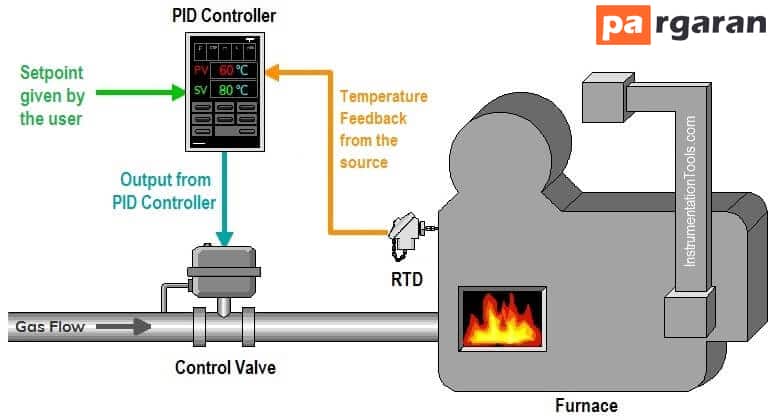
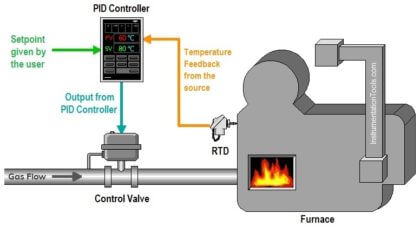
This is a small example of a temperature control process using a PID controller. Here we have a furnace and we want to control the temperature of the furnace. That’s why we need to provide a target temperature that we wish to maintain, and this temperature is called the setpoint.
The furnace temperature that we receive here is through a temperature detector, an RTD sensor that is directly connected to the PID controller. We call this feedback or actual value. This feedback or actual value is compared with the setpoint, and the difference between these two signals is our error. The PID controller produces an output based on this comparison, which is sent to the control valve.
To maintain the furnace temperature, we control the gas flow here using a control valve. The position of this control valve is managed here through the PID controller. The process response time is solely dependent on three values such as proportional gain, integral time, and derivative time.
Proportional Control Mode (P-Controller) in PID Controller:
The proportional controller produces control output proportional to the error. This error value is multiplied by the proportional gain to determine the output response.
If the gain is set too high, the controller output begins to oscillate and becomes unstable; if the gain is set too low, the controller output does not respond to changes in the setpoint.
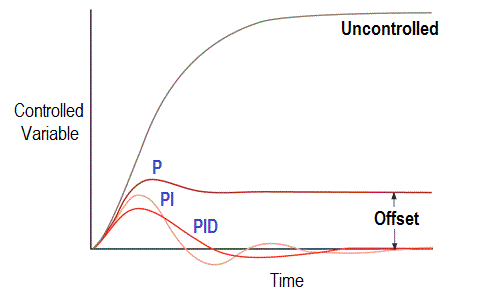
Using a proportional controller alone has a significant drawback. The offset is a persistent error and will not be eliminated using a proportional controller alone.
As the proportional gain increases, the response speed increases.
Integral Control Mode (PI-Controller) in PID Controller:
Due to the limitations of a proportional controller, a persistent offset exists. The integral controller continuously increases and decreases the controller output to reduce the error.
If the error is large, the integral mode rapidly increases/decreases the controller output, and if the error is small, the integral mode slows down the operation.
For a large integral time, the controller response speed decreases, and for a small integral time, the response speed will be fast.
Derivative Control Mode (PID-Controller):
There is a limitation for the I-controller that cannot predict the future behavior of the error. Therefore, when the setpoint changes, it reacts only once.
The derivative controller changes the output based on the rate of error, functioning quickly, and then PI controller. If there is no change in the error, the output of this controller is zero.
The response speed increases with an increase in derivative time. If the derivative time is too large, oscillation will occur and the system becomes unstable. For a zero derivative time, the controller output becomes zero.
Graph of P Controller vs PI vs PID
Some Examples Where PID Controller is Generally Used in Industries:
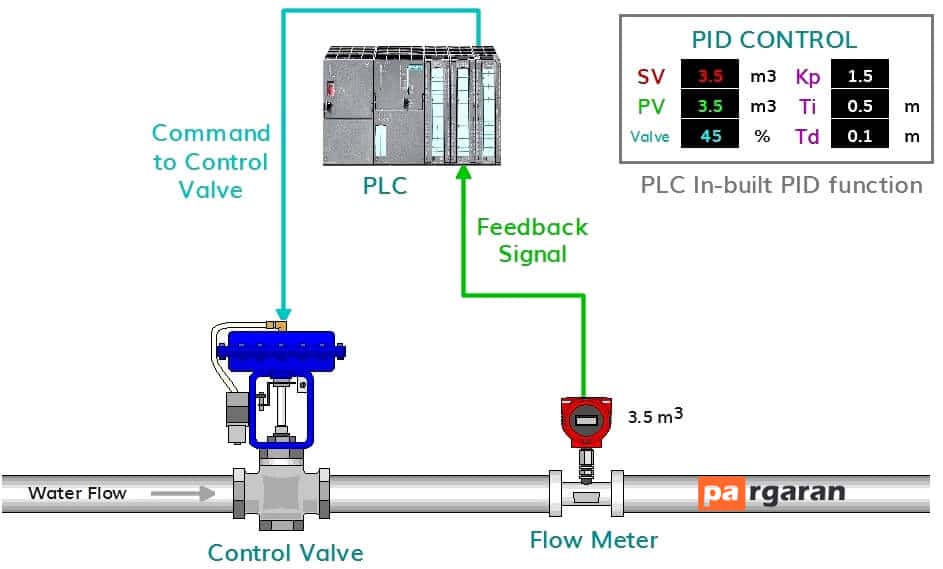
In the above example, controlling the position of the control valve using the internal PID function of the PLC.
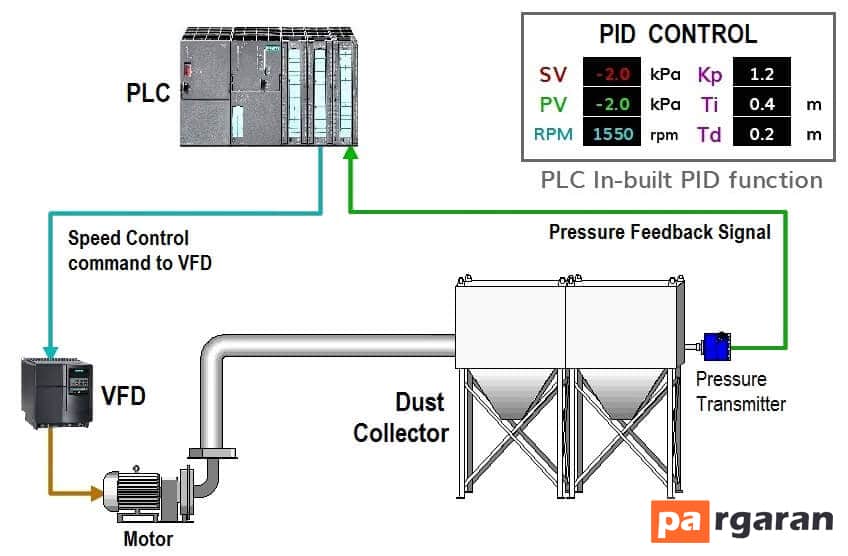
In the above example, we control the suction pressure at a specific value by controlling the motor speed using the internal PID function of the PLC.
Application of PID Controllers:
PID Controller in Car Cruise Control
The speed control system in vehicles, or cruise control, is one of the essential PID controllers used in our daily lives.
First, we accelerate the car to our desired speed, then we set the cruise control.
The cruise control sends output signals to adjust the speed to the throttle.
A speed sensor obtains feedback from the control loop and sends it to the cruise, determining the decrease or increase in speed and the amount of this increase or decrease for the car's throttle.