Electron Beam Machining (EBM) is a thermal process used to remove metal during machining operations. In electron beam machining, electrical energy is utilized to generate high-energy electrons.
In the electron beam machining process, a focused high-speed beam of electrons is used to remove metal from the workpiece.
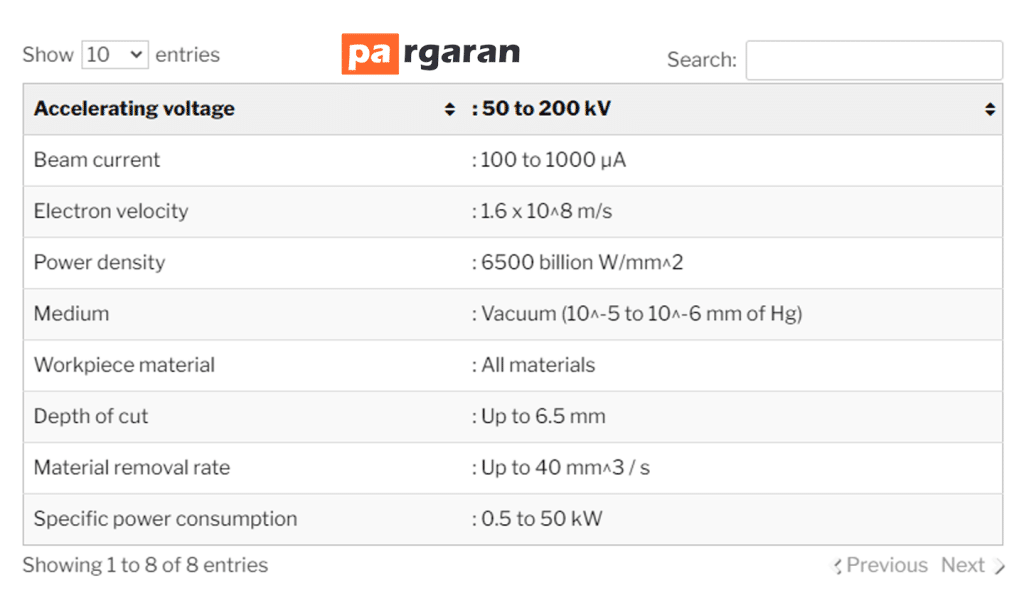
These electrons move at half the speed of light, which is 1.6 x 10^8 m/s. This process is suitable for breaking down materials.
In this article, we will explore the principle of electron beam machining, its construction, function, diagram, process parameters, advantages, and disadvantages of the EBM process. The EBM process has several significant applications, which will be discussed further.
Principle of Electron Beam Machining (EBM):
When the high-speed electron beam strikes the workpiece, its kinetic energy is converted into heat. This concentrated heat raises the temperature of the work material and evaporates a small amount of it, resulting in the removal of material from the workpiece.
Types of EBM Process:
Two methods are utilized in the EBM process.
1. Machining inside a vacuum chamber
2. Machining outside of a vacuum chamber
Construction and Function of Electron Beam Machining (EBM):
Construction of EBM:
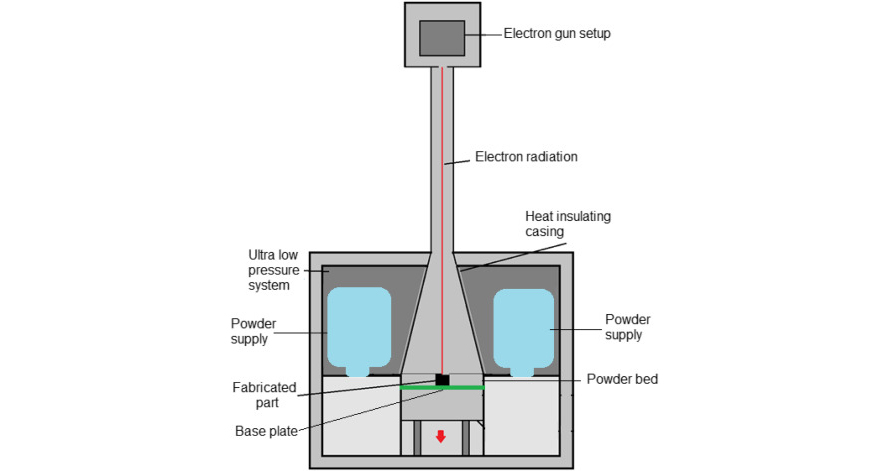
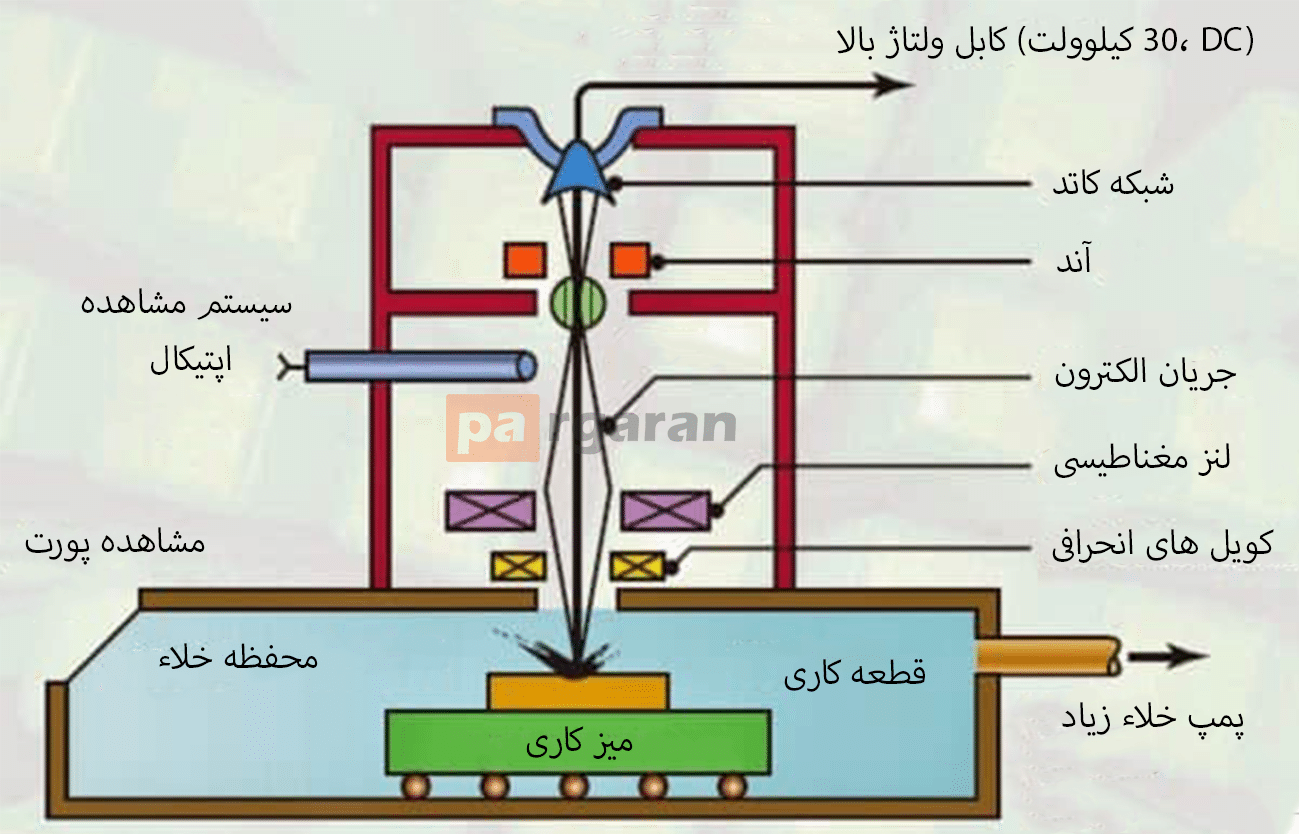
The schematic arrangement of electron beam machining (EBM) is shown in the figure. It includes an electron gun, diaphragm, focusing lens, deflection coil, work table, etc. To prevent the accelerated electrons from colliding with air molecules, a vacuum is required. Therefore, the entire EBM setup is enclosed in a vacuum chamber, which maintains a vacuum level of 10^-5 to 10^-6 mm of mercury. This chamber has a door through which the workpiece is placed on the table. The door is then closed and sealed. The electron gun is responsible for emitting electrons and consists of three main components:
Tungsten Filament
which is connected to the negative terminal of the DC power supply and acts as the cathode.
Grid Cup
which is based on the negative filament.
Anode
which is connected to the positive terminal of the DC power supply.
The focusing lens is used to concentrate the electrons to a point, reducing the electron beam to a cross-section of 0.01 to 0.02 mm. The electromagnetic deflection coil is used to deflect the electron beam to different points on the workpiece. It can also be used to control the cutting path.
EBM Diagram
Function of Electron Beam Machining (EBM):
- When a high DC voltage source is applied to the electron gun, the tungsten filament heats up and its temperature rises to 2500 degrees Celsius.
- Due to this high temperature, electrons are emitted from the tungsten filament. These electrons are directed downward by a grid cup and are absorbed by the anode.
- The electrons that pass through the anode are accelerated to high speeds of half the speed of light (i.e., 1.6 x 10^8 m/s) by applying 50 to 200 kilovolts at the anode.
- This high speed of the electrons is maintained until they strike the workpiece. This is made possible because the electrons pass through a vacuum.
- This high-speed electron beam, after exiting the anode, passes through the tungsten diaphragm and then through the electromagnetic focusing lens.
- Focusing lenses are used to concentrate the electron beam on the desired point of the workpiece.
- When the electron beam strikes the surface of the workpiece, the kinetic energy of the high-speed electrons is immediately converted into thermal energy. This high intensity heat melts and vaporizes the work material at the point of beam contact.
- Since the power density is extremely high (about 6500 billion watts per square millimeter), the melting and vaporizing of materials due to impact takes a few microseconds.
- This process occurs in repeated pulses of short duration. The pulse frequency may range from 1 to 16,000 Hz, with durations from 4 to 65,000 microseconds.
- By alternating the focus and turning off the electron beam, the cutting process can continue as long as needed.
- A suitable visual device is always accompanied by the machine, making it easy for the operator to observe the progress of the machining operation.
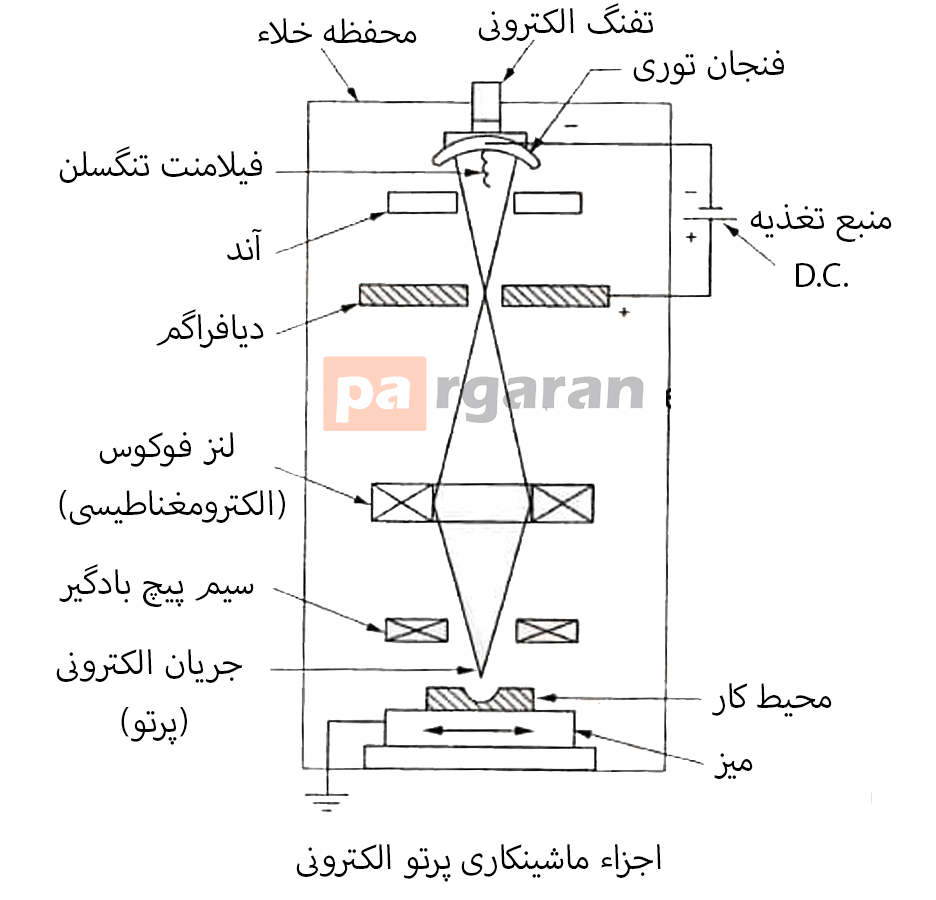
Diagram of Electron Beam Machining
Machining Outside of the Vacuum Chamber:
As a complete vacuum system is more costly, recent developments have made machining possible outside the vacuum chamber.
In this arrangement, the necessary vacuum is maintained inside the electron gun, and gases are expelled as they enter the system.
Process Parameters:
Parameters that significantly affect beam intensity and metal removal rate include:
1. Current control.
2. Spot diameter control.
3. Focal length control of the magnetic lens.
Features of Electron Beam Machining Processes (EBM):
Advantages of Electron Beam Machining (EBM)
Electron Beam Machining has the following advantages:
- This is an excellent process for micro finishing (milligrams per second).
- Very small holes can be drilled in any material with high precision.
- Holes of various sizes and shapes can be machined.
- There is no mechanical contact between the tool and the workpiece.
- This process is faster. Harder materials can be machined at a higher speed compared to conventional machining.
- Electrical conductive materials can be machined.
- Physical and metallurgical damage to the workpiece is significantly less.
- This process can be easily automated.
- Very tight tolerances are achieved.
- Brittle and fragile materials can be machined.
Disadvantages of Electron Beam Machining (EBM)
- The metal removal rate is very slow.
- The cost of equipment is very high.
- Not suitable for large workpieces.
- Requires highly skilled operators to work with the machine.
- High specific energy consumption.
- A slight taper is created on the holes.
- The need for vacuum limits the size of the workpiece.
- Applicable only for thin materials.
- At the point where the electron beam strikes the material, a small amount of remelting and metal spatter on the surface may occur. Subsequently, this must be removed through abrasive cleaning.
- Not suitable for creating deep, perfectly cylindrical holes.
Applications of Electron Beam Machining (EBM)
- EBM is mainly used for micro machining operations on thin materials. These operations include drilling, hole cutting, grooving, and marking, among others.
- Drilling holes in pressure differential devices used in nuclear reactors, aircraft engines, etc.
- Used for removing small broken valves from holes.
- Micro drilling operations (down to 0.002 mm) for thin openings, molds for wire drawing...