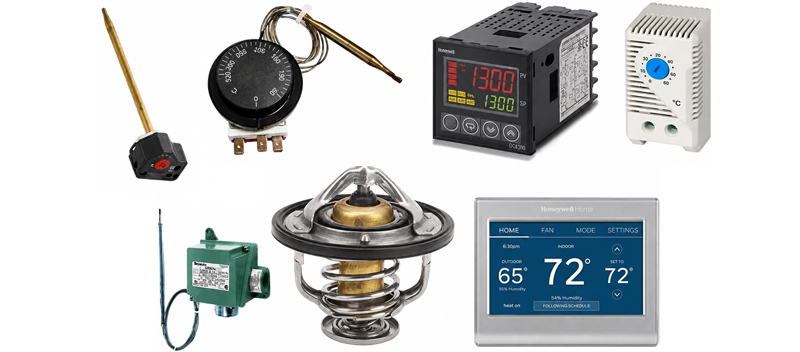
Thermostats or temperature controllers (thermostats) are devices used to sense (sense) and regulate the temperature of air, fluids such as water, or processes.
In addition to measuring temperature, thermostats can be used to control, increase, or decrease temperature from the current level to a specified point.
Thermostats can be classified into various types based on their application and design/functionality. The following sections describe these types.
Types of Thermostats (Temperature Control) Based on Application
Heat Control Thermostats

The most common and well-known application for thermostats is heat control. Heat control thermostats are used to regulate the temperature of a room.
By connecting these devices to a heating temperature control system such as a furnace or boiler, we send electrical signals to the system when heat is needed.
This means that the thermostat can detect when the room temperature drops below the desired level. The signal activates the control relay, initiating the heating process of the boiler or furnace and sending heat through airflow or via a radiator.
When the temperature exceeds the desired level, the thermostat signal turns off the furnace or boiler.
Electric heater thermostats sense the temperature and send periodic power cycles to the electric heating elements when heating is needed in a room.
Cooling fans equipped with fan control thermostats turn the fan on and off according to the room temperature.
Heating pad thermostats operate similarly to prevent accidental burns, limiting the temperature of the heating pad that may rise.
Pool thermostats are used in swimming pool heaters to sense the temperature of the circulating pool water within the pool heater.
Home hot water systems use hot water thermostats (aquastats) to determine when a water heater should turn on to generate hot water for use.
Temperature Regulation Thermostats

Automotive Thermostats

Thermostats play a crucial role in the automotive industry and are used in several applications. Automotive thermostats control the cabin temperature.
They are used to increase heat or activate the air conditioning system to maintain a comfortable level in the passenger compartments.
Automotive and aircraft cooling system thermostats aim to regulate the temperature of the coolant fluid in vehicles or aircraft.
They remain closed in cold engine start conditions and then open to allow coolant to circulate to the radiator or heat exchanger as the engine temperature rises.
An additional thermostat control is used in the cooling system to sense the temperature of the coolant or engines, activating electrical fans to draw additional air through the radiator to cool the fluid as needed.
Thermostatic monitoring is also applied to critical components of a system. Oil thermostats are designed to monitor the temperature of lubricant fluid in machines and engines to ensure engine protection.
Rotating shafts supported by bearings may use bearing thermostats to monitor bearing temperatures, which can help predict conditions requiring maintenance.
Diesel engine thermostats maintain the appropriate engine temperature in large vehicles such as trailers, where cooling requirements depend on operational load.
Some designs employ two thermostats that act as control valves for regulating the amount of coolant fluid flowing to the vehicle radiator.
Thermostatic Monitoring


Thermostats are used in other setups such as laboratories to maintain process temperatures. Hazardous area thermostats are used in applications where the risk of an explosive environment may exist.
There are even automatic thermostats to control temperature in beverage machines to keep drinks cold or prevent snacks like chocolates from melting.
Types of Thermostats Based on Design/Functionality
There are various designs of thermostats that utilize different materials and their properties to sense temperature changes and send control signals to other systems.
One of the oldest types of thermostats is the mercurial thermostats. This design uses a thermal coil and a mercury switch controlled by a lever or manual indicator on the thermostat.
When adjusting the temperature by turning the knob up, this action causes the mercury switch to close, sending a signal to turn on the heating system.
As the air begins to warm, the temperature change causes the thermal coil to open, which opens the mercury switch and turns off the heating system.
When the set temperature is increased by turning the indicator, the mercury switch closes again, sending an on signal to the heating system.
When the air heats up, the temperature change causes the thermal coil to open, which opens the mercury switch and turns off the heating system.