Anyone who is only familiar with fluid technology can easily underestimate the performance and intelligence of modern hydraulics.
Who would think that this highly precise, energy-efficient technology is now available for Industry 4.0 applications?
Here are six amazing capabilities of modern hydraulics, a powerful drive technology:
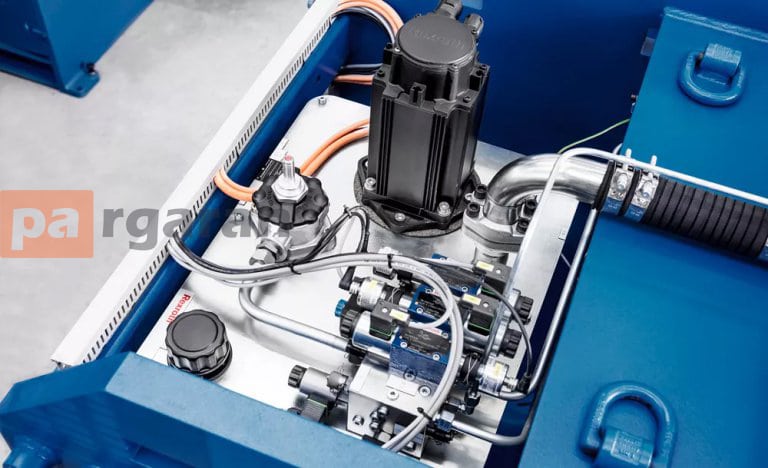
1- Micrometer Precision in Modern Hydraulics
Electro-hydraulic servo controllers close the control loop in a decentralized manner, similar to electric servo drives, and synchronize the target/actual position in real-time within milliseconds.
Motion precision solely depends on the measuring system being used. In machine tools and plastics machinery, hydraulic drives reliably position axes with precision of several micrometers.
One way to achieve this precision is by using more robust and accurate measurement system technology.
Converter electronics are significantly improved, so that digital converters are free from electrical noise interference present in older analog devices.
In combination with a suitable digital hydraulic controller, converter electronics achieve and maintain a much higher level of control over parameters of motion sequences such as speed and force. This equates to much greater control over the quality and precision of the produced part.
2- Compact - Space-saving
It is usually difficult to place electromechanical drives with adequate performance in tight building spaces. Unlike hydraulic drives, they also add significant heat.
Since power generation is decentralized and is transferred to the actuator through lines or hoses, OEMs can generate substantial forces even in minimal construction space.
The relatively low level of heat in the workplace is favorably distributed by the hydraulic fluid.
Even for older stamping press models, significant improvements in power density can be achieved by retrofitting them with modern electro-hydraulic technology, which is compact and simultaneously offers hydraulic pressure up to 5000 psi.
This type of reinforcement can also add a level of sophistication to the functions of stamping press cushions.
Synchronizing the speed and force parameters of the cushion drive cylinders can now create a complicated asymmetrical part.
As a result, older presses equipped with the latest hydraulics can produce higher quality and value products.
3- Balanced Drive Physics in Modern Hydraulics
Fluid technology is not inherently linear. Drive software for hydraulic actuators considers these characteristics and automatically synchronizes them.
Typical hydraulic functions are pre-programmed. For example, synchronization or position-dependent braking only requires parameter optimization within the startup range.
They are based on a transparent software structure and operate uniformly across all hardware platforms.
Hydraulic motion control components are specifically engineered to leverage modern electro-hydraulic advantages and variable-speed pump drives.
They provide intelligent, high-efficiency control for these pump systems, as well as traditional proportional valve-controlled systems.
They typically have advanced control software packages tailored to the unique needs of hydraulic system features.
For instance, the software compensates for factors such as fluid compressibility and the nonlinear dynamics of the system.
Specific hydraulic algorithms for variable-speed pump drives and proportional valves enable smooth transition between position control and force control, creating smooth motion paths and multi-axis synchronization.
These features reduce system shock and impact on tools, improving dynamics and precision. Moreover, they enhance energy efficiency and press productivity.
4- Modern Hydraulics are Simply Interchangeable
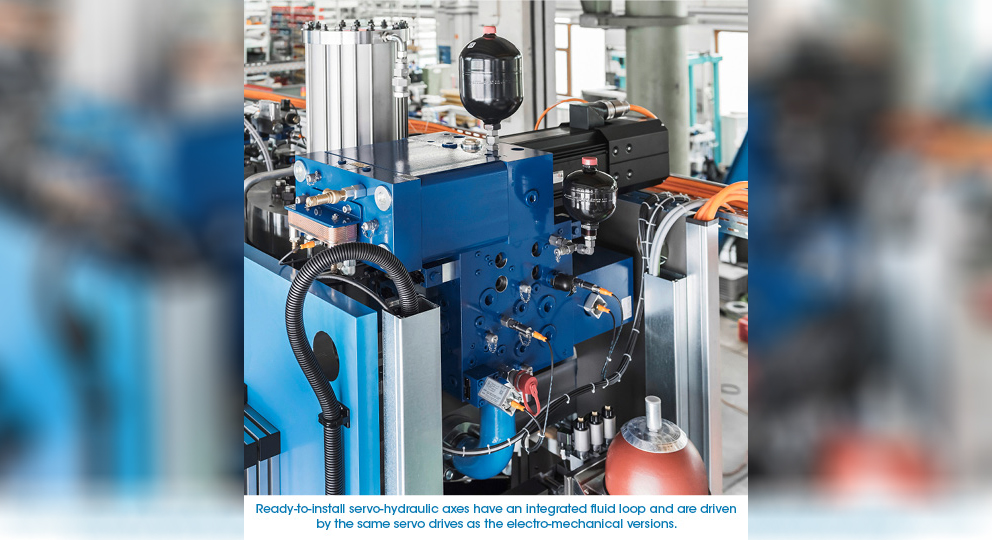
Existing hydraulic servo axes for installation have an integrated fluid loop. They are guided by servo drives similar to electromechanical versions.
Since the axes are encapsulated systems, engineers only need to connect power and communication cables for assembly and startup, after which commissioning can begin.
All other elements (for instance, the parameter values determined from simulations) have already been stored in the drive software, supporting the philosophy of plug and play.
Real-time Ethernet protocols are increasingly being used in modern machines to integrate all actuators and ancillary equipment together. This trend also encompasses stamping press operations.
One crucial actuator in this realm is quality control and data collection for process diagnostics and documentation of quality processes for end-user part customers.
Hydraulic control platforms not only need to tell the valve what to do. They also need to gather data such as valve position and cylinder delivery force. Then, that information must be transferred from the presses to higher-level management systems and quality control.
Modern motion controls for hydraulic drives support all common protocols such as Sercos, EtherCAT, IP Ethernet, PROFINET RT, Powerlink, and VARAN.
Their software is also based on open standards, including IEC 61131-3 and PLCopen. With this support, they are an ideal match for integrated infrastructures and the increasing overlap of technology in modern manufacturing environments, providing competitive advantages for stamping press operators.
Because they work with customers who require machine-to-machine communications and sharing of information for a “smart factory.”
This is especially important as machines incorporate Industrial Internet of Things (IIoT) concepts and Industry 4.0.
5- Demand-Based Energy Efficiency
The software combines the best of electrical and hydraulic systems. Decentralized intelligence in the electronic control device adjusts the pump drive speed as needed, whether the consumer requires power or brings it to zero.
Compared to traditional constant-speed drives, this reduces energy consumption of hydraulic units by up to 80 percent.
Energy-efficient hydraulics in combination with hydraulic systems for specific applications are gaining importance, which directly beneficially influences cost efficiencies.