Instrumentation is a branch of engineering that deals with measurement and control.
According to ISA, or the International Society of Automation, which was previously known as the Instrumentation Society of America, the formal definition of instrumentation is a set of tools and their applications for observation, measurement, and control. Reference: ISA std. S 51.1 - (Instrumentation Society of America)
Instrumentation and Control
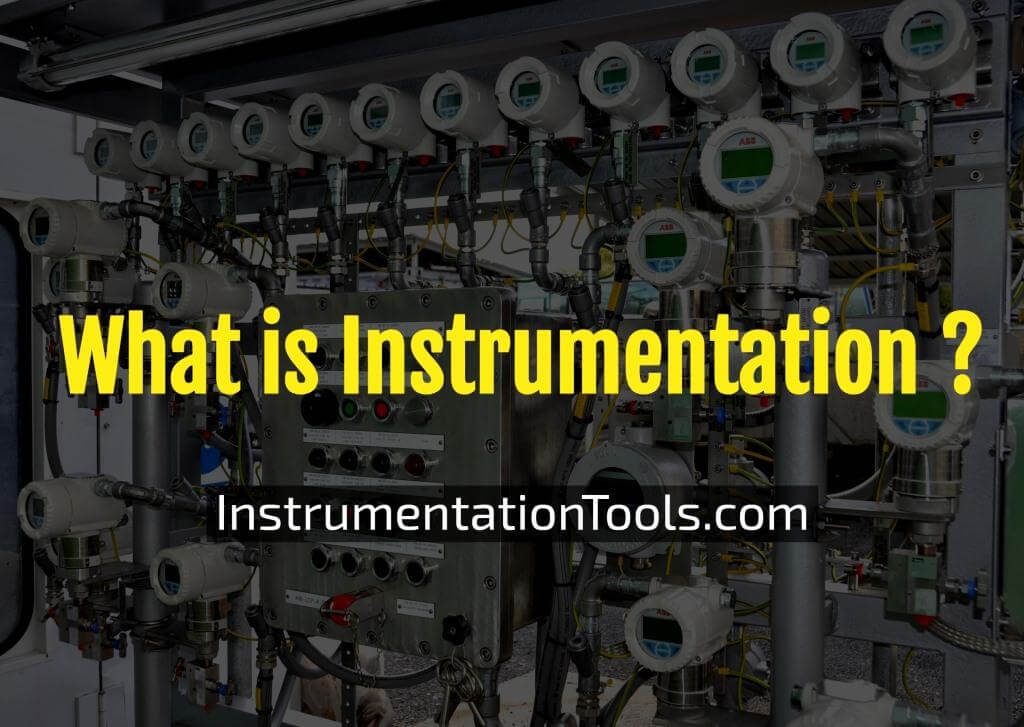
Instrumentation is a device that measures or manipulates physical process variables such as flow, temperature, level, or pressure, etc. Instruments include various tools ranging from simple valves and transmitters to complex analyzers. Instruments often include control systems from diverse processes. Process control is one of the main branches of applied instrumentation.
Control instrumentation includes devices such as solenoid valves, actuators, circuit breakers, and relays. These devices can change field parameters and provide remote or automated control capabilities.
Transmitters are devices that generate analog signals, typically in the form of a 4 to 20 milliamp electric current signal, although many other options utilizing voltage, frequency, or pressure are also available.
This signal can be used for direct control of other instruments or can be sent to a PLC, DCS, SCADA system, or another type of computer controller, where it can be interpreted into readable values and used for controlling other devices and processes in the system.
Instrumentation plays a significant role in both collecting information from the field and altering field parameters, thus forming a key part of control loops.
Measurement
Instrumentation can be used to measure specific field parameters (physical quantities):
Pressure, differential or static, flow, temperature, level, density, viscosity, radiation, process instrumentation, etc...
Control
In addition to measuring field parameters, instrumentation is also responsible for providing the capability to change some field parameters.
Instrumentation Engineering
Instrumentation engineering is a specialized field of engineering that focuses on the principles and operation of measuring instruments used in the design and configuration of automated systems in electrical, pneumatic, and other domains.
They typically work in industries with automated processes, such as chemical or manufacturing plants, aiming to improve efficiency, reliability, safety, optimization, and sustainability of the operational system.
For controlling parameters in a process or a specific system, devices such as microprocessors, microcontrollers, or PLCs are used, but their ultimate goal is to control system parameters.
The Value of an Instrumentation Engineer:
The goal of an instrumentation engineer is to conceptualize, design, detail, maintain, and troubleshoot control systems for their client/industry. Changing mindsets and adapting regulations have prioritized safety over profit and production.
When the word safety comes, I often compare it with the vehicle I am driving, and suddenly I have to brake.
A good vehicle stops immediately without skidding and without harming the passenger.
Being an Instrumentation Engineer What It Means
"Know Yourself" an Instrumentation Engineer-
The eye and ear draw the events of the industry. It is the art and science of measurement and control.
To list a few tasks, selecting and implementing sensors, troubleshooting all its functional instruments, and adjusting its brain (the control system) for optimal performance and response.
The Value of a Designing Engineer
"Rewards are just indicators, hard work is what matters"
Automation is a buzzword in the process industry, and automating is the core work of instrumentation engineers. Therefore, there will always be a demand for instrumentation.
But how much you can cash in your job depends entirely on what level you stand among a myriad of this field. Largely concerning country, company, and specialization. For example,
A vendor might pay an automation engineer less than a start-up engineer from a consulting engineering and construction firm, even though both perform the nature of the work.
Among Men Behind Industry's Successful Profits
"Saved money is the same money earned. Safety = $$$$$"
The design of instrumentation engineers maintains safety systems, control systems, and troubleshooting responsibilities within the industry, and is responsible for the smooth operation of the plant.
If any of the systems fail, the industry faces production loss, system damage, plant shutdowns, fines, compliance losses, and potential fatalities, and the industry's image in society also diminishes.
Learn from the Worst Incidents that Happened Previously
"Planning for a Safer Future"
The most beneficial thing during design can be past lessons and techniques that were ineffective, and human errors or responses that did not work.
These lessons can aid in designing a robust control system that operates flawlessly and is flexible for additional control measures that workers learn from daily activities.
Upgrading and Updating
"Change - Better replace the existing, or else replace yourself with better to save your day"
This is one of the most versatile branches of engineering, and changes happen at a very rapid pace with global competition.
The technologies that we utilized about ten years ago are now replaced with more reliable and high-speed data communication protocols.
Similarly, the technology used in the industry is regularly updated at intervals, and the responsible individual must keep themselves updated for understanding and implementing changes.
Technologists and Instrument Mechanics
Technologists, technicians, and instrument mechanics specialize in troubleshooting and maintaining instruments and instrumentation systems.
This trade is so intertwined with electricians, plumbers, electrical engineers, and engineering companies that a person may find themselves in very diverse job positions.
A broad term, "Instrument Fitter" is often used to describe individuals in this field, irrespective of any specialty.