Most smart field devices installed around the world today have an active HART protocol. However, some new players in the automation field may need to revisit this powerful technology.
In simple terms, HART protocol (Highway Addressable Remote Transducer) is a global standard for transmitting and receiving digital information over analog wires between smart devices and control or monitoring systems, or handheld communication devices.
Specifically, HART is a bi-directional communication protocol that facilitates data access between smart field instruments and host systems (DCS/PLC or Handheld Communicator). The host can be any software application from a technician's handheld device or laptop to process control, asset management, safety, or other plant systems using any control platform.
HART Protocol Technology
Utilizing HART technology for commissioning and calibrating smart devices as well as for continuous online diagnostics is very easy and highly reliable.
There are multiple reasons for host communication with smart devices. These include:
- Configuring or reconfiguring devices
- Device diagnostics
- Fault detection
- Reading additional measurement values provided by the device
- Device health and status
- Much more
Years of success with these advantages explain why HART technology remains the largest communication protocol installed in over 30 million devices worldwide.
If you have ever used a landline phone and noticed the caller ID display showing who is calling, you already know half of what the HART protocol does. It tells you “who” is calling.
In an industrial automation network, the “who” is a microprocessor-based smart field device. HART Communication not only allows such field smart devices to “phone home” but also lets the host system send data to the smart instrument.
HART emerged in the late 1980s based on the same technology that brought caller ID to analog phones. They have undergone continuous development, leading to automation products that now communicate wirelessly with HART internal communication.
How HART Protocol Works
“HART” stands for Highway Addressable Remote Transducer. The HART protocol uses the Bell 202 Frequency Shift Keying (FSK) standard to place digital communication signals in the low end of the 4-20mA range.
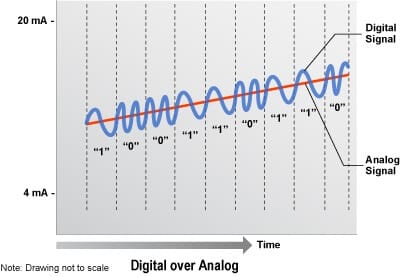
Frequency Shift Keying of HART Protocol
The HART communication protocol is based on the Bell 202 telephone communication standard and operates using the principles of Frequency Shift Keying (FSK). The digital signal consists of two frequencies - 1200 Hz and 2200 Hz, representing bits 1 and 0, respectively.
The sine waves of these two frequencies are superimposed on the direct current (DC) analog signal cables to provide simultaneous analog and digital communications. Since the average FSK signal is always zero, the 4-20 mA analog signal remains unaffected.
The digital communication signal has a response time of approximately 2-3 data updates per second without interrupting the analog signal. A minimum loop impedance of 230 ohms is required for communication.
This enables bi-directional field communication and allows the transfer of additional information beyond normal process variables to/from a smart field device.
The HART protocol communicates at 1200 bps without interrupting the 4-20mA signal, allowing a host (master) application to receive two or more digital updates per second from a smart field device. As the FSK digital signal is continuous phase, there is no interference with the 4-20mA signal.
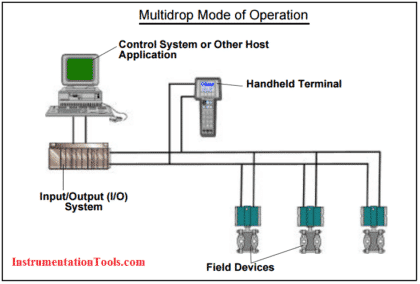
HART technology is a master/slave protocol, meaning that a smart field device (slave) only speaks when addressed by a master. The HART protocol can be utilized in various modes, such as point-to-point or multidrop for transferring information to/from smart field devices and central control or monitoring systems.
HART communication between two devices with HART typically occurs between a smart field device and a control or monitoring system. Communication is accomplished using precision-grade wiring and standard wiring methods and terminations.
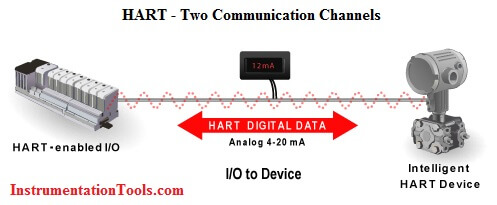
The HART protocol provides two simultaneous communication channels: a 4-20 mA analog signal and a digital signal. The 4-20mA signal utilizes the 4-20mA current loop - the fastest and most reliable industry standard - to transmit the primary measured value (in the case of field instruments). Additional device information is transmitted using a digital signal that is superimposed on the analog signal.
The digital signal contains information from the device including device status, diagnostics, additional measured or calculated values, and more. Together, these two communication channels provide a complete, low-cost, highly robust field communication solution that is easy to use and configure.
HART Protocol Networks
HART devices can operate in one of two network configurations—point-to-point or multidrop.
POINT-TO-POINT
In point-to-point mode, the traditional 4 to 20 mA signal is used to communicate one process variable, while additional process variables, configuration parameters, and other device data are transmitted digitally using the HART protocol (Figure 2).
The 4 to 20 mA analog signal is unaffected by the HART signal and can still be used for control in normal mode. The HART digital communication signal allows access to secondary variables and other data that can be used for operations, commissioning, maintenance, and diagnostic purposes.
The HART protocol provides for up to two master devices (primary and secondary). This means that secondary Masters such as handheld communicators can be used without interrupting communications to/from the primary host system.