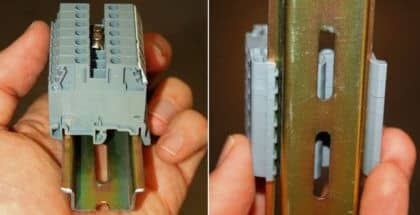
DIN Rail is short for "Deutsches Institut für Normung," which means "German Institute for Standardization." In the 1970s, the DIN name became the official symbol of technical standardization in Germany.
Installing automation equipment on 35 millimeter DIN rails has become a common practice. The DIN standard is used for the normalization of installations for everything from PLCs to small drives across North America.
What is DIN Rail Installation?
A DIN rail is a standard metal rail widely used for mounting circuit breakers and industrial control equipment inside equipment racks. These products are usually made of cold-rolled carbon steel sheets, coated with zinc or featuring a bright chrome surface.
Fundamentals of DIN Rail
A standard industrial structure for connecting terminal blocks and small electrical components to flat metal panels is known as a DIN rail.
This is a narrow channel of metal - made of bent steel sheet or extruded aluminum - with edges designed for plastic parts to “clip” onto.
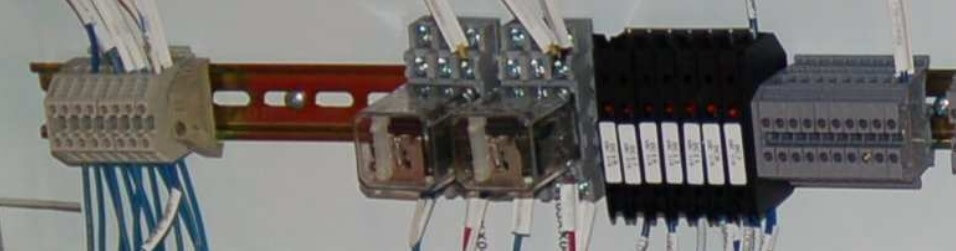
The image below shows terminal blocks, relay sockets, fuses, and other terminal blocks mounted along the horizontal length of a DIN rail in a control system enclosure:
Two photographs of a cluster of terminal blocks placed on the length of a DIN rail show how the special arms of each terminal block module rest on the edges. This equipment is used for secure connections:
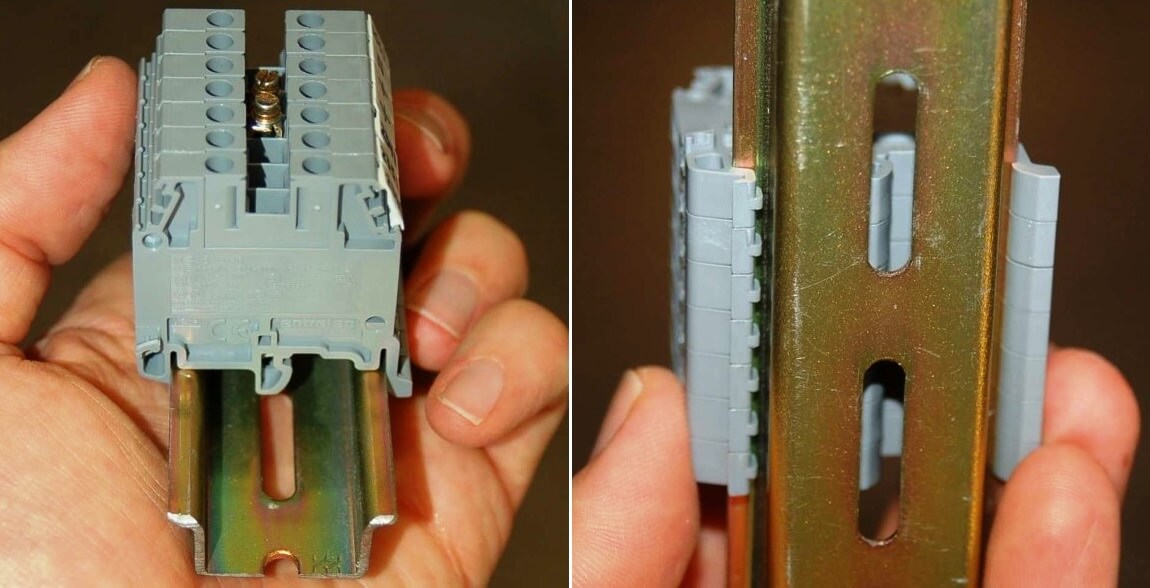
DIN Rail itself is installed on any flat surface using screws that enter through its base slots. In most cases, the flat surface in question is a metal subpanel of an electrical enclosure to which all the electrical components of that enclosure connect.
An obvious advantage of using this equipment to secure electrical components is the convenience compared to separately connecting those parts to a subpanel with their own set of dedicated screws: it requires significantly less work for installation and removal. An assembly connected to a DIN rail is much easier to install than one connected with its own set of dedicated screws.
This ease of use significantly simplifies panel configuration changes. With many different devices being produced for DIN rail installation, upgrading or changing a panel layout is as simple as disconnecting components, sliding them to new positions on the rail, or replacing them with other types or styles of components.
Installation
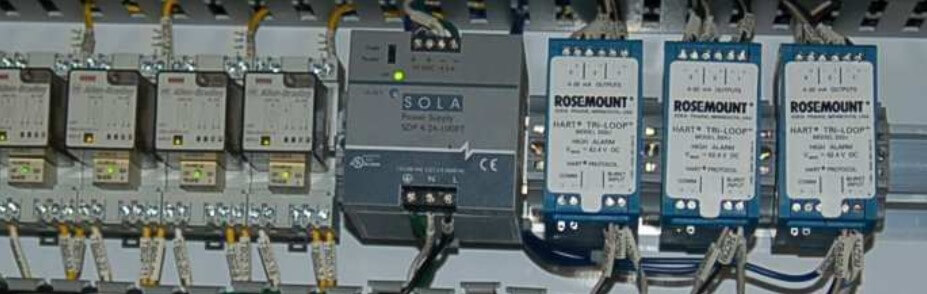
The next photograph shows some of the variety available in base components.
From left to right, four relays, one power supply, and three HART protocol devices, all connected to an extruded aluminum rail:
As mentioned earlier, DIN rails are available in two forms: stamped steel and extruded aluminum.
A comparison of the two materials, with steel sheet on the left and aluminum on the right:
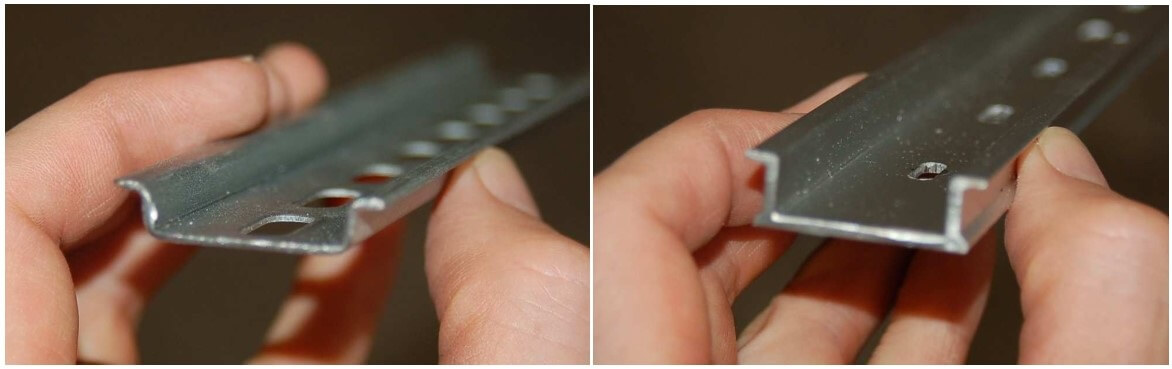
The figure shows that in all photos so far, the DIN rail referred to is known as the “top hat” profile.
A variation in DIN rail design is the so-called “G” rail, which has a completely different shape:
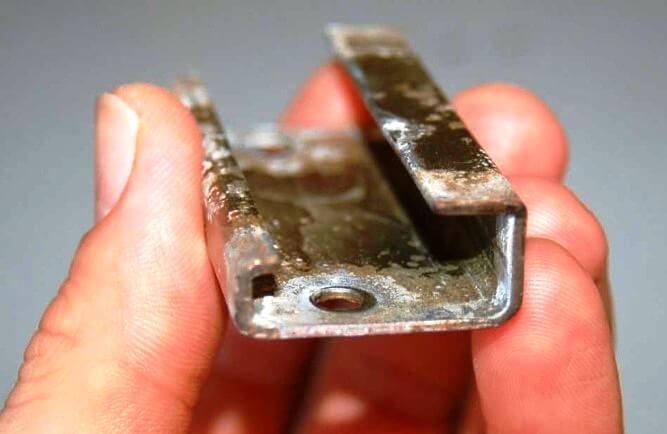
Fortunately, many modular terminal blocks are designed to connect to either style of rail, such as these two specialty blocks, with the left being a terminal block with an internal disconnect switch and the right being an “earthing” terminal block where its endpoints are electrically common with the DIN rail itself:
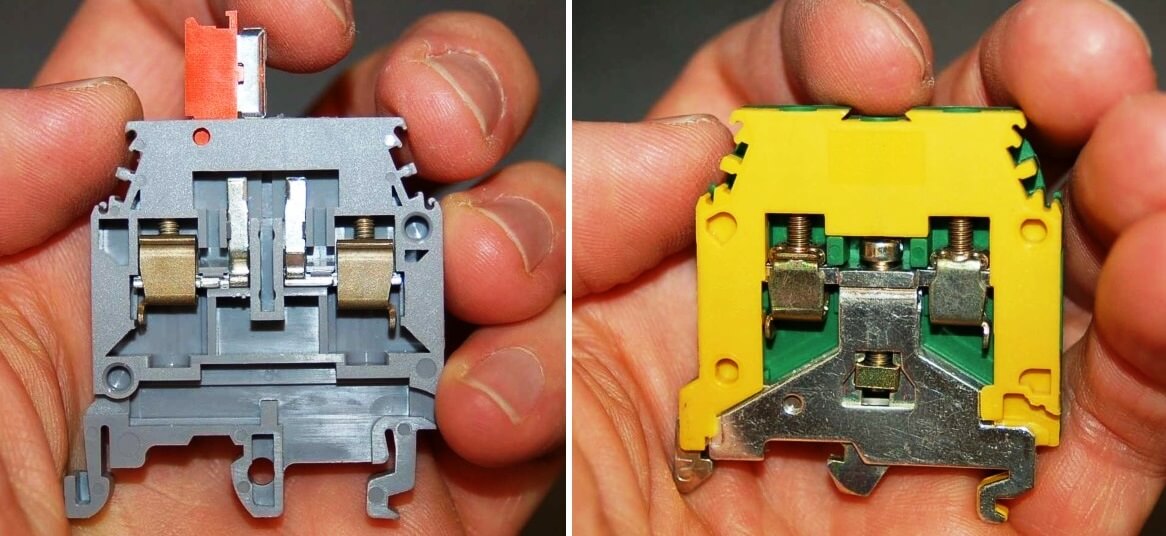
If you examine the bottom structure of either block, you will see structures designed to connect to the edges of standard (“top hat”) DIN or “G” rails. There are smaller standards available as well, although they are much less than the commonly used standard size of 35 millimeters:
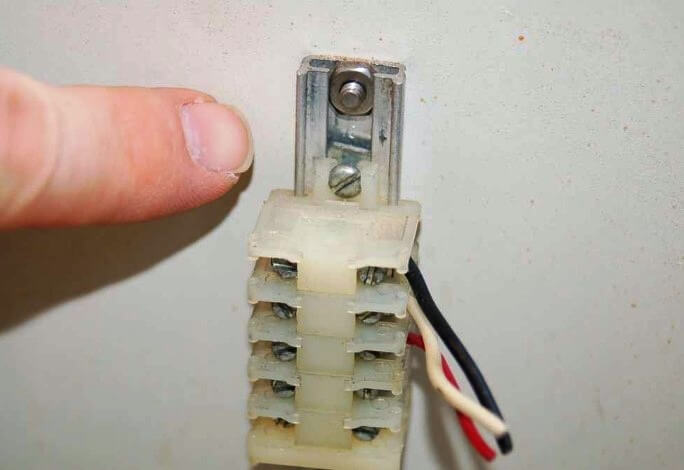
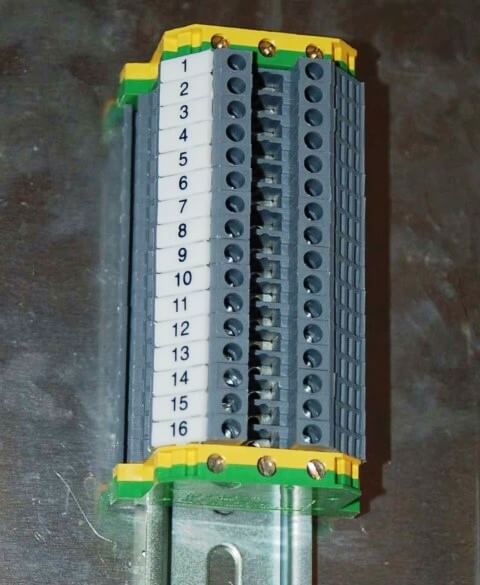
One of the nice features of many terminal blocks is the ability to attach pre-printed terminal numbers.
This makes wiring documentation much easier, so that each terminal connection has its own unique identification number: