


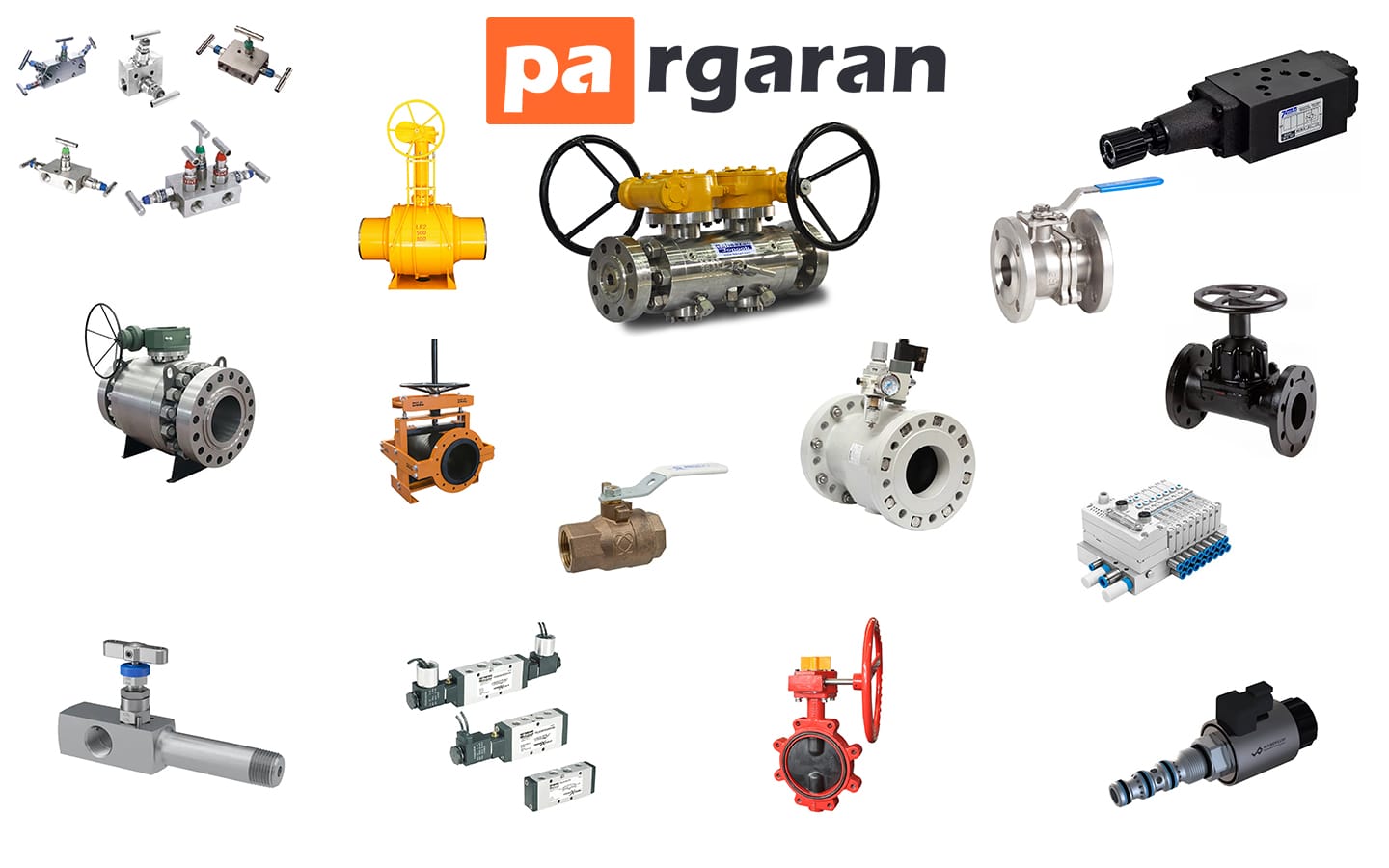
A valve, or industrial valve, is an instrument used to control, regulate, start, or stop the flow of fluids in piping systems.
Valves play a crucial role in managing fluids within piping systems by either stopping or starting the flow of gas, liquid, slurry, steam, or mixtures of gas and liquid. They also help regulate pressure, flow rate, and other controllable parameters, such as temperature, direction of flow, isolation, and system protection under critical conditions.
The components of valves are categorized into two groups based on their pressure tolerance:


Types of Industrial Valves
Common types of valves can operate manually or automatically, or be equipped with actuators. The actuators for valves can be electric, pneumatic, hydraulic, or a combination thereof.
Depending on their application, valves are classified based on hydraulic and pneumatic functions, material composition, operational duties, mechanism of the blocking component’s movement, energy source of the actuator, connections, type of blocking element, temperature and pressure ratings. Each of these categories will be discussed in detail below:
Hydraulic and Pneumatic Industrial Valves
Hydraulic Valve

The control of fluid flow in a piping system can be performed using hydraulic valves. Hydraulic valves can be classified based on their mode of operation and actuation type as follows.
Pneumatic Valve

In pneumatic systems, the fluid control unit consists of pneumatic valves. These valves control the flow of air by applying pressure. Pneumatic valves can be broadly categorized into two groups:
1. What is controlled is air or inert gas (the controlling system can handle any fluid).
2. What is controlled is other than air (the controlling system is air or gas) (pneumatic actuator).
Pneumatic valves can be categorized based on type of operation, number of flow paths, method of opening and closing the valve, number of ports, and type of actuation as follows:
Pneumatic solenoid valves are named based on their state numbers and the number of input and output ports. For example, a 7/5 valve (read as seven to five) indicates that the valve has five states and seven input and output ports.
Types of Industrial Valves by Material
One of the most critical aspects of designing and manufacturing a valve is selecting the material or substance for its various components, especially the body. To choose the appropriate material, various parameters and different standards must be considered, such as temperature tolerance, pressure tolerance, conductivity properties, the internal surface friction with the fluid, corrosive and abrasive properties, flow stress, and more.
Table 1 shows suitable materials based on temperature range, and Table 2 indicates suitable materials based on ASTM and ANSI Class standards.
Some commonly used materials in the construction of industrial valves include:
Carbon steel, alloy steel, cast iron, bronze, stainless steel, ductile iron, ductile iron with nickel coating, aluminum, copper, brass, silicon bronze, aluminum bronze, Monel, Stellite, Hastelloy, glass, special steels, and non-metals such as PVC and PP.
Types of Industrial Valves by Pressure Tolerance
The wall thickness of each valve and the material used in its construction are the two key criteria determining the pressure tolerance of fluid flow.
To determine the pressure tolerance, two standards are utilized:
ANSI B16.34
If the pressure tolerance is calculated in PSI, the temperature and pressure tolerance rates according to this standard are taken into account. These valves are referred to as Class-rated.
EN 1092-1
If the pressure tolerance is calculated in BAR, the temperature and pressure tolerance rates according to this standard are taken into account. These valves are referred to as PN-RATED.
| 16 bar | Class 150 |
| 40 bar | Class 300 |
| Class 400 | |
| 100 bar | Class 600 |
| 160 bar | Class 900 |
| 250 bar | Class 1500 |
| 400 bar | Class 2500 |
Types of Industrial Valves by Port Size
Full port valve: The diameter of the valve's connection to the pipe equals the diameter of the pipe.

Standard port valve: The diameter of the valve's connection to the pipe is slightly smaller than the diameter of the pipe.

Reduced port valve: The flow path in the valve is narrower than the flow path in the pipe.

Types of Industrial Valves Based on the Movement Mechanism of the Flow Blocking Element:
The actuator's state change, whether manual, energy-based, or automatic, causes the stem or blocking element (disk, rod, or flexible material) to move.
This movement facilitates stopping, starting, or adjusting the fluid flow.
Based on the manner of disk movement, valves can be classified into two general groups:

Linear Valves

A linear motion valve operates based on the displacement of the blocking element in a straight path (perpendicular to the fluid flow direction). This direct or linear displacement enables stopping, starting, or adjusting fluid flow. The activation of the linear movement of the blocking element in this type of valve occurs through rotational or axial displacement of the actuator.
Generally, the rate of flow change in linear valves is lower than that of rotary valves, but they offer greater stability and accuracy.


