


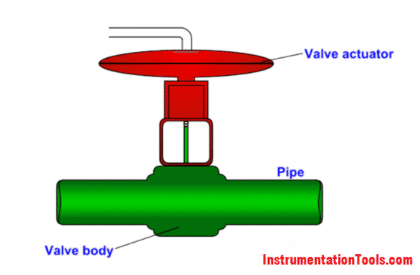
Spring and diaphragm pneumatic actuators can operate "directly," meaning that air pushes down on the diaphragm chamber, moving the actuator stem downwards.
A spring and diaphragm pneumatic actuator consists of a diaphragm, a spring, and a stem as its main components. Air applies pressure to the diaphragm and spring. In addition, the compression of the spring causes the valve stem to shift. Spring diaphragm pneumatic actuators have a wide range of applications in industrial processes.
Pneumatic actuators essentially consist of a diaphragm, a stem, and a spring. By applying pressure on the diaphragm, the spring compresses. The compression of the spring causes the actuator mechanism to move. Thus, air pressure forces the spring to compress and activate the actuator.
Spring and Diaphragm Pneumatic Actuators

Additionally, spring and diaphragm pneumatic actuators can operate in a "reverse action" manner, meaning that the air in the diaphragm chamber causes the actuator stem to move upward.
This action "opens the air" compressing the spring, which in turn causes the actuator stem to move downward as the source pressure decreases.
This is the most common type of diaphragm actuator used, as the spring action makes it so that in the event of loss of supply air, the valve remains in the "fail closed" position.
Principle of Operation of Spring and Diaphragm Pneumatic Actuators:
The linear diaphragm actuator operates on the principle that when the supply air signal pressure passes through the air chamber composed of the upper diaphragm cover and diaphragm, it moves the pressure rod downwards as thrust is created on the diaphragm and compresses the spring.
When the force of the spring equals the thrust produced by the feeding air signal pressure on the diaphragm, the pressure rod is stabilized in its corresponding position. Thus, the pressure rod extending from the actuator causes the displacement referred to as the job.
Components:
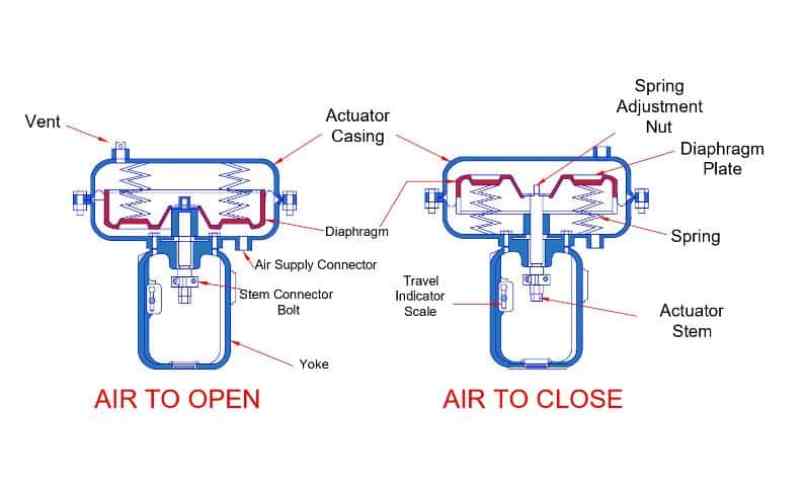
How Does the Spring and Diaphragm Pneumatic Actuator Work?
The spring and diaphragm actuator refers to the diaphragm or flexible membrane that separates two flat concave chambers.
Pneumatic actuators of the spring and diaphragm type are classified as "air to expand" or "air to contract." If the valve is of the push-to-close type, lowering the rod with a pneumatic signal will cause the valve to close. If the valve is of the push-to-open type, lowering the rod will cause it to open with the application of a pneumatic signal.
At least one of the cavities is connected to a pressure line that operates the actuator. Pressurized air expands the diaphragm and draws the actuator shaft in a linear motion. If it passes above the graph line, the forces cause deformation of the diaphragm and displacement of the stem downwards. On the other hand, if air enters below the graph line, the movement will be upwards.
These actuators act against the spring pressure that is responsible for returning the diaphragm to its initial position when the diaphragm is not experiencing pressure.
Types
1. Direct Action (Spring to Contract):
Most diaphragm actuators are of the direct action type. The upper cavity of the diaphragm receives pressure, and the reducing rod moves downward. In direct spring and diaphragm pneumatic actuators, the air pushes down on the diaphragm case.
By applying a certain pressure on the diaphragm, the spring compresses in such a way that the stem begins to move. The stem continues to move until the diaphragm pressure equals the spring pressure.
When air pressure operates in the upper chamber, it operates directly. Excessive pressure on the diaphragm can damage it.
In the event of air failure (or loss of air), the valve opens. The spring opens the air for direct closure action.
2. Reverse Action (Spring Driven):
There are reversible diagram actuators where air causes the stem to move either downward or upward.
This is the lower chamber that receives pressure, so the stem moves upwards. When air pressure acts in the lower chamber, it causes the diaphragm to move upwards and the stem to retract, having a reverse action.
For any questions or comments, please contact Pargaran.
For more information, click here or here.


