


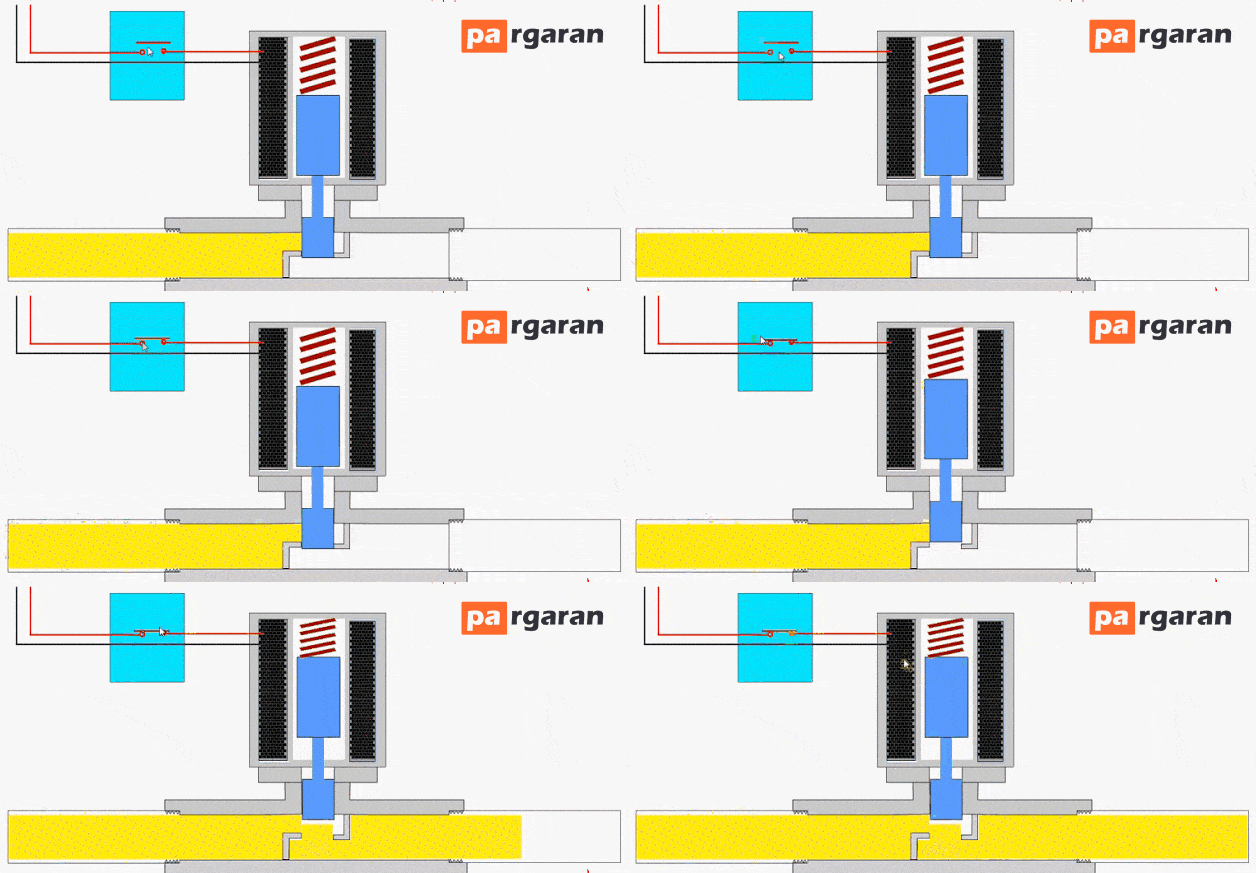
A Solenoid Valve, also known as an electric valve, is a control valve with an electromechanical actuator used to shut off, start, measure, distribute, or mix fluid flow.
High operating speed, good reliability, long lifespan, compatibility with various materials, low energy consumption, and small size are some of the capabilities of solenoid valves.
Solenoid valves are applied in the control of fluid flow in cylinders, hydraulic motors, large industrial valves, and mechanized irrigation systems.
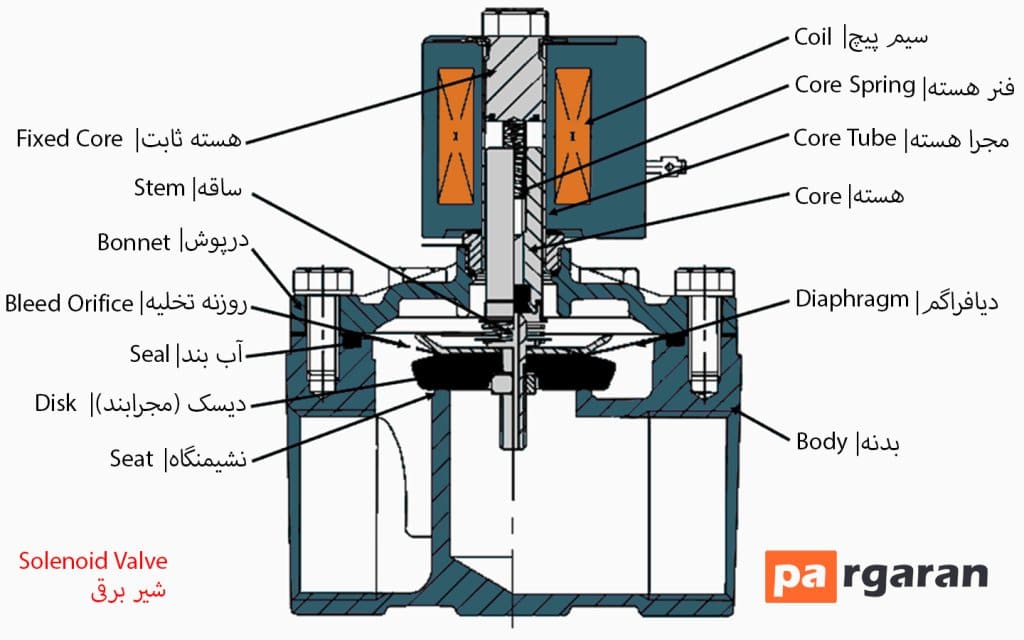
Solenoid valves are produced in various types based on their application type and location, which consequently have different variable and fixed components.
The components of a simple solenoid valve are illustrated below.
Solenoid valves are categorized based on their operating type, input-output configuration, and whether they are pneumatic or hydraulic, as shown below:

Types of Solenoid Valves Based on Operating Type
When electric current enters the coil, a magnetic field is created, which attracts the piston upwards, overcoming the spring force, thereby opening the valve.
Direct acting solenoid valves come in two types: normally closed and normally open. Normally open valves operate in the opposite manner to normally closed valves as described above.
Indirect Acting (Servo or pilot operated)
In indirect acting electric valves, opening and closing are accomplished using pressure differential across the input and output ports. The minimum pressure differential required for these valves to function is approximately 0.5 bar.
The speed of pilot-operated valves is lower than that of direct acting electric valves, and they are designed in two types: internal pilot and external pilot.
These are somewhat similar to indirect acting solenoid valves; the main difference is that in the assisted lift valve, the diaphragm is connected to the piston, allowing it to detach directly when the coil is actuated at low pressure and shift with the internal pressure of the valve at higher pressures; this means that the diaphragm is moved by both the differential and the piston.
Electric Valves Based on Input-Output Type
This has one input port and one output port, where an increase in pressure at the input port relative to the output port initiates the fluid flow, and an increase in pressure at the output port stops the fluid flow.
The pressure at the port is created by the actuator structure of the electric valve. These types of valves are designed in normally open and normally closed configurations.
A three-way valve has three input-output ports and two seals. One of these seals is always open, while the other is normally closed (inactive).
With changes and application of an electrical signal, the state between the seals and the ports changes.
Three-way solenoid valves are designed in three types: open structure, closed structure, and universal structure, which differ based on the normal position of seals (the opening controlling the flow in and out).
A four-way valve has four input-output ports that operate with a double-acting actuator. Half of the pressure connections control the pressure at the input ports, while the other half controls the pressure at the output ports.
Types of Hydraulic Solenoid Valves
The duty of hydraulic solenoid valves is to control pressure and protect the system from sudden pressure changes. These valves come in various types, with some of the most important being:
Simple hydraulic solenoid assurance valves, combined hydraulic relief solenoid valves, pressure-reducing hydraulic solenoid valves, unloading hydraulic solenoid valves, balancing hydraulic solenoid valves, sequential hydraulic solenoid valves, pressure switch hydraulic solenoid valves.
These valves regulate the cylinder and hydraulic motor speed by changing the input and output flow rates and are designed in two types: with pressure compensator for fluctuating pressure systems, and without pressure compensator for fixed pressure systems.
By combining a digital valve with a servo valve, proportional hydraulic valves can be achieved. These valves incorporate more advanced technology compared to other electric valves.
The solenoid in these valves determines the position of the ferromagnetic core based on the amount of electric current, meaning that the proportional hydraulic electric valve can adjust the flow of the fluid passing through it.
Its application is in military industries, hydraulic presses, metal rolling, and machining.
Pneumatic Electric Valve
These control the direction of gas flow in pneumatic systems and have the capability to cut off and enable the flow. Pneumatic solenoid valves for directional control are named based on their input and output ports as follows: two-way directional control valve, three-way directional control valve, four-way directional control valve, spring offset.
These are designed for controlling fluid flow in two forms: open flow and closed flow. In the open flow type, increasing the voltage in the solenoid decreases fluid flow, while in the closed flow type, increasing voltage in the solenoid increases fluid flow.
In pneumatic systems, pressure is controlled using electric pneumatic valves with various applications.
Among the most important applications and classifications of these valves are electric pneumatic pressure-limiting valves for reducing pressure and pneumatic solenoid pressure-regulating valves for maintaining pressure against flow fluctuations.
Additionally, some types include pneumatic solenoid valves for pressure that provide alarms when pressure falls below or rises above a specific level.
These valves are used for controlling fluid movement in a designated path. Pneumatic electric non-return valves prevent backflow by blocking the pathway. Various types of pneumatic solenoid non-return valves include:
Check valves, shuttle valves, quick release valves.
These are responsible for completely stopping or allowing flow as needed in emergencies; in some systems, this operation may be accompanied by changes in the system flow.
These valves are more advanced in design compared to other pneumatic valves and are used in various applications, such as controlling pressure, speed, and the amount of transferred air.
Advantages and Disadvantages of Electric Valves
Strengths (Advantages) Weaknesses (Disadvantages) Strengths (Advantages)
- Fast response time
- Low power consumption
- Remote control
- Easy maintenance
- Inexpensive components
- Operational in high and low temperatures
- Compatible with both AC and DC voltages
Weaknesses (Disadvantages)
- Voltage sensitive
- Improper magnetic field adjustment can lead to incomplete valve closure
- Potential need to replace the coil
- Control signal must remain on during operation
- Flow can be affected under certain conditions


