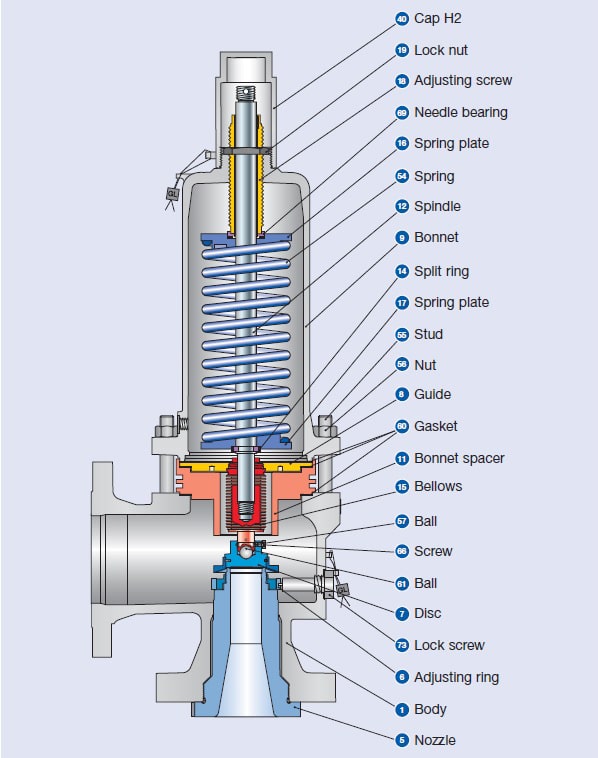
A Safety Valve, or شیر ایمنی, is used to protect equipment and facilities against explosion or failure. This valve operates automatically and is installed where there is a risk that the operational pressure of the system or the pressure pipeline may exceed its maximum allowable limit.
Examples include electric steam boilers, gas storage tanks, turbines, boilers, etc. When the nozzle of the safety valve senses a pressure higher than the predefined pressure at the fluid inlet to the valve, it opens the valve's passage and discharges fluid until the pressure returns to below the set point. Subsequently, the disk returns to its normal state, which is closed.
Various conditions that can lead to increased pressure include:
- Imbalance in flow rate due to accidental opening and closing of isolation valves in pipelines
- Failure of the cooling system resulting in fluid or steam expansion.
- Transient pressure surges
- Fires
- Failure of the heat exchanger pipe
- Uncontrollable thermal reactions in chemical facilities
- Changes in ambient temperature
The following are types of safety valves:

Spring-Loaded Pressure-Relief Safety Valves

This is the most common and widely used type of safety valve, which is why in many cases, the term safety valve refers to this type. The internal force of the spring keeps the disk against the internal pressure.
Pilot-Operated Pressure-Relief Safety Valves

This is a combination of a pilot assembly and a main valve (which can be any type of valve). In a spring-loaded pressure relief valve, the force opposing the incoming pressure is provided by the spring. However, the relieving pressure and reseating pressure are controlled by the pilot assembly, making it function similarly to spring-loaded pressure relief valves.
When using pilot-operated pressure relief valves, the main valve cannot be adjusted.
This valve is larger than the spring-loaded type, and is therefore used in more challenging situations, such as when high pressure is present.
Dead-Weight Pressure-Relief Safety Valves

If the design pressure of a pressure vessel is set at a low value, the dead-weight type pressure relief valve adjusts the relieving pressure with the weight of the disk. The vacuum relief valve absorbs pressure when the internal pressure of the pressure vessel changes to negative pressure.
Do you have a friend, customer, or colleague who could benefit from some of this information? Please share this article.
If you have any questions or comments, please contact the Pargaran team.