In hydraulic systems, optimizing pressure regulation using proportional valves is one of the critical factors. In this article, we will define proportional valves for pressure regulation and examine the importance of pressure regulation in hydraulic systems.
For several decades, electronic pressure regulators (or IP converters) have been a core part of pneumatic control systems. Some electronic pressure regulators still use electric valves, but this can create various issues in pressure control applications.
Many of these issues can be resolved by utilizing proportional valve technology as flow in (fill) and flow out (exhaust) controls for pressure regulation.
To better understand the benefits of proportional valve technology for pressure control, we must consider the general characteristics of electronic pressure regulators and the design of proportional valves.
Advantages of Electronic Pressure Regulators Over Mechanical Regulators in Proportional Pressure Regulation
Electronic pressure regulators have numerous advantages over mechanical regulators. A mechanical regulator maintains pressure downstream effectively at a constant flow rate. However, downstream flow and pressure often fluctuate in most applications. Pumps and compressors send pulses, and pressure varies with demand.
When a mechanical pressure regulator lacks accuracy or cannot respond quickly enough, the result is uneven output pressure. This simple device may suffice when precision isn't critical. However, an electronic or digital pressure regulator provides better accuracy and dynamic output pressure adjustment using control signals and feedback signals to establish a closed-loop pressure control.
Electronic pressure regulators maintain a steady output pressure in a pressurized system even if there are fluctuations in the input pressure to the regulator. Mechanical pressure regulators are usually only manually adjustable, limiting their use in high-tech applications.
When using an electronic pressure regulator with a digital control system, the output pressure can be precisely controlled through minor adjustments in the control signal. An internal pressure converter creates a true closed-loop control device, providing a voltage feedback of the output pressure. By reading this feedback signal from an electronic regulator, control systems can make real-time adjustments and significantly improve steady pressure regulation in the most demanding applications.
Comparison of Electronic Pressure Regulators and Mechanical Regulators in Proportional Pressure Regulation
Electronic pressure regulators represent a significant advancement over mechanical regulators. They are relatively simple and effective at allowing for better control. They utilize a fill valve and an exhaust valve to maintain output pressure at the desired set point.
A small internal pressure sensor monitors the output pressure, and a digital controller adjusts the flow rates of internal valves to maintain the required set point (i.e., closed-loop control). This means that when you set the desired pressure, the regulator maintains this pressure even with changes in flow rates in the system. The internal pressure converter provides instantaneous feedback to adjust the fill or exhaust valve flow to keep the output pressure constant.
When the control signal increases, the internal proportional valve activates, increasing pressure to the internal pilot chamber. When this occurs, more input pressure from the fill valve passes through to the pilot chamber. The pressure in the pilot chamber rises, causing the upper diaphragm to function.
Consequently, the supply air valve connected to the diaphragm opens, converting part of the supply pressure into output pressure. This output pressure is fed back to the control circuit using the pressure sensor. The fill valve continues to make slight adjustments until the output pressure matches the desired set point of the control signal.
As demonstrated, in standard electronic regulator design, using highly precise and fast fill and exhaust valves significantly impacts overall pressure control characteristics. But how do proportional valves achieve this?
Proportional Valves
Traditional electronic pressure regulators typically use a dual design of on/off valves, with both inlet and outlet valves. Pressure variations are controlled by modulating the on/off valves by adjusting their duty cycle.
Utilizing pulse width modulation can create several problems for control systems. Issues related to using pulse width modulation with on/off valves and recurrent valve cycling include significantly shorter product life, product noise, deadband in the control circuit, pressure oscillation, and inconsistent performance in dynamic output conditions.
Some pressure regulators use an input proportional valve to compensate for these performance issues. However, these units typically use an electric on/off output valve to vent excess pressure and compensate for changes in flow rates to the system.
Typically, this is achieved through rapid valve cycling, making applications with more dynamic output pressure rates more susceptible to fluctuation. Since the exhaust valve must continuously cycle at high hertz to compensate for dynamic pressure changes.
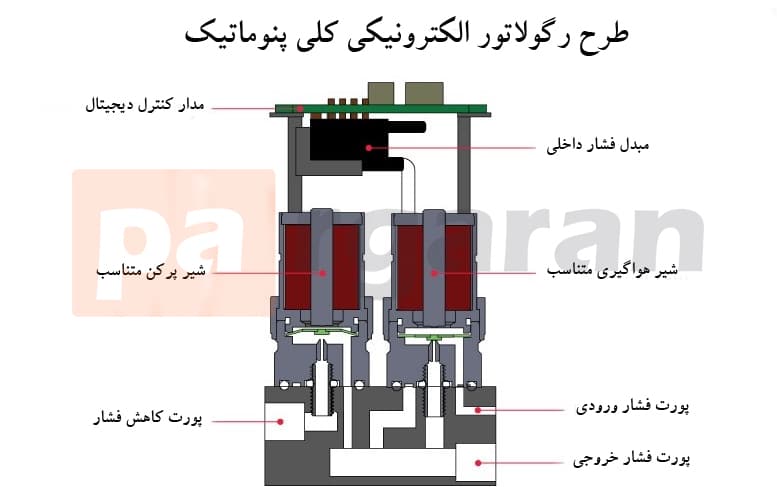
General Electronic Pneumatic Regulator Design
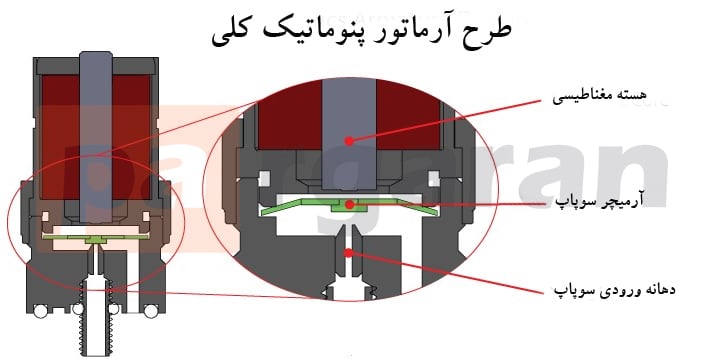
General Pneumatic Actuator Design
Proportional Pressure Valve
A critical element of an electronic pressure regulator is the dual proportional valve design. One valve controls the inlet and the other controls the exhaust. Each valve respectively increases or decreases the output pressure.
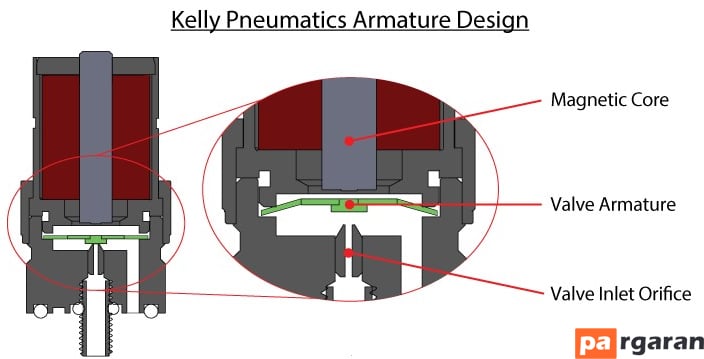
Integrating two proportional valves prevents many issues associated with traditional on/off valve regulators. This is largely due to the inherent design of proportional valves that manage pressure adjustments. Each proportional valve utilizes an armature design that provides nearly frictionless operation.
Output pressure/flow is achieved by the proportional armature movement of a single valve from the inlet opening. The total travel distance of the valve armature is only thousandths of an inch. A slight increase or decrease in the armature's distance from the valve opening results in a change in output flow rate and pressure.
In contrast, on/off valves typically do not provide a variable flow rate and utilize calibrated travel distance armatures. The valve armature blocks completely against the valve seat when in the off state, while in the on state, it fully opens against the valve chamber.
Cycling the on/off valve can pose problems, especially considering the aforementioned use of pulse width modulation in other pressure control units needing to cycle valves at specific hertz. This can significantly shorten the life of rotating electric valves and consequently the product itself.
This is particularly true for applications with consistent output flow or frequently changing output pressures to the system, where consistent valve cycling is more advantageous. Therefore, in many applications, valve cycling can be fixed for these products and significantly limit product life.
In the Kelly Pneumatics electronic pressure regulator, the internal proportional valves only need to change their respective armature distance to modify the output pressure and flow of the pressure controller.
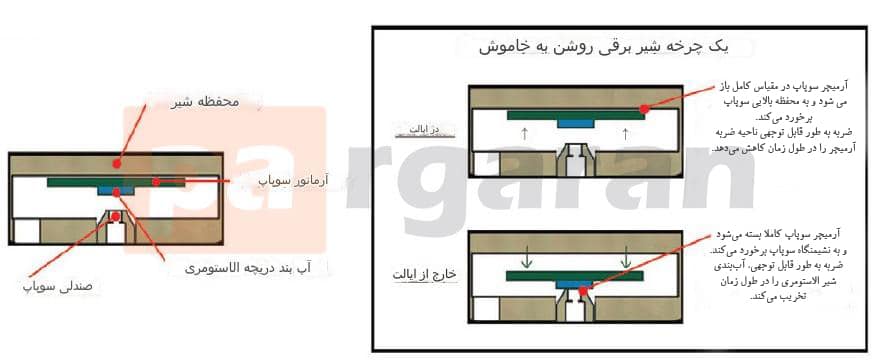
An Electric Valve Cycle from On to Off
For instance, when an increase in downstream flow occurs, the proportional inlet valve is adjusted immediately to compensate with a slight adjustment of the internal valve armature in one motion. Additionally, during steady states, the proportional valves maintain the valve armature distance without wear on the valves themselves.
Using on/off valves for fill valves or exhaust valves in pressure controllers can create...