Pressure Switch Valve | شیر سوئیچ فشار
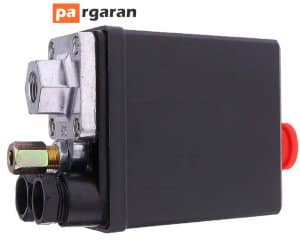
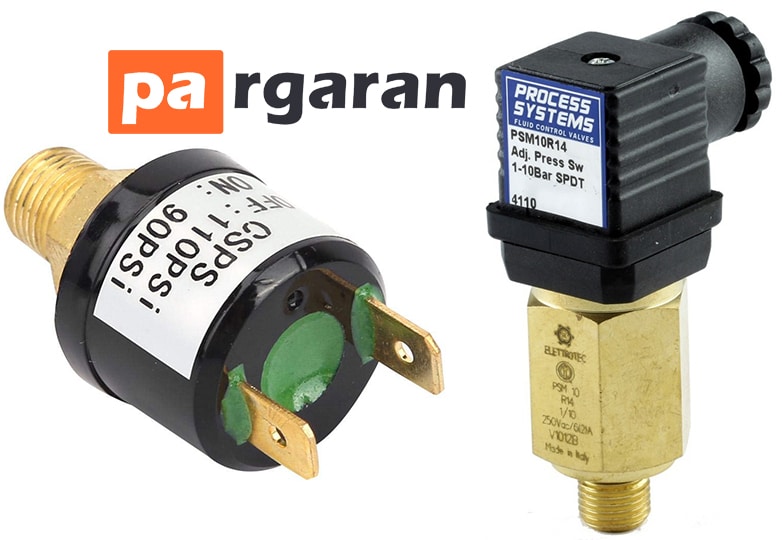
The Pressure Switch Valve is an electrical device that measures pressure in any environment. This device is used to detect the presence of a fluid. The pressure switch detects increases or decreases in pressure and achieves the pressure level specified by the user. This device is designed to monitor the process pressure. When a specified pressure (set point) is reached, it transmits an output signal. To perform this function, the pressure switch applies the process pressure to a diaphragm or piston and generates a force. It then compares this force with the force of a compressed spring.
Most pressure switches use a diaphragm or bellows-like element as a sensing element. The movement of this sensing element activates one or more switch contacts and starts or activates a warning signal or control alert. This valve comes in various designs with different sensing elements.
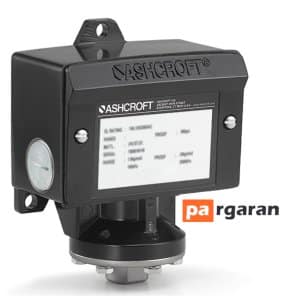
A pressure switch typically has one or two pressure ports. In a pressure switch with one port, pressure enters through the port and is applied to an internal diaphragm. If the applied pressure exceeds the pressure of the compressed spring, the switch contacts open or close the circuit. This creates an alert in the system and notifies the user that the pressure in the desired environment has changed.
In a pressure switch with two input ports, the pressures entering through these two ports are compared. If the pressures entering the two ports are different, the pressure switch provides a warning to the user for this change.
The safety switch of the pressure switch, which is located below the pressure switch, is sealed to the top of the one-way control valve by a nylon or copper tube. When the pressure switch contacts separate, this valve is activated by a lever to release the pressure trapped between the pump and the one-way valve.
Pressure switches are divided into two main categories: electromechanical and solid-state.
.
The most common electromechanical pressure switches consist of a sensing element and a rapidly acting electrical switch. Various types of sensing elements can be used in these switches; however, these sensing elements share one characteristic: they move due to changes in process pressure and directly affect the opening or closing of the switch contacts through their movement. Differential pressure switches are somewhat different. These switches have two pressure ports: one for the low-pressure side and another for the high-pressure side of the process. Both low and high-pressure fluids enter a single pressure sensing element. Since the surface area of this sensing element is the same on both sides, when the pressures on both sides are equal, the switch remains in a neutral state. When pressure increases on the high-pressure side or decreases on the low-pressure side, the piston moves upward and activates the switch at a specified pressure differential. Electromechanical switches are usually classified based on the type of sensor technology used in them. Sensor characteristics can determine the relative accuracy and lifespan expected from the switch.
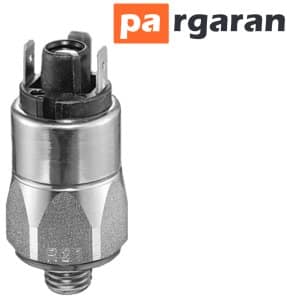
All pressure switches have two operational points known as cut-in (restart point) and cut-out (shutdown point). The cut-in point applies during pressure drop, while the cut-out point applies during pressure increase. Additionally, each pressure switch has a differential value or a range between the cut-in and cut-out points. In most switches, the cut-in and cut-out points can be adjusted as needed for the process. In simpler terms, there are two pressures at which the switch opens and closes the circuit. When the pressure decreases to the cut-in point, the pressure switch closes the circuit, and when the pressure increases to the cut-out point, it opens it.
.
Therefore, the cut-in point is always lower than the cut-out point. The distance between these two points is referred to as the pressure band or pressure differential. The difference between these two points should not be less than a certain limit. There is a general rule stating that the pressure band must be at least 1 bar (psi14). Band settings play an important role in preventing rapid switching, which can have detrimental effects on the equipment controlled by the pressure switch and wear out electrical contacts. For example, in the case of air compressors, if the pressure band is too low, the compressor will repeatedly turn on and off at a high speed. As a result, the compressor motor may burn out, and there will be increased wear on compressor components. Consequently, the pressure switch may become damaged. For some machines, it may be better to consider a higher pressure band (e.g., 2 or 3 bars). This is more beneficial for machines that operate only for a short time. For instance, in the case of a compressor, increasing the pressure band allows the compressor to run for a longer duration, which provides more time for temperature rise and for removing water and moisture inside the compressor (the number one enemy of compressors!). The pressure band can be set or fixed based on a percentage of the total pressure range. Usually, Bourdon tube and diaphragm switches have a small pressure band, while piston switches have a wide pressure band. The pressure band in solid-state pressure switches can be adjusted to 100 percent of their total range. Depending on the model and design of the pressure switch, some switches may only permit changes to the pressure settings while the pressure band remains fixed, while in others, both pressure and band settings can be adjusted.