Pressure regulators or pressure controllers are devices used to control the fluid pressure within a specific range. The main function of a regulator is to reduce high input pressure to control low output pressure. Pressure regulators can even find applications in situations where a constant output pressure is required.
Pressure regulators are widely used for various domestic and industrial applications. Some common applications of pressure regulators include:
- Gas furnaces,
- Heating furnaces,
- Dental equipment,
- Pneumatic automation systems,
- Automobile engines,
- Aerospace applications,
- Hydrogen fuel cells,
- Helmets recovery
- Pressure cookers and pressure vessels,
- Welding and cutting,
- Gas-fueled vehicles,
- Mining and natural gas industries,
- Hyperbaric chambers,
- Inflating tires, etc.
Functions of a Pressure Regulator
As previously mentioned, the main purpose of installing a pressure regulator is to reduce pressure. However, they can effectively be used to perform the following functions:
- Adjusting return pressure
- Acting as a pressure switch valve in pneumatic logic systems.
- Functioning as a vacuum regulator to maintain a constant vacuum.
Components of a Pressure Regulator
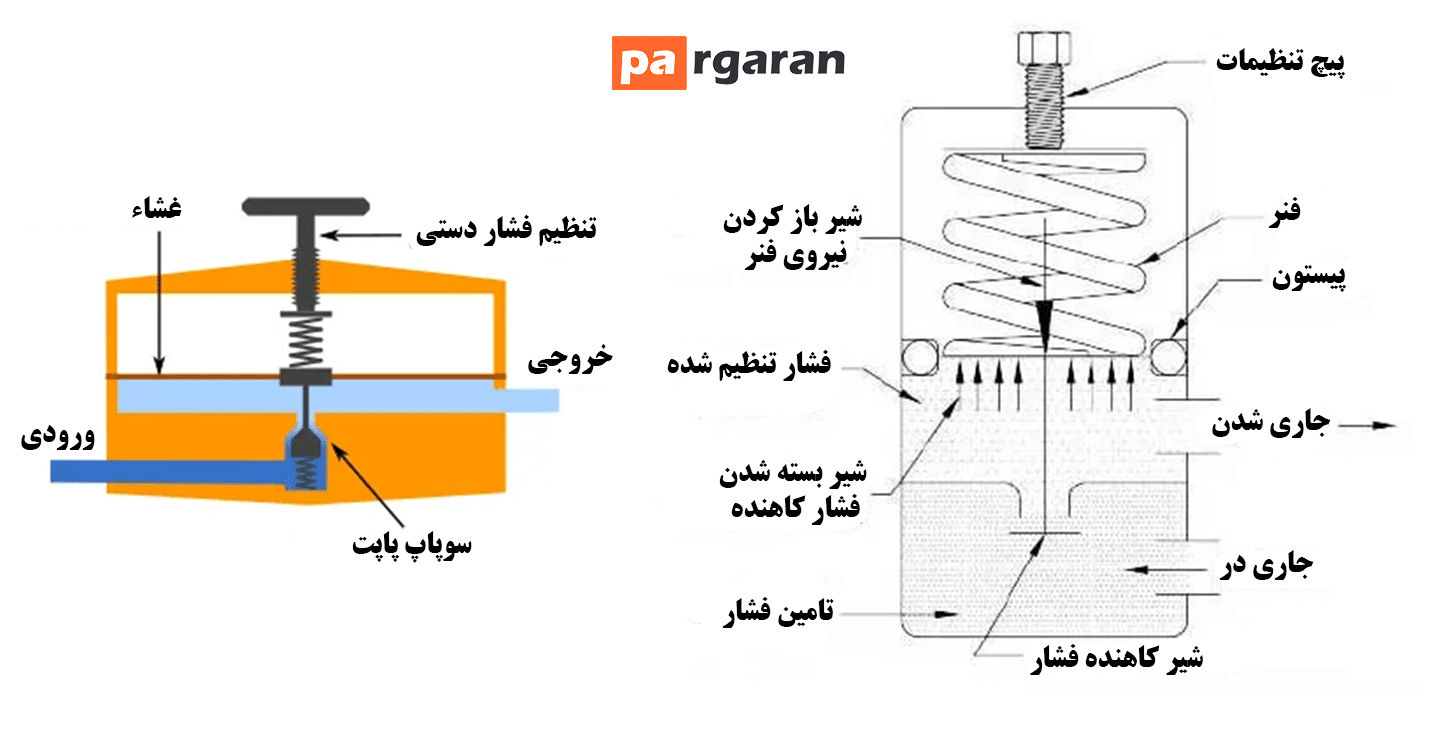
All pressure regulators are characterized by the reduction of input pressure to achieve a lower output pressure. There are three main components that help the pressure regulator perform its desired function:
- A pressure-reducing valve
- A loading element such as an actuator or spring to apply the required force
- A sensing element such as a piston or diaphragm.
Schematic of a Typical Pressure Regulator

The pressure-reducing valve is also known as the limiting element. It creates a variable limiting flow. Examples include globe valves, butterfly valves, poppet valves, and so forth.
The loading element is the part that can exert the required force on the pressure-reducing valve. Weights, springs, diaphragm actuators combined with springs, or piston actuators can serve as loading elements.
The measuring element or sensing element determines when the inlet flow equals the outlet flow. Often, the diaphragm itself acts as a measuring element, and it can function as a combined element.
Types of Pressure Regulators
Based on the number of stages employed to achieve the final reduced pressure, there are three types of pressure regulators.
Single-stage Pressure Regulator:
Used for relatively low-pressure reductions in the range of 100 to 150 psi. Applications include machine tools, test stands, linear actuators, automated machinery, leak testing equipment, and so on.
Two-stage Pressure Regulator:
Suitable for large variations in input pressure.
Three-stage Pressure Regulator:
They provide stable output pressure and are capable of further pressure reduction. Typical examples include drones, medical devices, analytical instruments, hydrogen fuel cells, etc.
Again, based on the mode of operation, they can generally be classified into the following two classes.
-
Automatic Pressure Regulator:
The simplest design. They have greater accuracy at lower pressures and less accuracy at higher pressures. They do not require external sensing lines for effective operation.
-
Pilot Pressure Regulators:
Complex in design but can tolerate larger pressure fluctuations. Pilot pressure regulators provide precise pressure control.
Based on the application of the pressure regulator, they are sometimes referred to as follows:
- Water pressure regulator
- Gas pressure regulator
- Fuel pressure regulator
Operation of Pressure Regulators
A pressure regulator matches the flow of gas through the regulator to the gas demand placed on it. At the same time, they maintain the output pressure sufficiently constant. When the load flow decreases, the regulator flow also decreases.
Again, when the load flow increases, the regulator flow also increases, thereby preventing controlled pressure drop due to gas shortage in the pressure system. Pressure regulators are designed such that the controlled pressure does not vary significantly from the set point over a wide range of flow rates. At the same time, the flow through the regulator is stable and the set pressure does not experience excessive fluctuation.
Materials of Pressure Regulators
Of course, the materials of pressure regulators vary based on the working environment and fluid compatibility used. Common materials used in conventional pressure regulators include:
- Brass
- Aluminum
- Stainless steel
- Plastic
For spring materials, stainless steel and sometimes carbon steel are used. Sealing materials are typically fluoroelastomer, EPDM, perfluoroelastomer, or silicone.
Selection of Pressure Regulators
Although pressure regulators come in various sizes and structures, certain parameters must be considered for proper selection. Common parameters that influence the selection of pressure regulators include:
- Operating temperature and pressure range (both input and output temperature and pressure)
- The environment and characteristics of the fluid service (gas or liquid, corrosive or non-corrosive, hazardous or non-toxic, explosive nature, etc.)
- Required capacity or flow (maximum, minimum, and flow variations)
- Material requirements
- Necessary accuracy
- Connection size
- Dimensions, weight, and size
Installation of Pressure Regulators
The installation of pressure regulators should be performed considering the manufacturer's guidelines. Generally, the following steps are followed for installing a pressure regulator:
- Step 1: Connect the pressure source to the inlet port and the reduced pressure line to the outlet port. These ports are usually marked; if not, contact the manufacturer.
- Step 2: Gradually turn on the supply pressure to avoid any shocks.
- Step 3: Set the regulator to the desired outlet pressure. Minor adjustments may be made to achieve the desired pressure.
Types of Pressure Regulators for Industrial Gases
Pressure management of industrial gases is crucial for safe operation due to the high static pressures used to store gases in cylinders for transportation. The high-pressure cylinders supplied by gas manufacturers may have pressures depending on the bottle size and type of gas, often around 200 bar but can be much higher.
These cylinders can be installed individually, in pairs, or in large banks in systems where high gas volume or stable delivery is very important. Pressure regulators for high-pressure cylinders are often referred to as first-stage regulators. This is because they take the 200-400 bar static pressure of the cylinder and reduce it to a safer and more controllable level, which can range from 5 to 50 bar.
In some cases, it may be necessary to use a regulator to introduce lower pressure, such as for diving equipment or breathing devices, in which case a two-stage regulator is required. This unit combines a first-stage regulator with a second-stage unit to provide two stages of reduction, and the only adjustment is for the final delivery pressure. The intermediate pressure between the stages is constant.
First-stage regulators are often directly used with threads...