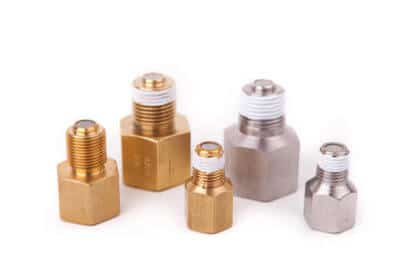
A snubber pressure gauge is a device used to suppress additional force or rapid motion in mechanical systems. Pressure snubbers are designed to reduce the effects of pressure spikes and surges, ensuring longer life and readability of pressure gauges in harsh applications.
These units are available in porous, piston, or gas designs and can handle a wide range of media, from air and other gases to water, steam, gasoline, and oil.
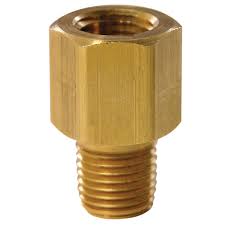
Snubber Pressure Gauge
Snubber pressure gauges protect against the harmful effects of vibrations created in a pressurized system from pulses generated by positive displacement pumps or compressors.
The pressure snubber works by reducing pressure fluctuations. It does not change the process but reduces the spikes in the line, thereby improving the stability of the gauge reading and extending the effective life of the gauge.
A liquid-filled gauge can achieve similar results, but some pressure systems are so highly pressured that a snubber must be installed in addition. When someone is interested in measuring rapid and transient pressures (such as safety interlock activation during pressure increase), a snubber pressure gauge should not be used as it delays the safety system response.
Types of Snubber Pressure Gauges
At the low-cost end of the snubber spectrum, the porous disc type (also known as the "filter type") is located. The fixed disc creates a semi-permeable barrier between the incoming pressure and the pressure gauge inlet.
Pressure impacts that disc, and its force is distributed through a metal mesh. It slows down the pressure to avoid damaging the gauge. The pressure gradually increases, preventing the gauge from jumping or the Bourdon tube from bursting.
The design of the porous disc allows a steady pressure at low speeds, ensuring that the gauge reading is not affected by filter materials.
A disadvantage of porous discs is that they can become blocked depending on the measurement process. In this case, readings are affected, and the snubber must be cleaned by flushing it from the gauge side with a solvent.
A piston snubber has a more advanced design that is often self-cleaning. It is commonly designed in two pieces, with the piston moving freely within the snubber and acting as a barrier against rapid pressure increases.
When pressure rises too quickly, the piston positions itself against the inlet leading to the gauge and stops the flow for milliseconds. It should be long enough to avoid damaging the gauge as long as it is just a spike.
Snubber
This type of snubber can often be adjusted to meet the needs of a process, using pistons that easily come in various sizes. The diameter of the piston and its spacing in the clamp determine the amount of "snubbing".
The third adjustable option takes this fine-tuning to another level. Many use a ball check combination to prevent fluctuations and some kind of throttling valve to smooth the material flow into the gauge. The ball check operates similarly to the piston-type snubber, acting as a passive element until its rapid pressure change activates it.
Even adjustable snubbers without a ball check can be effective in smoothing excessive pulses, thanks to an integrated throttling valve that only allows substantial fluid flow at once. At a certain pressure, a standard needle valve can be replaced, but this does not necessarily provide a permanent solution to the customer's above issue. In that case, it was a large instantaneous spike in pressure that damaged the gauge, and a needle valve alone could not fully stop the surge.
Many adjustable clamps also have the advantage of being leak-tight, allowing the operator to remove the gauge for repair or removal.
How to Select a Snubber Pressure Gauge?
Did you know that snubber pressure gauges protect against the harmful effects of vibrations generated in a pressurized system? The snubber functions by smoothing the speed at which the fluid or gas is measured. While the snubber does not change the pressure process, it reduces the pulses in the line. Consequently, it improves the stability of the gauge reading and increases the effective lifespan of that specific gauge.
You might now wonder, does a liquid-filled gauge not achieve the same result?
Well, yes, it does. However, most of the time, you will need a snubber after installing a liquid-filled gauge. In many high-pressure systems, you start with installing a liquid-filled gauge to improve the gauge readability while also providing protection. But some pressure systems are so highly pressurized that you must install a snubber in addition to the liquid-filled gauge.
As with all components of pressure systems, the price of a snubber depends on several different factors. At the lower end of the scale, porous disk clamps are available. These snubbers use a fixed mesh disc to provide stable measurements. The price heavily depends on the size, materials, and pressure rating of the snubber. Snubbers at the higher end utilize a piston mechanism, which can increase the price.
Installing a low PSI rated snubber in a high-pressure system will inevitably lead to problems. When selecting a snubber, make sure to check the pressure created by your system and then choose a snubber with an appropriate PSI range.
For any questions and comments, please contact the Pargaran team.
For more information, click here.