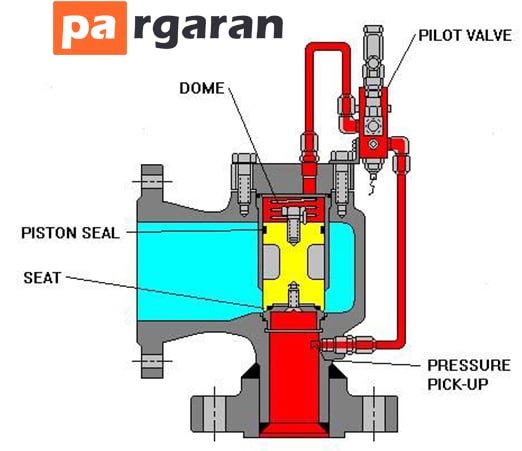
The Pilot Valve, also known as شیر پیلوت, is a small valve that controls the flow of limited feed to a separate pilot valve. This separate valve typically controls a high-pressure or high-flow feed. The pilot valve allows for a small and easy feed to control much higher pressures or flow rates; otherwise, it would require significantly more force to operate.
Pilot valves are often used in critical applications (such as emergency controls and Safety Instrumented Systems - SIS) and are activated by human operation. They can be set up as a push button to turn the system on or off.
When you increase the pressure and reach the set point, the pilot opens. It separates the top of the piston. The pressure creates a direct vacuum to the atmosphere, causing the piston to open and reduce the overall capacity of the main valve. Therefore, pilot valves are installed on top of the main valve.
Thus, the pilot valve hydraulically displaces the main valve. In this valve, the valve piston is activated indirectly. To do this, oil is supplied to the pilot valve.
Key Differences Between Direct-Acting Solenoid Valves and Pilot Valves
The primary difference between direct-acting solenoid valves and pilot valves is that direct-acting solenoid valves have a direct relationship with the armature for opening and closing, while pilot control valves use the process fluid to help guide the operation of the valve.

The main advantage of a pilot operation over a manually actuated valve is that it may generate substantial displacement forces without impact or wear. A pilot control valve can be installed at any distance where pressurized fluids need to be piped. The lack of sparks or increased heat in the pilot valve makes it suitable for use in combustion environments.