



A Needle Valve, or شیر سوزنی, with linear motion and a needle-shaped blocking element, controls, regulates, or stops the flow of fluid.
In systems with low flow rates, needle valves are used for continuous flow adjustment. The design of the needle valve is quite similar to that of a globe valve.
To prevent damage to instrumentation in piping systems, a needle valve is installed to control sudden pressure increases in fluid flow.
The needle-shaped disc of this valve is very effective for controlling low-flow movements due to the threaded surface it possesses.
There is a 90-degree angle between the inlet and outlet of fluid flow in the valve, with the thin-walled needle disc (blocking element) positioned for controlling, reducing, or increasing the flow. The diameter of the flow passage in a needle valve is generally less than the diameter of the fluid transport pipe.
Needle valves are used in industrial and laboratory systems. The high precision of these valves at low and high pressures makes them very suitable for precise control and measurement of flow rates in research work, instrumentation, and analytical applications; the precision of needle valves for accurate applications ranges from flow coefficients of 0.004 to 0.16.
The components of a needle valve can be seen in the figure below.
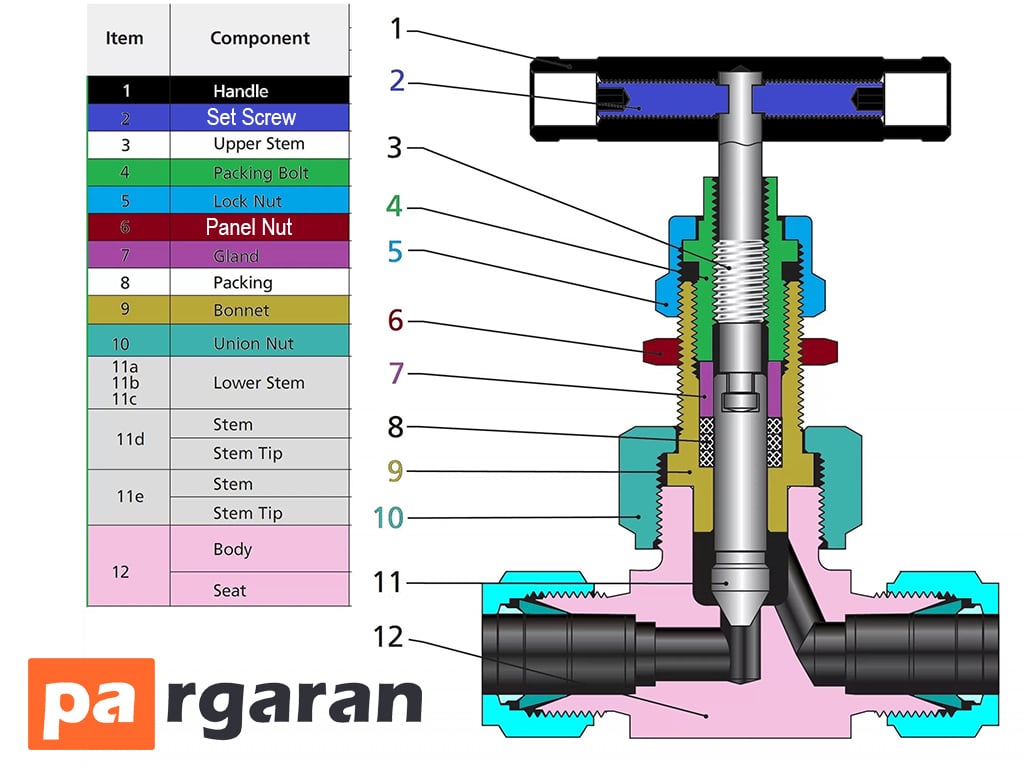
Needle valves are classified based on the type of actuator, blockage path, material, and model as follows.

Types of Needle Valves Based on Actuator
manual
The actuator is manual and is produced in various designs and sizes.
solenoid
An electric actuator is used to position the needle disc. This actuator can be adjusted by the operator as well as automatically.
pneumatic
Air flow and pressure are used to change the position of the blocking element.
Types of Needle Valves Based on Model
steam
Used for steam fluid and high temperatures. Steam needle valves are designed in two types: bellows and accordion.
- The accordion type, also known as hot oil globe valve, is used for controlling, turning on, and off the fluid.
normal (standard)
Normal needle valves are used to control and break the flow pressure. The output flow from a normal needle valve has a lower pressure compared to the input flow.
Vane ring
Vane ring needle valves are used similarly to standard needle valves for pressure reduction; however, they can withstand higher pressures.
perforated cylinder
Needle valves with perforated cylinders are used for flow rate and pressure control. This type of valve is produced based on the outlet service discharge to the atmosphere in two types: hooded and non-hooded.
- The hooded type is for cases where there is a possibility of backflow into the valve. The hood with an outlet diameter twice that of the nominal valve prevents backflow into the valve.
- The non-hooded type is used in cases where there is no obstruction in the flow path.
Types of Needle Valves Based on Material
brass
This valve is made of brass to withstand corrosive and chemical fluids. Brass needle valves are used in hydraulic systems, drinking water, high temperatures, and gas piping lines.
Stainless steel is generally used in steel needle valves for high resistance to corrosive fluids, temperature, and pressure.
Types of Needle Valves Based on Blockage Path
T-shaped
The inlet to outlet position of fluid flow is either horizontal or vertical.
bar stock
The body of these valves is bar-shaped, and a ball joint is installed at the end of the shaft to provide the necessary rotation for opening and closing the valve without any damage.
angled (90 degrees)
The angle between the inlet and outlet of the fluid is accompanied by a 90-degree rotation. This rotation facilitates flow control.
linear (straight)
The body design of the needle valve is linear and direct, used for fluid flow regulation and control. The actuator of straight-bodied needle valves is manual.
Z-shaped
The flow of fluid in this needle valve resembles the letter Z.
Advantages (Strengths) and Disadvantages (Weaknesses) of Needle Valves
simple operation
Pressure loss due to high ability to block the flow path of fluid.
Precise control of fluid at low flow rates.
Only suitable for low flow rates.
small size
Unsuitable for fluids containing solid particles.
Flow regulation at low flow rates.
No possibility of instantaneous opening or closing of the valve.
Very high accuracy in flow rate adjustment.


