


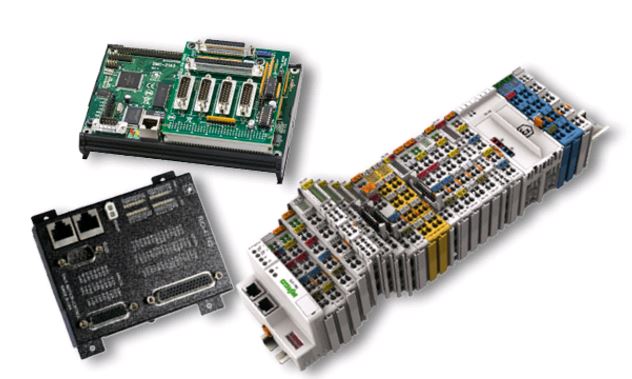
A motion and automation controller, or automatic controller, serves as the intelligence or brain of a motion control system. It is responsible for calculating and generating output commands for a desired movement path or trajectory.
Motion controllers vary in complexity. Complex motion controllers typically consist of a path generator (trajectory planner), interpolation, and a control loop to regulate a servo motor.
An industrial motion control system is one that manages the position, speed, force, or pressure of certain machines.
For example, an electromechanical motion control system includes the following components:
- Industrial motion controller (the brain of the system).
- Drive (which takes low-power command signals from the motion controller and converts them into high-power current/voltage for the motor).
- Motor (which converts electrical energy into mechanical energy).
- Feedback device (which sends signals back to the motion controller to adjust settings until the system produces the desired outcome).
- Mechanical system (including actuators that physically achieve the desired end result).

Motion and Automation Controller
Motion and Automation Controller – Open Loop vs Closed Loop
Open Loop Motion and Automation Controller System
An open-loop system is one that does not use feedback to verify the desired result or output. Most stepper motor systems operate in an open loop.
Closed Loop Motion and Automation Controller System
A closed-loop system utilizes feedback to confirm the desired result or output.
For example, a feedback device such as an encoder is typically used to provide position or speed information to a motion controller.
A servo motor system requires the use of a feedback device.
Motion and Automation Controller Topologies
PLC-based motion controllers typically use a digital output device, such as a counter module, housed within the PLC system to produce command signals for the motor drive.
They are usually selected when simple and cost-effective motion control is required, but are often limited to a few axes and have limited coordination capabilities.
Computer-Based Motion and Automation Controller
Typically consist of dedicated hardware operated by a real-time operating system.
They utilize standard computer buses such as PCI, Ethernet, Serial, USB, etc., for communication between the motion controller and the host system.
Computer-based controllers generate an analog output voltage command of ±10 volts for servo control and digital command signals, which are commonly referred to as step and direction for stepper control.
Computer-based motion controllers are usually employed when a high number of axes and/or intense coordination is required. Drawbacks of this topology include complex cabling and potentially long wiring distances between drive and motor.
Fieldbus-Based Motion Controller Topology
Consists of a communication interface device and one or more intelligent drives. The communication interface device is typically housed within a PLC or PC and connects to one or more intelligent drives.
These drives include all motion controller functionalities and act as a complete single-axis system. Often, drives can be daisy-chained to other intelligent drives within the same fieldbus.
Benefits include comprehensive digital communication, precision definition, reduced cabling, high number of axes, and short wiring distances between drive and motor.
This topology has higher costs, especially with fewer axes, and has limitations in achieving precise coordination for multiple axes.
Examples of this topology include Profibus, DeviceNet, RS-232/485, and others.
Asynchronous vs. Deterministic Topology
Asynchronous communication is the transmission of data, typically without utilizing an external clock signal, where data can be transferred intermittently rather than as a steady stream.
Asynchronous
Literally meaning "not simultaneous", this denotes that data is not sent at regular intervals. Thus, variable bit rates may occur, and the clock generator for the transmitter and receiver does not have to be perfectly synchronized at all times.
Deterministic communication refers to data that arrives at its destination at a specific and predictable time.
Critical data transmission must be guaranteed within short and precisely adjustable cycles. While non-critical data can be conveyed during asynchronous gaps.
Data arriving at guaranteed times is crucial for motion control.
Deterministic Bus-Based Motion Controller Topology
The deterministic bus-based motion controller topology distributes the operation of the motion controller across a communication interface device and intelligent drive(s) via a deterministic digital network.
The communication interface device is generally positioned within a PLC or PC and contains a path generator. Intelligent drives typically include control loops and interpolation, and can be connected in a daisy chain to other intelligent drives within the same network.
The deterministic digital network operates with low jitter to enable precise coordination in multi-axis applications.
This topology offers benefits including full digital communication, precise detection, reduced cabling, a high number of axes, precise coordination, and short wiring distances between drive and motor. However, this topology incurs higher costs, especially when dealing with fewer axes.
Examples of this topology include EtherCAT, SERCOS, Ethernet Powerlink, PROFINET IRT, SynqNet, CANopen, and others.


