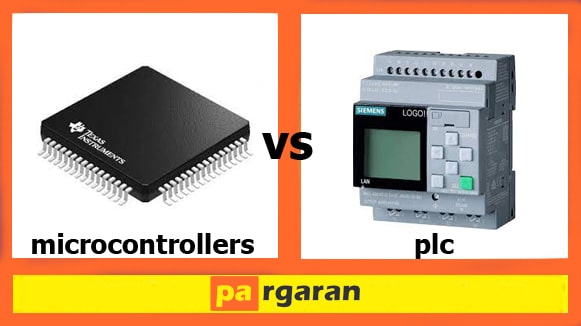
This article explores microcontrollers and PLCs in detail, examining their differences. If you want to better understand the selection between these two, be sure to read this article.
Introduction to Microcontrollers
As open-source electronic prototyping platforms like Arduino, BeagleBone, and Raspberry Pi continue to expand the realm of possibilities for digital devices and the development of interactive objects, there is greater interest in microcontrollers and the components related to them than ever before.
However, this industry is so nuanced that microcontrollers can easily be confused with their larger counterparts, programmable logic controllers (PLC). PLCs are fundamentally similar but are more robust in terms of capacity, offering numerous advantages and applications.
Today, we are examining the differences between microcontrollers and PLCs. We will explain what each system does and who utilizes them to help discern the unique features of each. Ready to learn more? Let’s get started!
What is a Microcontroller?
Let’s start from the smaller side of the equation. In short, a microcontroller is a computer. However, it differs from the laptop or personal computer you are accustomed to, even though all computers share the same features:
- A central processing unit (CPU)
- The ability to load programs (e.g., desktop computers load browsers from the hard drive)
- Random access memory (RAM) for storing variables
- Input and output devices to facilitate communication (such as keyboards, mice, printers, monitors)
A major difference? Those larger versions are "general-purpose computers.” They can run thousands of programs and are useful for various purposes. In contrast, a microcontroller is more specialized and performs one task well.
Features of a Microcontroller
Unsure if the device in question is a microcontroller or another type of computer? Let’s look at a few features that distinguish it:
Embedded
A microcontroller is embedded within another device. It helps control the actions or features of the device. For this reason, you may hear people refer to a microcontroller as an embedded microcontroller.
Dedicated to a Specific Task
Microcontrollers are dedicated to a specific task. They are designed to execute a particular program. Unlike RAM, this program resides in read-only memory (ROM), where it does not change.
Low Power
A general-purpose computer plugged into the wall consumes about 50 watts of power. A microcontroller consumes only about 50 milliwatts.
Dedicated Input/Output Device
A microcontroller typically has a dedicated input device and, in most cases, an output device (such as an LCD or LED display). Additionally, the microcontroller accepts inputs from the device it controls and sends signals to other components inside it to assist in that control.
For example, consider the microcontroller inside a television. It accepts input from the remote control and then displays output on the TV screen. Internally, it controls the speaker system, channel selector, and electronic components like brightness. Or consider the microwave. The oven controller accepts input from the keypad and displays output on the LCD screen. It also controls the relay that manages the microwave generator's power on/off.
Economic and Small
A microcontroller won’t break the bank. In most cases, users seek the smallest and most cost-effective unit that can get the job done.
Robust
Many microcontrollers can withstand high heat and harsher conditions than standard computers. For example, the microcontroller managing your car's engine must resist extreme temperatures ranging from below zero in Alaska to over 100 degrees Fahrenheit in Nevada. While this scenario requires a robust microcontroller, not all need this feature. For instance, the microcontroller embedded in a Blu-ray player doesn't require ruggedization.
Microcontrollers in Manufacturing
Because microcontrollers are very affordable and include a wide range of peripherals, their use has become mainstream. For years, their use focused on the maker world, including automation clubs and personal robotics makers.
However, as their functionality expands, manufacturers are also examining their use in industrial applications. Is this a wise move? Are these two the same? Next, let’s look at what distinguishes a PLC from a microcontroller.
What is a PLC?
Now that we have covered the fundamentals of a microcontroller, let’s compare it with a PLC. The simplest definition? A PLC is a larger-scale microcontroller. It is an industrial digital computer designed to facilitate tough and robust manufacturing processes.
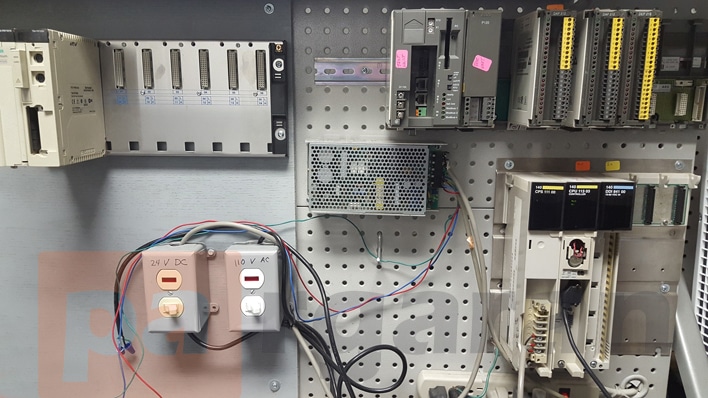
Its most common applications include:
Assembly Lines
Robotic devices and machine learning for any function requiring high reliability control or process fault detection.
How Does It Work?
A PLC accepts information from connected sensors and input devices. It processes that data and generates outputs based on preset parameters. Depending on the exact settings, a PLC can even monitor and log runtime data, such as machine line productivity or operational temperature.
Features of a PLC
What distinguishes a PLC from a microcontroller, a larger industrial PLC, or any other industrial control solution? Let’s take a look at some key features.
Input/Output
A PLC includes a CPU that stores and processes program data. However, it relies on input and output modules to connect to the rest of the device. These I/O modules send information to the CPU and generate specific results.
PLC I/O controls can be either analog or digital. Inputs may range from sensors and switches to variable meters, and outputs include relays, valves, drives, and lights. One advantage PLCs offer is that users can customize their I/O to meet their program configuration needs.
Human-Machine Interface
When humans want to interact with a PLC in real time, they rely on a Human-Machine Interface (HMI) to do so. These can vary in scale from a simple display with buttons and text to a smart touchscreen display similar to modern consumer electronics.
Communications
While I/O devices are a start, a PLC may also need to connect to various types of systems. For instance, a user may need to export logged program data from the PLC and send it to a Supervisory Control and Data Acquisition (SCADA) system. To facilitate this function, most PLCs have multiple ports and communication protocols to ensure the device can communicate with other systems.
Comparing Microcontrollers and PLCs: A Scenario
While there may be some applications where a microcontroller can perform a similar function to a PLC, users must...