Mechanical seals are used to control leakage from centrifugal pumps and mixers. They also separate the shaft chamber from the process fluid and reduce leakage to the surrounding environment. Before the invention of mechanical seals, packing was used to control the leakage of process fluid to the environment. However, the leakage rate of packing was very high, and if the packing was not properly maintained, it could lead to shaft wear and the destruction of the packing material.
This accelerates the leakage rate and causes the sealing to fail. The inherent problems associated with packing lead industries to seek a more reliable and efficient way to control process fluid leakage. These needs resulted in the invention of mechanical seals.
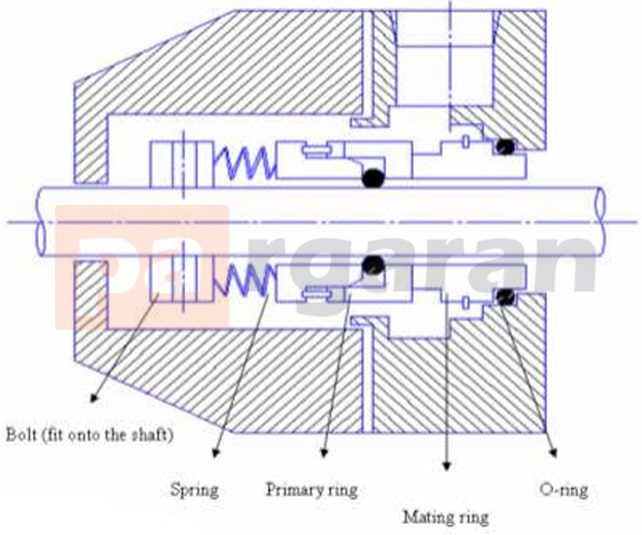
Figure 1: Components of mechanical seal (Somanji, 2004)
The introduction of mechanical seals for controlling process fluid leakage has made packings less desirable. When the amount of process fluid leakage from packing is compared to the leakage rate caused by mechanical sealing, packings become unacceptable. The ratio between the leakage amount of packing and mechanical seals is 800:1 (PPc pp1-3).
Furthermore, packing increases the required power compared to mechanical seals by a ratio of 6:1. With the limitations imposed by the Environmental Protection Agency (E.P.A.), the Occupational Safety and Health Administration (O.H.S.A.) on process industry plants and manufacturers, and the economic implications of process fluid wastage alongside downtime and worker safety, the development of a mechanical seal becomes advantageous compared to packing.
Thus, developing a mechanical seal that can effectively prevent leakage and has a longer lifespan becomes critically important.
What is a Mechanical Seal?
A seal is a device that has a mechanical load which uses rotating and stationary members, having edge surfaces that work in close proximity under hydraulic load, to minimize leakage between the rotating shaft and stationary housing (PPc pp 2-1).
Types of Seals
There are two distinct groups of seals, namely surface-guided seals and fixed clearance seals.
1) Surface-guided seals are those in which one of the sealing faces is flexibly mounted relative to the shaft or casing, and thus it is entirely supported and guided by the three sealing faces of the second seal, one of which is sliding relative to the other.
Surface-guided seals have common characteristics for bearings. The leakage gap is determined by the characteristics of the surfaces and the design of the seal.
In cases where lift is absent, the seal is termed contact seal, and when lift occurs during operation, they are termed non-contact. However, in both cases, under static conditions and zero pressure, all surface-guided seals contact each other (Lebeck, 1991).
2) Fixed clearance seals are seals that, by design, do not contact each other throughout the service life of the seal.
Fixed Clearance Mechanical Seals
-
Viscoseal:
The effectiveness of viscoseal depends on the viscosity of the fluid used for the sealing action and the gap. This seal uses the fluid itself for sealing against it or utilizes a separate fluid source. It may also be sealed against gas.

Figure 2: Viscoseal (Lebeck, 1991)
-
Labyrinth Seal:
This is a mechanical seal that is placed around a shaft to prevent oil or other liquid leakage. This seal consists of many direct threads which press tightly into another shaft or static hole, creating a very difficult pathway for the fluid to escape around.
Some designs feature threads that exist on both the outer and inner sides of the seal. These threads interconnect to create a characteristic long path that reduces leakage. However, for these seals to be effective on a rotating shaft, there must be a very small distance between the tip of the labyrinth threads and the running surface.
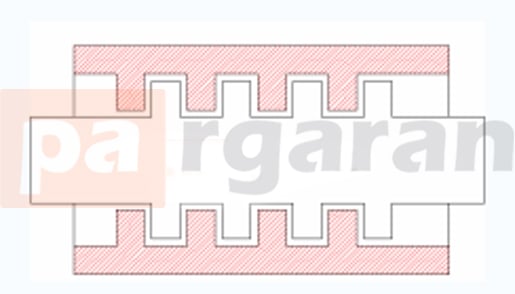
Figure 3: Labyrinth Seal
-
Bushing Seal:
These seals limit leakage while allowing limited lubricant flow speed along with pressure drop, the lubricant flows at a slight pressure higher than the sealing pressure. The flow area for this sealing is the gap between the bushing and the shaft.
Its effectiveness in reducing process fluid leakage is determined by its length and clearance. The clearance must be sufficiently large to allow for shaft rotation.
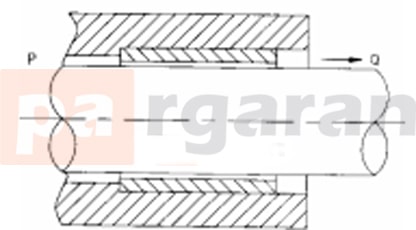
Figure 4: Bushing Seal (Lebeck, 1991)
-
Floating Ring Seal:
These seals are used in buffer gas assemblies to ensure that the mating surfaces never contact each other. The potential for excessive wear on the seal assembly is very low. This minimizes the chances of seal failure. However, due to the relatively large clearance required, floating ring seals exhibit a high leakage rate.
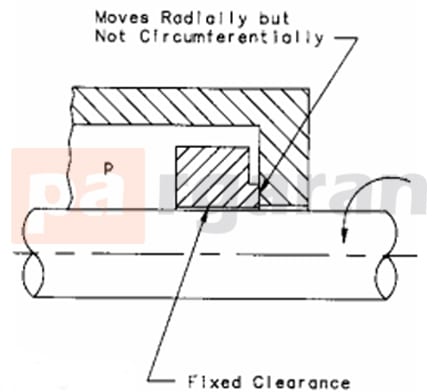
-
Magnetorheological Seal:
This seal uses the magnetic fluid response to an applied magnetic field to perform its sealing action. The main components of the seal include the magnetorheological fluid, a permanent magnet, two pole pieces, and a magnetically permeable shaft.
The magnetic circuit is completed when the fixed pole pieces and rotating shaft concentrate the magnetic flux under each pole piece in the radial gap. The fluid applied to this gap takes the shape of a liquid O-ring and creates a hermetic seal.

Figure 6: Magnetorheological Seal (Lebeck, 1991)
Surface-Guided Mechanical Seals
-
Lab Seal:
This seal has a flexible lip that creates contact over a small axial length on the shaft. This lip is worn to prevent leakage or contamination and other undesirable elements from reaching the shaft or casing. The lip of the seal must face the existing environment.
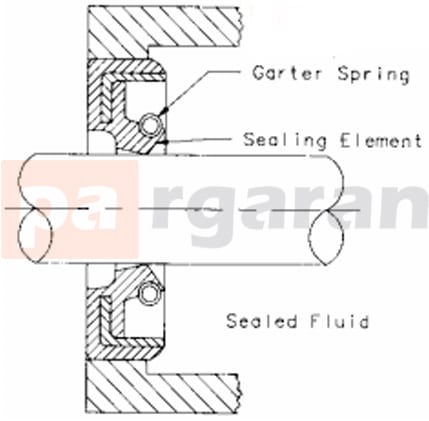
Figure 7: Lab Seal (Lebeck, 1991)
-
Seal...