A manometer is one of the most precise devices for measuring pressure in lower ranges. It is one of the oldest pressure measuring devices still in use today. It is an instrument for measuring pressure. A typical simple manometer consists of a U-shaped glass tube filled with a liquid. Typically, this liquid is mercury due to its high density.
As one of the first pressure measuring tools, due to its inherent accuracy and simplicity of operation, it is still widely used today. This U-tube manometer is a U-shaped glass tube partially filled with liquid.
This manometer has no moving parts and does not require calibration. Manometric measurements depend on gravity and liquid density, both physical properties that make the U-tube manometer a NIST standard for accuracy.

Since manometers are highly accurate, they are often used as calibration standards.
Manometers are both pressure measuring instruments and calibration standards. They range from simple U-tube and liquid-filled wells to portable digital instruments with computer interfaces.
When each base of the U-tube manometer is exposed to the atmosphere, the height of the liquid in the columns is equal. By using this point as a reference and connecting each base to an unknown pressure, the height difference in the columns indicates the difference in pressures.

Figure 1. When both bases of a U-tube manometer are open to the atmosphere or subjected to the same pressure, the liquid in each base maintains the same level, establishing a zero reference.
Figure 2. When more pressure is applied to the left side of the U-tube manometer, the liquid in the left leg drops and rises in the right leg. The liquid moves until the weight of the liquid column, as denoted by h, exactly balances the pressure.
The fundamental relationship for pressure expressed by a liquid column is:
Δp = P2-P1 = ρgh
Δp = differential pressure
P1 = pressure at low-pressure connection
P2 = pressure at high-pressure connection
ρ = density of the indicator fluid (at a specific temperature)
g = acceleration due to gravity (at a specific latitude and altitude)
h = height difference in the column
The resulting pressure is the difference between the forces applied over the unit area of the liquid columns, measured in pounds per square inch (PSI) or Newtons per square meter (Pascal). Manometers are often used to measure pressure, where the height difference in the column is also a common unit. This is expressed in inches or centimeters of water or mercury at a specific temperature which can be converted to standard pressure units with a conversion table.
All pressure measurements are differential. The reference may be absolute zero pressure (a total vacuum), atmospheric pressure (barometric pressure), or another pressure. With one base of the manometer open to the atmosphere (see Figure 3A), the measured pressure is the pressure above atmospheric pressure, which is 14.7 PSI, 101.3 kPa, or 76 centimeters of mercury at sea level.

Gauge pressure measures relative to atmospheric pressure and changes with barometric reading. Gauge pressure readings are positive when the unknown pressure exceeds the atmospheric pressure (A) and negative when the unknown pressure is less than atmospheric pressure (B).
We call this measurement gauge pressure, and positive pressure is expressed by:
- Absolute pressure = atmospheric pressure + positive gauge pressure
For negative pressure (vacuum) measurements, the column height reverses, and the relationship is expressed as follows:
- Absolute pressure = atmospheric pressure + negative gauge pressure

The graphical representation of positive and negative gauge pressure illustrates the differential aspect of all pressure measurements, where gauge pressure is the difference between absolute pressure and atmospheric pressure.
A manometer can be designed for direct measurement of absolute pressure. The manometer in Figure 5 measures pressure compared to absolute zero pressure at a sealed base above a mercury column. The most common form of this manometer is the traditional mercury barometer used to measure atmospheric pressure. With a single connection, this configuration can measure both higher pressures and sub-atmospheric pressures.

In a sealed tube manometer, the reference pressure is a vacuum or absolute zero pressure. The most common type of manometer is the traditional mercury barometer used to measure atmospheric pressure.
Variations in the U-Tube Manometer
Differential pressure is always the difference in height of the columns, regardless of the size or shape of the tubes, as shown in Figure A, where both bases of the manometers are open to the atmosphere and the indicating fluids are at the same level.
The same pressure connection applied to the left leg of each manometer causes a decrease in its level. Due to changes in volume at the bases of the manometer, the fluid in each column travels a different distance. However, the difference between the fluid levels in both manometers is the same B.

Pressure readings always reflect the difference in fluid height regardless of tube size. With both bases of the manometer open to the atmosphere, the fluid level is the same (A). With the same positive pressure applied to one base of each manometer, the fluid levels differ, but the distance between fluid heights remains the same.
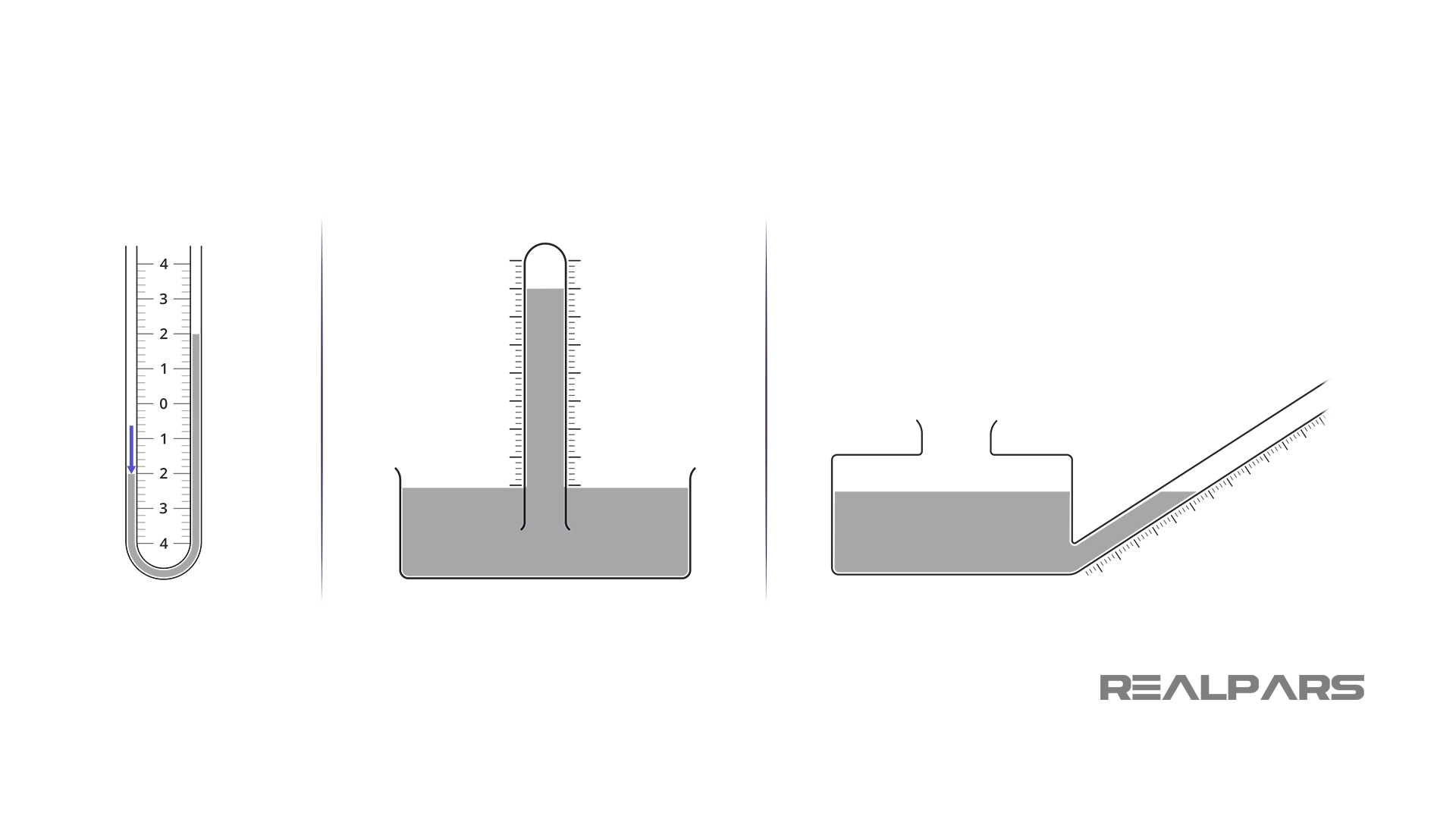
A common variation in the manometer type is the well (or tank) type. By applying pressure to the well, the level decreases slightly compared to the increase in level in the column. By compensating the scale graduations in the column to correct the well drop, a direct differential pressure reading can be made.
Compared to U-tube types, there are connection guidelines for well-type manometers:
Connect pressures above atmospheric to the well. Connect pressures below atmospheric to the tube.
For differential measurements, connect the higher pressure to the well.
For tall well manometers, the well connection can be used for gauge and vacuum measurements.
One variation of the well-type manometer is the inclined tube manometer (or tension gauge) shown in Figure 8. With an inclined indicating tube, one inch of vertical rise is stretched over several inches of scale length. The inclined tube manometer offers better sensitivity and resolution for low pressures.

In a well-type manometer, the cross-section is...