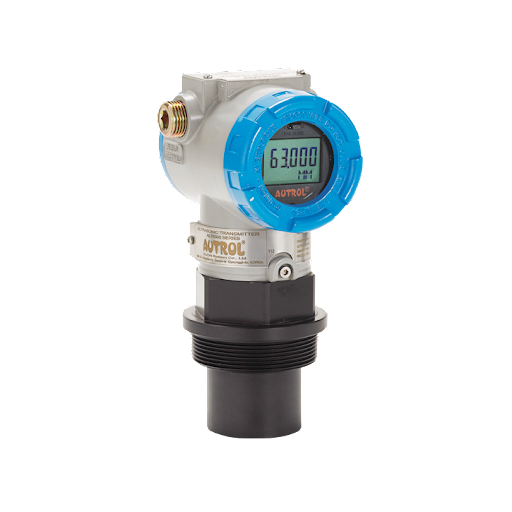
A level transmitter is a device that offers both contact and non-contact level measurement. The level transmitter consists of a sensor and an electronic transmitter.
It is used for continuous level measurement and point level detection in liquids and bulk solids. Liquid levels, slurries, bulk solids, or liquefied gases are often measured in tanks, silos, or moving containers.
Level transmitters have types such as magnetic, radar, guided wave, ultrasonic, differential pressure (DP), and hydrostatic. A differential pressure transmitter with a capillary and diaphragm is a more economical choice. The magnetic level transmitter is often used for measuring oil levels (diesel, fuel).
The level transmitter provides continuous level measurement with a sensor and electronic transmitter. Level transmitters can be used to determine the level of a specific liquid or solid at any given time.
Capacitive, radar, float, and ultrasonic are various types of available level transmitters.
Level measurement transmitters are used in numerous applications that require level measurement in containers or tanks. Ambient levels such as water, viscous liquids, and fuels or dry environments like bulk solids and powders can be measured using transmitters.
What are the types of level transmitters?
There are 7 main types of level transmitters that Pargaran strives to supply.
Each type of transmitter operates differently and is useful for various types of processes.
- Magnetic level transmitter
- Displacer level transmitter
- Ultrasonic level transmitter
- Hydrostatic level transmitter
- Radar level transmitter
- Capacitive level transmitter
- Capacitive type level transmitter
- Guided Wave Radar (GWR) level transmitter
- Differential Pressure (DP) level transmitter
What does a level transmitter do?
The level of liquid present in a container is referred to as the liquid level. Therefore, the device that measures the liquid level is called a liquid level transmitter.
A level transmitter is a type of level device. There are two types of level transmitters: continuous and point. Continuous level transmitters provide real-time monitoring of liquid height in a container.
The point type generally involves two points, high and low, triggering an alarm signal when the medium inside the container reaches either of these two points.
There is a wide range of liquid level transmitters.
Specific types include: magnetic flap liquid level gauge, tuning fork type, differential pressure type, ultrasonic type, magnetic float level gauge, magnetic flap, radar, etc.
Ambient levels such as water, viscous liquids, and fuels or dry environments like bulk solids and powders can be measured using transmitters.
Level measurement transmitters are utilized in countless applications requiring level measurement in containers or tanks.
These transmitters often find their application in material transport, food and beverage processing, power plants, chemical industries, and water treatment.
What is the working principle of a level transmitter?
Let’s take a closer look at how various types of level transmitters function.
Hydrostatic or pressure level transmitters
Submersible level transmitters require precise design and construction standards for long-lasting durability.
They are equipped with a ventilating cable to compensate for pressure changes.
They are suitable for immersion of up to 200 meters.
While moisture protection is crucial, many transmitters are also subjected to physical pressure and corrosive environments.
Including turbulence and corrosive chemicals. The durable stainless steel structure of the transmitters provides higher protection for long-term use.
While float transmitters are typically used in clean water applications.
They can also be used for maintaining tanks, lift stations, wet wells, chemical plants, and rivers.
Float transmitters are equally reliable for refineries and paint factories.
They may also be used with distillation equipment, filling equipment for flammable gases, and overfill protection systems.
Working principle of non-contact radar level sensors (unguided waves)
The antenna system for launching and receiving microwave energy is a very low and very short pulse.
Radar waves move at the speed of light.
Execution time can be converted to a signal through electronic components.
Measuring this method can achieve stable and accurate specific time increases quickly.
Even if the conditions are extremely complex, the presence of false echoes is processed using the latest technology and software debugs it. You can also analyze the echo level with precision.
The microwave antenna receives the reflected pulse and transmits it to the electronic circuit.
The microprocessor signals to identify the micropulse generated in the echo of the material level.
Echo detection is completed by the pulse system, with accuracy reaching millimeter level.
The distance of the material level between pulses D and T corresponds to travel time: D = C × T/2 where C is the speed of light as the air in the tank has a specific distance E, L: L = E-D. By adjusting the empty tank height E (= zero), full height F (= full scale) and some application parameters automatically create the measurement tool for the environment.
4 - 20 mA with the corresponding output.
What is a radar level transmitter?
Liquid level transmitter: Used for measuring liquid levels.
It converts the change in liquid level to the corresponding 4 ~ 20 mA current signal and transmits it to the control room for display and other operations.
Liquid level switch: Used for liquid level alarm or locking.
It pre-defines the value (for alarm or locking).
If the high level value is set at 80, when the liquid level reaches the specified value (i.e., 80), the digital signal output alarms or locks the signal source.
Radar level transmitter is a type of liquid level transmitter that operates on the principle of radar.
The radar level sensor, also known as radar level transmitter, indicates the liquid level.
It provides non-contact continuous level measurement in liquids and solids with free space radar sensors.
RADAR (Radio Detection and Ranging) is a device that can detect the existence of distant objects by obtaining a reflection of electromagnetic waves emitted from the device itself.
Though invented much earlier, widespread deployment of radar by Britain occurred during World War II to detect German bombers.
Radar level measurement is a reliable solution even under severe process conditions (pressure, temperature) and steam. Various antenna versions are available for any radar application.
In continuous non-contact level measurement with radar, the sensor sends microwave signals from above towards the medium. The level medium reflects the returned signals towards the sensor.
Using the received microwave signals, the sensor determines the distance to the product level and calculates its height.