


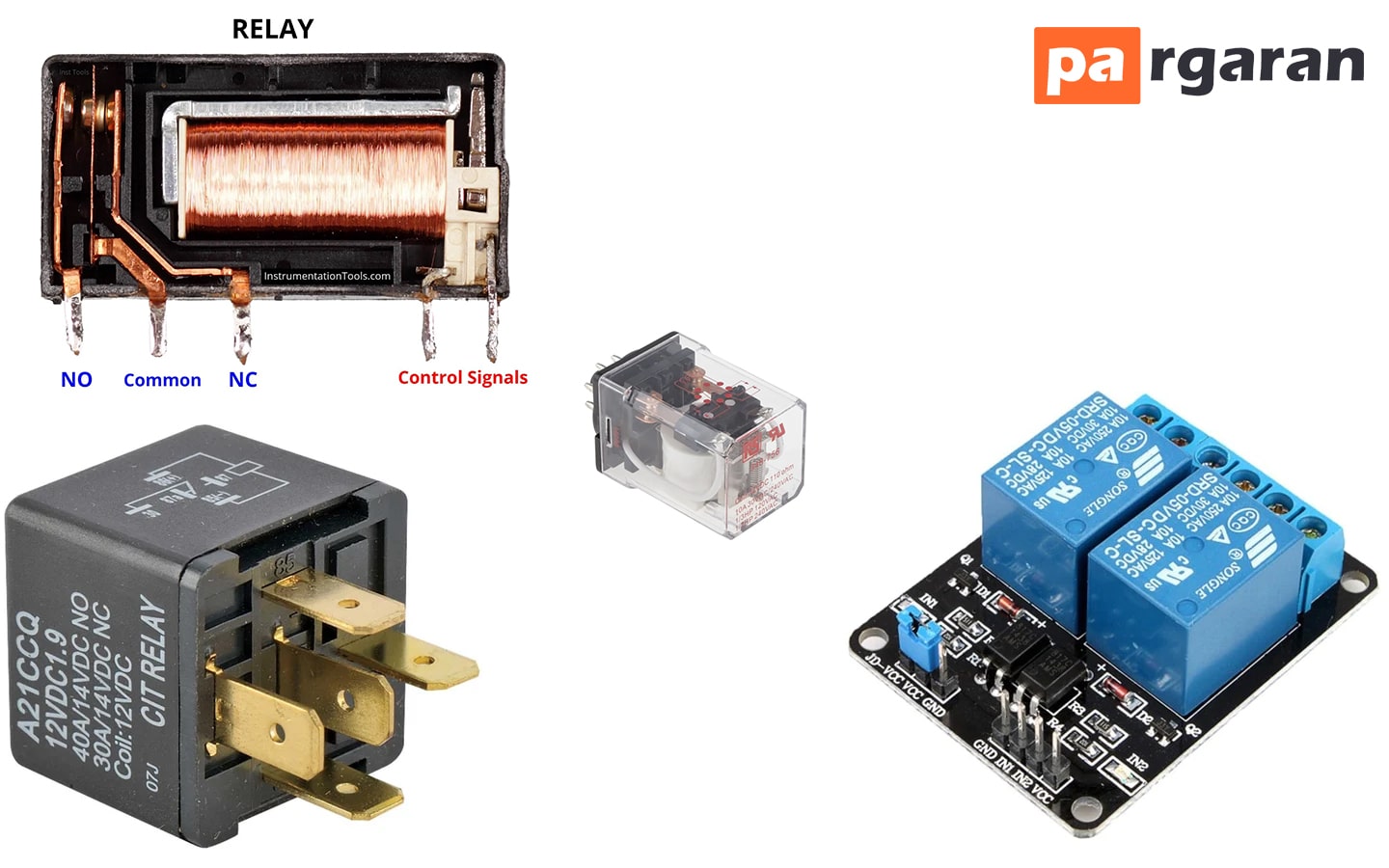
What is an Industrial Relay?
An industrial relay is a type of fast electromechanical switch that is activated by the flow of current through a coil, creating a magnetic field. As a result, relay activity can control and start high-current equipment with a weak control signal (very low electrical current).
At first glance, the function of a relay may seem similar to that of a contactor, but there are fundamental differences between the two. To better understand industrial relays, let's first look at the differences with contactors.
Difference Between Industrial Relay and Contactor
Relays are used in control circuits, while contactors are used in power circuits.
In other words, relays are used to amplify and protect the output current of control equipment such as PLC, DCS, etc., while contactors are used to reinforce the relay output signal in the control of power equipment such as capacitor banks, electric motors, lighting circuits, electric heaters, etc.
Based on the above explanations, a relay can be regarded as a kind of intermediary circuit.
Components of an Industrial Relay
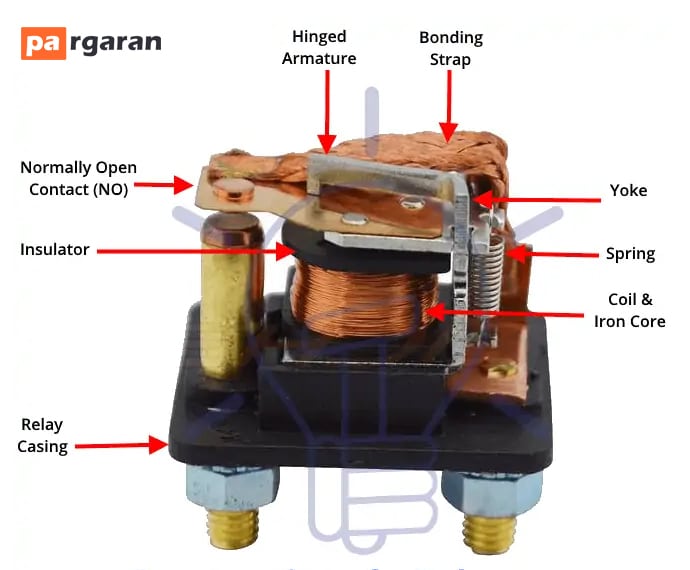
As mentioned, when electrical current passes through the coil and creates a magnetic field, the armature is activated; moving the contacts (opening or closing the current).
If the coil receives direct current, it is necessary to use a diode across the coil to dissipate the collapsing magnetic energy when deactivated. If a diode is not used, the voltage increase can become dangerous.
If the relay is controlling a large or reactive load, there is a possibility of dangerous voltage spikes, therefore a snubber circuit (capacitor and resistor in series) is used across the contacts to absorb the surge.
As you read, depending on the type and the conditions under which it is used, a relay can have varying components and parts. However, in a general schematic, the fixed components of a relay are as shown in the image below.
Types of Relays
Relays can be divided into two categories based on their operation:
- One-stage Relays: After power is removed, the relay returns to its original state.
- Latching Relays: Unlike one-stage relays, after power is removed, the relay remains in its activated state. A separate coil is used to return the relay to its original state.
Next, we will examine the types of relays:
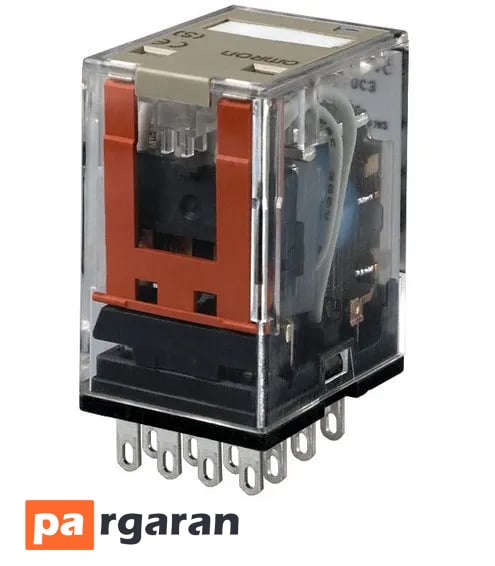
Industrial Relay
In industrial automation, protection systems, signaling, control systems, and electrical systems are utilized.
The features of industrial relays include:
- Number of contacts: 1 to 4
- Depending on the relay, the contact switch current can increase up to A48
- No voltage rise in various coil types
- Flagged types and manual test buttons
- Ability to latch open and closed contacts
- Mounting capabilities: on PCB, sockets and bases, 35mm rails
Auxiliary Relay
Also known as glass relays.
It is an electrical switch that performs the mechanical action of the switch using an electromagnet. It includes a coil and several normally open and closed command contacts.
These relays are used in the following cases:
- Controlling a circuit with low power signals
- Controlling multiple circuits with a single signal
Harmonic suppression, sparkless switching, and high switching capability are advantages of using glass relays.
These benefits have made glass relays a suitable option for applications in telephones, computers, and performing logical operations.
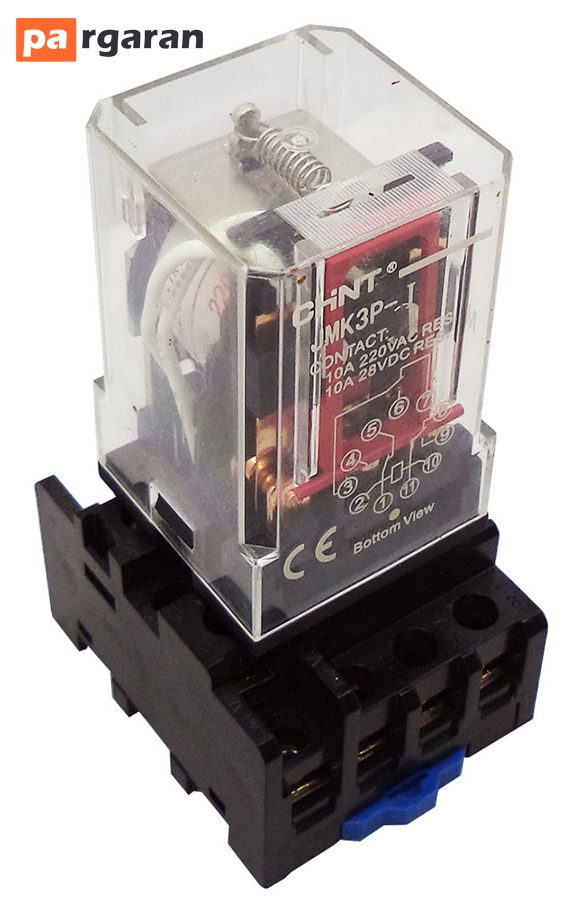
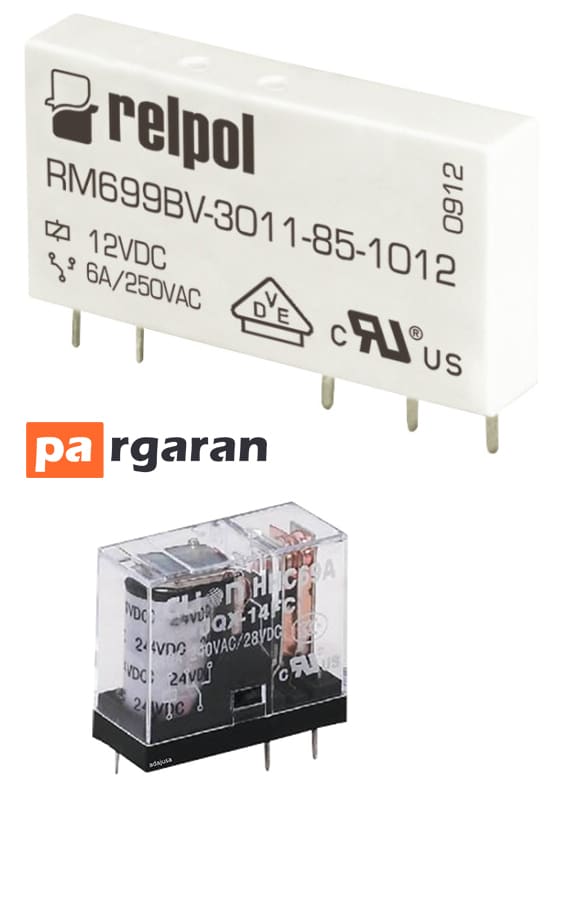
Miniature Relay
The prevalence and variety of miniature relays make them a suitable option for use in various systems. These relays can be used in: automation interfaces, alarm systems, staircase lighting control systems, electric power systems, emergency lighting control systems, home control systems, and food industry equipment, etc.
Features of miniature relays include:
- Wide range of AC and DC coil voltages
- High electrical insulation capability
- Mountable on SMT, PCB, and socket bases
- Depending on the type of relay, contact switch current can be increased up to A20
- Depending on the type of relay, height ranges from 10.5 to 26mm


