


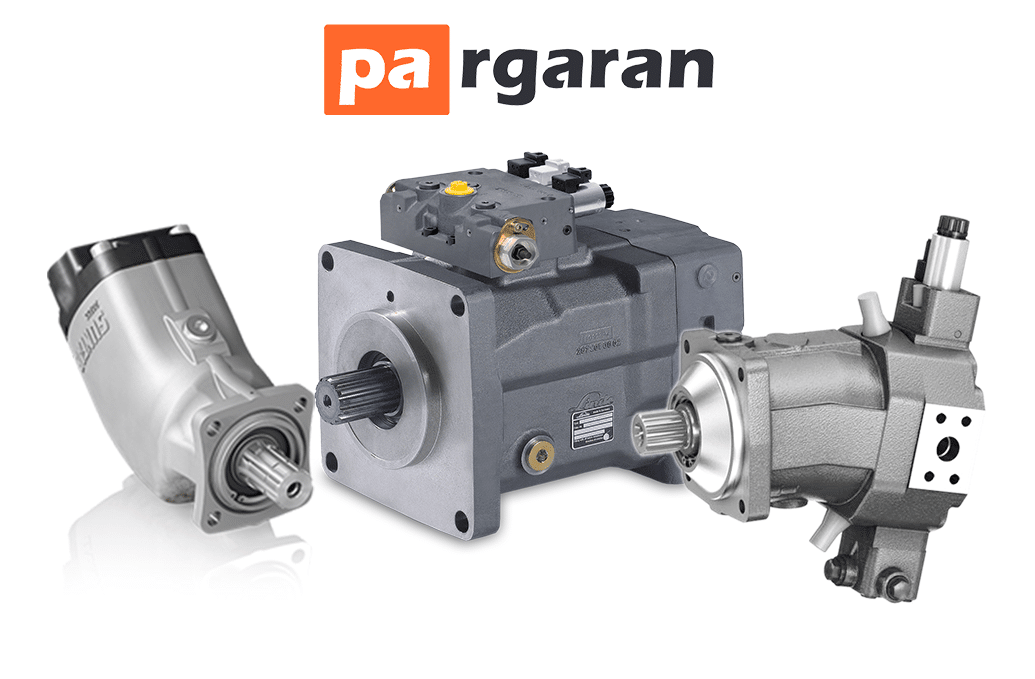
Hydraulic pumps are an essential component and the beating heart of some machinery and core equipment in an industry, used for carrying out extensive and complex tasks.
Contents:
- What is a hydraulic pump?
- Principles of operation and functionality of a hydraulic pump
- Components of this pump
- What are the types of hydraulic pumps?
- Applications of these pumps
What is a Hydraulic Pump?

If you have ever worked with construction, manufacturing, or industrial equipment, you have likely used some form of hydraulic pump.
This question may seem fundamental, but unfortunately, many people working in the industry do not know what a hydraulic pump is.
(In this article, we will provide a simple answer to this question and explain how hydraulic pumps function, so stay with Pargaràn.)
A hydraulic pump is a mechanical power source that transforms mechanical energy into hydraulic energy (hydrostatic energy, meaning flow and pressure). When a hydraulic pump operates, it executes two functions.
Firstly, its mechanical action creates a vacuum at the pump inlet, allowing atmospheric pressure to push the fluid from the reservoir into the pump's inlet line. Secondly, the pump's mechanical action delivers this fluid to the pump's outlet, directing it to the hydraulic system.
The pump generates the movement or flow of the fluid but does not create pressure. In fact, it generates the flow required to create pressure, which is a function of the resistance against fluid flow in the system.
For instance, the fluid pressure at the pump's outlet is zero for a pump that is not connected to a system.
Moreover, for a pump connected to a system, the pressure will only rise to the level necessary to overcome the load resistance.
Principles and Functionality of Hydraulic Pumps:
The functionality of a hydraulic pump is based on Pascal's law, which states that pressure applied to a fluid in a confined system is transmitted equally throughout the fluid in all directions.
In simple terms, a small force must overcome a significant load at the same pressure change.
This law can be mathematically expressed as:
∆P=ρg∆h
- P: Hydrostatic pressure, the pressure difference between two points
- ρ: Fluid density.
- g : Acceleration due to gravity.
- h: Height of the fluid above the measuring point.
Hydraulic pumps are driven manually, electrically, or by air/gas. Initial engines in heavy construction operations can also drive them. Hand hydraulic pumps typically come with single-speed or two-speed options. The two-speed option provides a high volume of fluid at low pressure to move the process forward before transitioning to low volume but high pressure, reducing cycle time for the operator.
The driving force creates pressure against the load on the system. The pressure continues to rise as long as it is sufficient to overcome the load. Unlike conventional pumps, without a load, a hydraulic pump does not generate pressure and will not operate.
Hydraulic pumps utilize an incompressible fluid, which is usually derivatives of petroleum oil and additives as the working fluid.
The oil may be fire-resistant or, in food processing plants, food-grade oil or water may be used for safety. They typically must have lubricating properties for the pump's components because they carry wear materials and operate hundreds of hours at high temperatures.
Hydraulic pumps transport oil or any other fluid from the reservoir to other parts of the system. The operation of a hydraulic pump is based on the principle of displacement (any object that is fully or partially immersed in a fluid is buoyed up by a force equal to the weight of the fluid displaced by the submerged object).
Both the inlet and outlet of the hydraulic pump have different valves. A return valve located at the inlet forces the fluid from the reservoir into the pump, and a valve at the outlet pumps the fluid to other parts of the system.
The vacuum pushes fluid into the pump's inlet. An electric motor, engine, or gas serves as the main actuator for rotating the shaft. The impeller blades are mounted on the shaft, and fluids surrounding them rotate as the shaft moves.
When the piston is drawn in, a vacuum is created inside the cylinder. The vacuum closes the output check valve and opens the inlet inspection valve. The fluid then enters the pump from the reservoir and partially fills the cylinder.
When the piston is driven out, the fluid molecules come closer together, closing the inlet check valve. This action opens the output check valve, allowing the fluid to pass through.
Components and Parts:
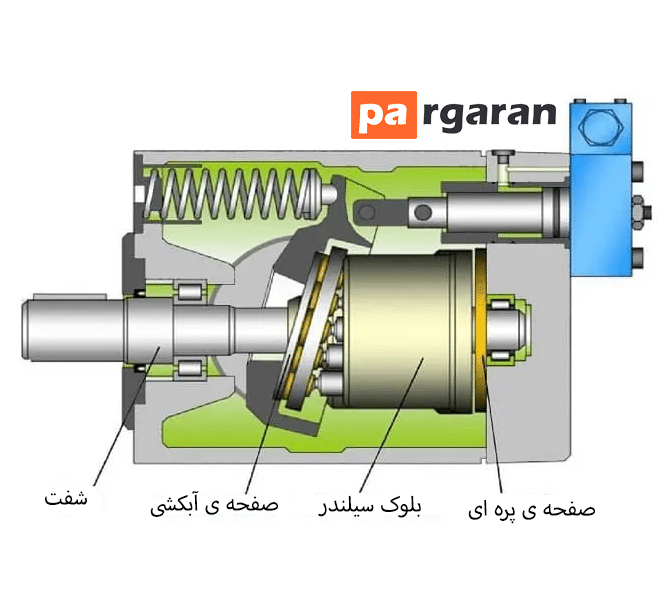
- Pump housing
- Impeller blades
- Pump shaft
- Bearing assembly
- Seals
Hydraulic pumps are utilized to provide energy to fluids to flow from lower to higher potential and consist of several mechanical moving components that receive energy from any other source.
Most hydraulic pumps have rotating components powered by an electrical source.
The main components used in hydraulic pumps are as follows:
Pump Housing:
This outer part of the hydraulic pump protects the internal components. Smaller pumps are made from aluminum, while others use cast iron.
Impeller Blades:
The impeller blades rotate within the pump housing. The rotation of the impeller blades turns the surrounding fluids, causing the fluid to flow at a higher potential. They also play an essential role in lubricating and cooling the system.
Pump Shaft:
The pump shaft is used to mount the impeller. Steel or stainless steel is used for making the shaft, and its size depends on the impeller.
Bearing Assembly:
The bearings assist in the continuous rotation of the impeller. Most centrifugal pumps use standard anti-friction ball bearings.
Seals:
Most pumps fail due to damage to the bearing assemblies. Seals protect the bearing assemblies from contaminants and coolants, greatly reducing the risk of failure.
Types of Hydraulic Pumps:
These pumps are produced based on different performance needs and hydraulic system requirements, such as operating environment, pressure range required, type of actuator, etc.
A wide range of principles and types of operation with diverse characteristics exist in hydraulic pumps.
As a result, no single pump can fully meet all the ensemble requirements to an optimal level.
The most common types of hydraulic pumps include:
- Gear Pumps
- Piston Pumps
- Vane Pumps
- Clutch Pumps
- Dump Pumps
Gear Hydraulic Pumps
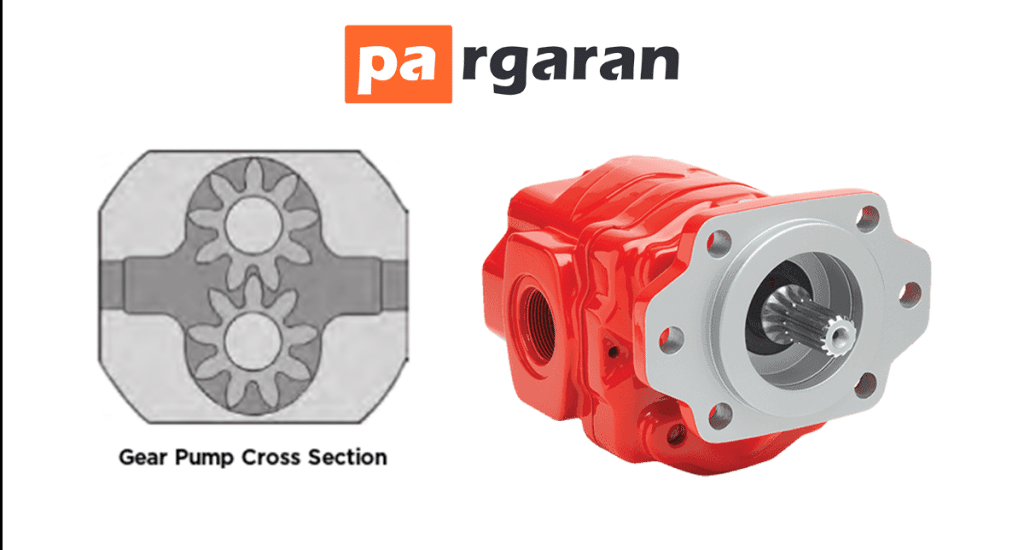
The most commonly used and relatively inexpensive pumps in the industry are gear pumps.
These pumps have fewer moving parts, service more effectively...


