


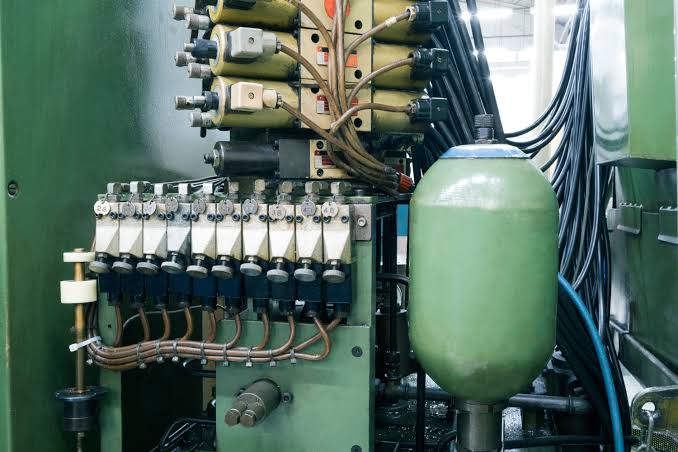
You may be familiar with most hydraulic components such as pumps, valves, motors, and actuators, but there is another very important component known as "hydraulic accumulator | hydraulic accumulators". As the name suggests, an accumulator is a container that stores, maintains, and recovers pressure.
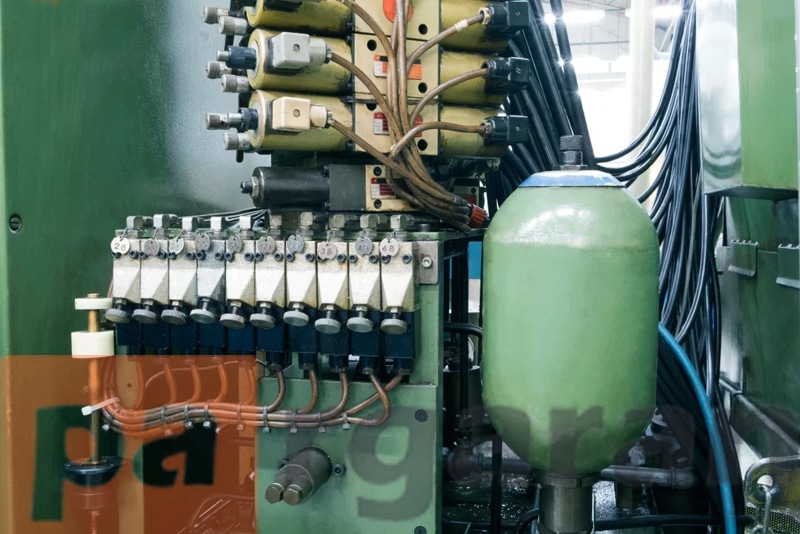
A hydraulic accumulator located within a fluid system.
What is a Hydraulic Accumulator | hydraulic accumulators ?
As we have learned in science class, when the volume of the filler material in a container is reduced, the empty space must be filled with air. In an accumulator, compressed gas is used to occupy the empty space.
However, we do not want the gas to mix with the hydraulic fluid. Therefore, there is usually a bladder inside the accumulator that separates the hydraulic fluid from the compressed gas.
Essentially, an accumulator is a container containing a bladder and gas. Thus, when the bladder fills with pressurized hydraulic fluid, the gas inside the container is compressed. When the fluid in the accumulator is released, the compressed gas pushes the fluid out.
The accumulator is precharged, meaning that a minimum pressure is required for fluid to flow into it. This precharging can be achieved through a spring, gas, or weight.
An accumulator can be compared to a battery or capacitor. It stores energy, but why do we want to store pressurized hydraulic fluid?
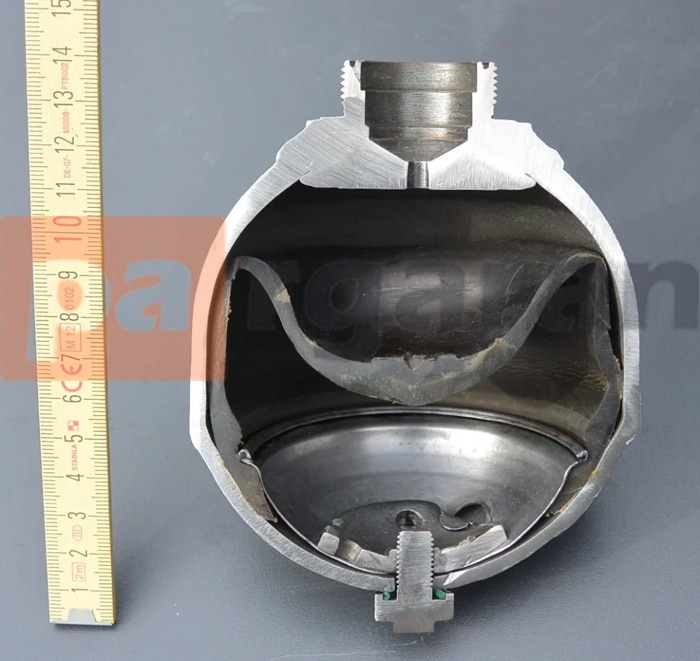
Cross-sectional view of an accumulator showing the flexible diaphragm and pressure chamber below (the fluid inlet/outlet port above)
Storing Pressurized Hydraulic Fluid
There are several reasons for wanting to store pressurized hydraulic fluid, similar to the reasons for storing electrical energy.
Mitigating Pulsating Fluid Systems with Hydraulic Accumulators
One reason is systems that may have pulsations in the hydraulic fluid. I once worked on a device that tested diesel fuel injectors.
As the injector fires the fluid, the pressure behind the injector drops slightly. Similar to rapidly opening and closing a water valve at the high speed of the injector, the system sensors beep and fluctuate their readings.
Since this is a test device, accuracy in pressure readings was very important, and the injectors required a stable pressure source.
By adding an accumulator, the system no longer had to rely on the pump to compensate for the pressure drop caused by the injector. The accumulator was able to quickly replace the lost pressure from the injector, which the sensor barely detected the change in pressure.
Compensating for Pressure Drops in Actuators
Similarly, the second reason for the importance of accumulators is for hydraulic motion control systems where actuators expand at very high speeds.
As the actuator increases in volume, the pressure in the system decreases because the pump cannot supply an infinite flow rate. This leads to a reduction in the system's response speed, which is unacceptable for many systems.
The accumulator provides flow capacity to maintain the system pressure, resulting in a much more reliable system response.
Allowing for Thermal Expansion
Another reason allows for fluid expansion. Some hydraulic systems operate in remote, hazardous locations. They may become very hot, and the process of pressurizing hydraulic fluid also raises the fluid temperature.
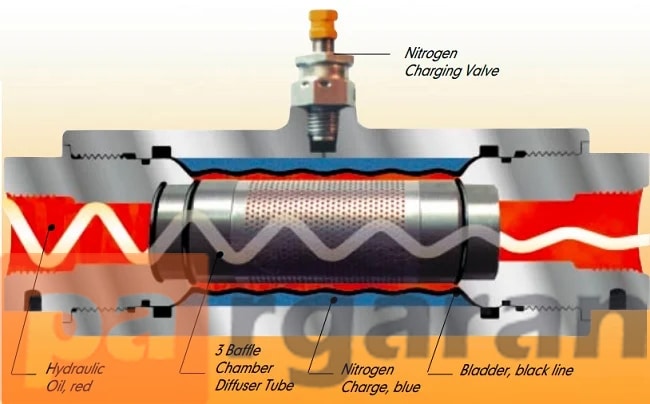
An internal rendering of a noise suppressor to reduce shock and vibration noise using the same concept of an inert gas-filled chamber as a standard battery
Where are Accumulators Located?
The location of the accumulator can vary based on its function. For example, an accumulator used for emergency energy storage might be placed off the path of the rest of the system and only pressurized once.
In emergencies or pump failures, the accumulator can come into play and help maintain pressure in the system.
Likewise, a common pressure tank within a residential water system is a form of an accumulator.
But instead of operating in emergencies, it simply allows the pump to operate in a less frequent cycle, rather than running constantly whenever water is needed.
If you want to reduce pulsations and lessen pump noise, you might consider placing the accumulator very close to the pump outlet.
All fluid always flows through the accumulator and reduces the vibrations produced by the pump. Since the accumulator stores energy, you will want to keep the battery on the high-pressure side of the system.
A piston-style accumulator is placed close to devices that create pulsing effects.
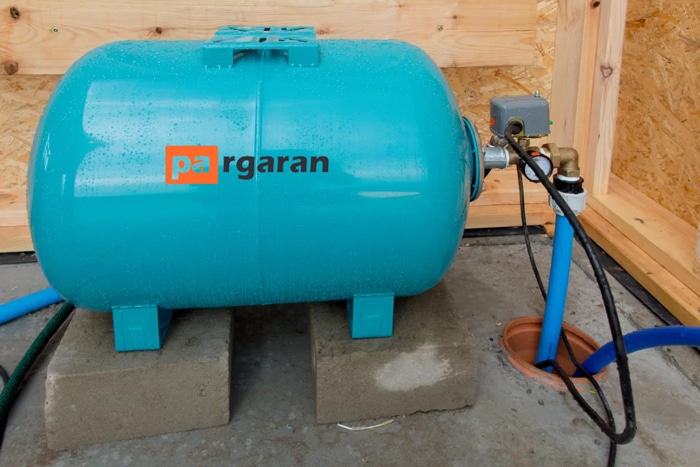
A pressurized water storage tank with a rechargable gas chamber inside, to maintain constant water pressure in a whole house system.
Maintenance of Hydraulic Battery
Accumulators, depending on the style of accumulator you have, are basic devices with minimal moving parts.


