Displacer Level Sensor uses Archimedes' principle to detect liquid levels by continuously measuring the weight of a displacer rod immersed in the process liquid.
The displacer is cylindrical in shape with a constant cross-section and can be elongated or shortened as necessary. Its standard height varies from 14 inches to 120 inches.
As the liquid level rises, the displacer experiences increased buoyancy, making it appear lighter to the measuring instrument, which interprets the decrease in weight as an increase in level and transmits an output signal proportional to it.
Conversely, as the liquid level decreases, the buoyancy force on the displacer reduces with the corresponding increase in weight, which is interpreted by the level sensor as a decrease in level, and subsequently provides the corresponding output signal.
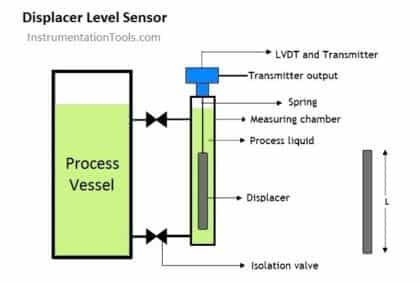
Below is a typical installation of a displacer level sensor:
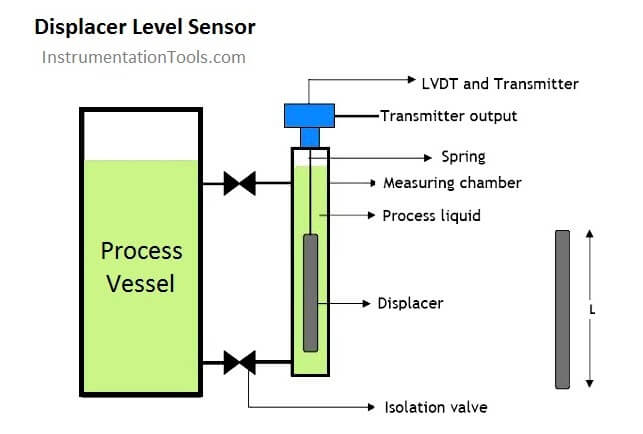
Although the theoretical principle of operation is mentioned above, in a practical displacer level sensor, the structure is engineered with complex electronic circuits to achieve the desired measurement objective.
In these types of displacer level sensors, the displacer is connected to a spring that limits its movement for every increase in buoyancy (i.e., level change).
A transmitter equipped with a Linear Variable Differential Transformer (LVDT) is used to track the up and down movement of the displacer as the liquid level changes. Complex electronics are then used to process the voltage signal from the LVDT to an output signal of 4-20 mA.
Archimedes' principle is applied to the displacer.
According to Archimedes' principle, the buoyancy force on an immersed object is always equal to the weight of the volume of fluid displaced by the object.
Suppose in a displacer level sensor, we have a displacer rod with density, ρ, radius, r, length, L, and the process fluid density, U. In this installation, the length of the displacer is proportional to the liquid level being measured:
The volume of the displacer, V=πr2L
In the diagram of a displacer level sensor installation above, when the vessel is full, the displacer is fully immersed in the process fluid, thus the volume of the process fluid displaced is V=πr2L. When the vessel level is empty or minimal, the volume of the process fluid displaced is V = 0.
Therefore:
When the vessel is full, the buoyancy force on the displacer is given by:
Buoyancy force = Weight of displaced process fluid
= πr2LУg (g = acceleration due to gravity)
Actual weight of the displacer = πr2Lρg
The net weight of the displacer as sensed by the LVDT, transmitter, and corresponding electronics when the vessel is full:
= πr2Lρg−πr2LУg=πr2Lg(ρ–У )=Vg(ρ–У)
As seen above, the net apparent weight sensed by the LVDT is proportional to the density difference between the displacer (ρ) and the process fluid (У).
Therefore, the displacer must have a higher specific gravity compared to the liquid level being measured and should be calibrated for the specific gravity of the liquid.
The typical specific gravity range for liquids where the displacer level sensor is applied is between 0.25 to 1.5. Another point worth mentioning is that the range of the displacer level instrument depends solely on the length (L) of the specific displacer rod designated for the particular application.
When the vessel is empty or the level is minimal,
Buoyancy force on the displacer = 0
Thus, the weight apparent to the LVDT =πr2Lρg
is
The LVDT registers a voltage signal at the minimum level of the tank and outputs the corresponding signal. The length of the displacer, with a defined operating range, specific gravity, pressure, and temperature of the process fluid, is determined. The diameter and weight are calculated to ensure proper operation and provide an accurate 4-20 mA output at the plant.
Applications of the Displacer Level Sensor
Displacer level sensors are used in level measurement applications such as surge pots, condensate drums, separators, flash tanks, storage tanks, and receiver tanks.
For any inquiries or comments, please contact Pargaran.
For more information, click here.