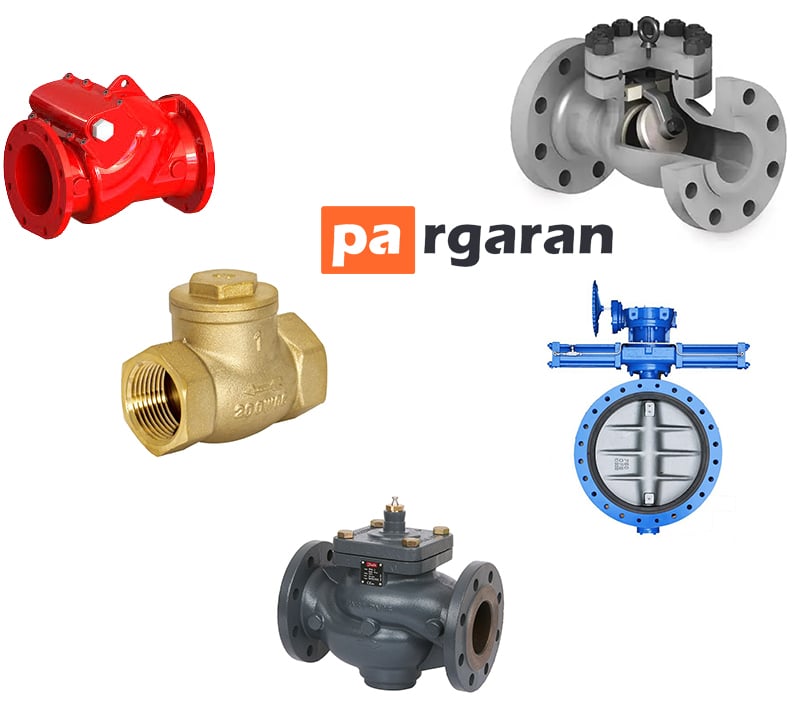
A check valve, also referred to as a non-return valve, one-way valve, NRV, or automatic valve, refers to valves . that allow fluid flow in one direction only.
In these valves, the fluid flows through the valve from one side only, while return flow in the opposite direction is not permissible. Typically, in some industrial piping systems, a one-way valve is used alongside gate valves to control fluid flow at low pressure without the need for an operator.
Check valves can be categorized into three types: hinged or swing, wafer, and poppet.
Swing check valves have a disk that pivots vertically around a pin to the body. With fluid pressure, the disk moves upward to 180 degrees in the direction of the inlet, allowing fluid passage. Subsequently, as fluid pressure drops . and the flow direction changes, the disk falls back, preventing reverse flow.
Turbulence and disturbance in swing check valves are minimal and are generally utilized in piping designs combined with gate valves and automatic or one-way swing valves .. These valves can be installed both horizontally and vertically.
It is recommended not to use this type of valve in lines where the fluid is turbulent and may generate shocks (water hammer) that could damage the disk and valve components.
.
A swing type wafer check valve functions similarly to a standard disc check valve, with the only difference being the type of body and connection method. These valves have a shorter body compared to traditional disc valves, making their installation and connection in pipelines . flange-based rather than bolted, as is the case with traditional disc valves.
In building systems, due to space constraints, swing wafer check valves are preferred. The disk operates with a 90-degree or semi-pivoting motion, allowing fluid to pass through when the valve is open. In the open position, its pressure drop is less compared to other configurations like butterfly valves.
Advantages of swing wafer check valves include lightweight design, compact dimensions, metal-to-metal sealing in the seat design, and easy maintenance due to fewer components.
Poppet or poppet check valves consist of a disk and a spring. In these valves, the disk is connected horizontally to the valve's top via the spring. When the fluid pressure reaches the required level, the spring compresses, allowing the disk to move upwards and fluid to pass through.
Types of Check Valves by Performance
Hinged disk, rising disk, ball type, axial or wafer disk, inclined disk (check valve with angled disk), disc type, double disc, weighted, spring-loaded stainless steel, non-slam, high pressure, forged, brass (poppet or spring-loaded, mesh poppet, disc)
Applications of Check Valves
One-way valves are typically used after various water pumps. Feed pumps or injectors supplying steam boiler water use one-way valves to prevent backflow. One-way valves are also utilized in pumps that supply water for slips.
In aircraft and aerospace applications where vibrations, temperatures, and corrosive liquids are significant, return check valves are employed. For example, spacecraft and launch rockets use them in Reaction Control Systems (RCS), Attitude Control Systems (ACS), and aircraft hydraulic systems.
Check valves are also commonly applied where different gases mix and culminate into a gas flow. A one-way valve is installed on each unique gas flow to prevent gas mixture reverting to the original state. For instance, a fuel and oxidizer combination ensures that the primary gas cylinder remains pure and non-combustible.
One-way valves or check valves are used in domestic heating systems to prevent vertical transfer, particularly in conjunction with solar thermal installations, also referred to as gravity brakes.
Rainwater harvesting systems, which are part of the main water supply, may require one or more one-way valves to prevent contamination of the primary water supply by rainwater. Hydraulic jacks also utilize one-way valves to create pressure on lift jacks.
I hope you enjoyed reading the article (Hydraulic Motor | Hydraulic motor).
For any questions or suggestions, please contact Pargarān.