Butterfly Valve | What is a Butterfly Valve?
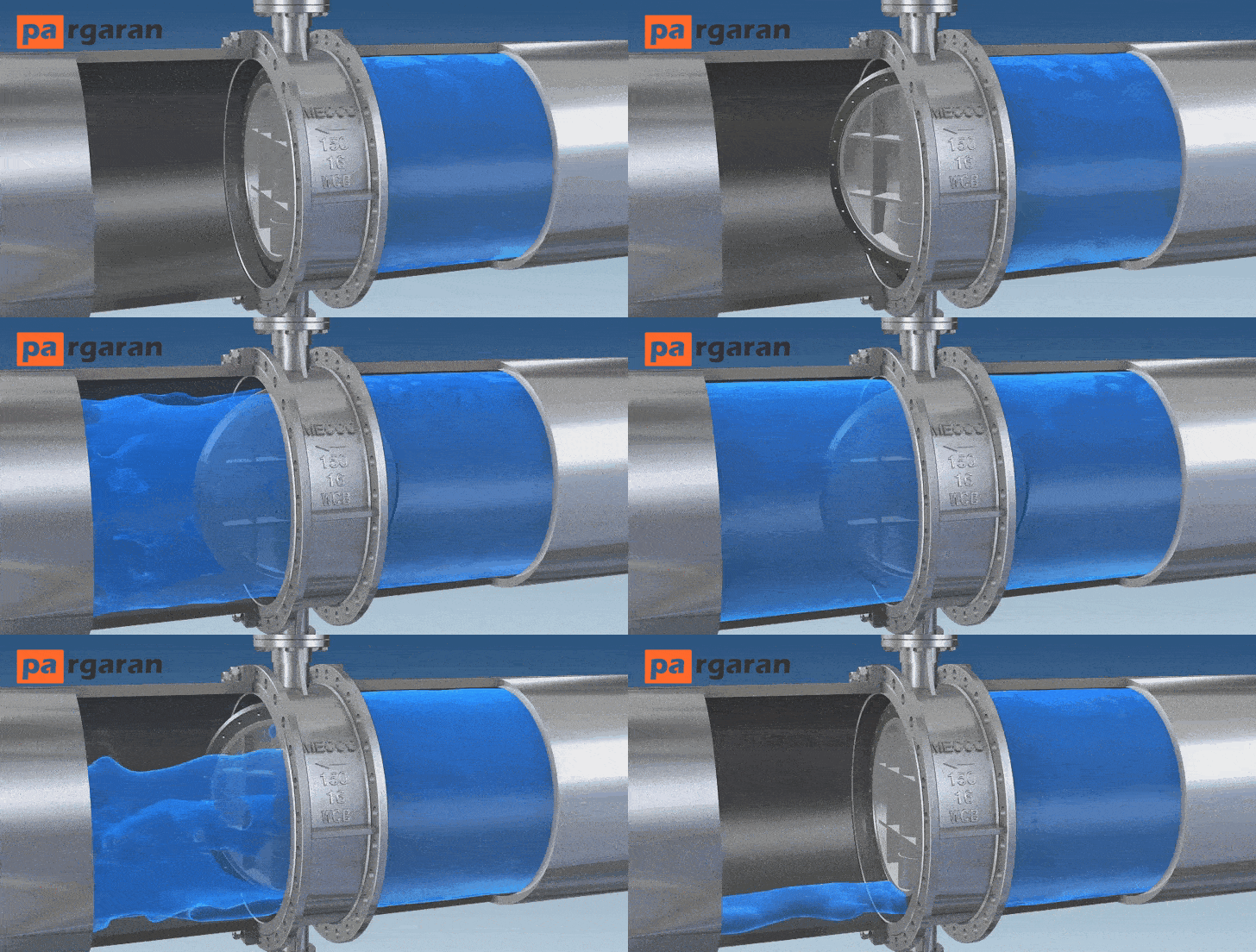
A Butterfly Valve is used for flow control with a rotational movement of up to 90 degrees.
Flow stopping, starting, and adjusting occurs with the rotational movement of rectangular or circular discs inside this valve.
The quarter turn of the valve's blocking element increases flow adjustment speed. Butterfly valves are often used in systems that do not require frequent stopping and starting of the flow.
The actuator of a butterfly valve larger than 8 inches has a gearbox that connects the handle to the stem, transmitting force more quickly between the handle and stem, thus reducing the speed required for flow adjustment.
Features of Butterfly Valves:
Lightweight, easy control, increased fluid speed when fully opening the blocking element, and high responsiveness are characteristics of butterfly valves. The opening and closing speed of the disc (blocking element) depends on its actuator type.
For high speeds, a solenoid or pneumatic actuator can be used. Additionally, to control fluid in conjunction with the pneumatic actuator, a switch box and solenoid valve along with a PLC are needed.
In this case, the opening and closing speed of the disc is faster than using a solenoid actuator alone. There are many similarities between butterfly valves and ball valves, but the main difference between the two types of valves is in the opening and closing operation.
The opening and closing of the butterfly valve disc occurs gradually, causing a pressure drop in the flow, whereas in a ball valve, the ball-shaped disc opens and closes quickly, resulting in much less pressure drop in the fluid flow.
The bidirectional nature of the butterfly valve installation allows it to be positioned without selecting a specific direction. The butterfly valve's resistance to extreme temperatures and corrosives ensures its sealing under various conditions.
When the blocking element is closed during installation, it causes the disc to face the seat, which leads to difficulties in opening the element.
A butterfly valve consists of many fixed and variable components based on its model and required application.
In the figure below, you can see the components of a simple flanged butterfly valve.

Butterfly valves are classified as follows based on connection type, the axis offset of the disc relative to the stem axis, and the type of actuator:

Types of Butterfly Valves Based on Actuator
Lever (Manual-Clutch)
Functionality: The two main components of the lever actuator are a simple handle and a movable handle. By pushing the lower movable handle up, the shaft connected to the disc can be rotated to open the disc; to close the disc, the operation is done in reverse.
Advantages: Easy to use and maintain, no power source required.
Disadvantages: Only for butterfly valves smaller than 8 inches, always requires an operator.
With Gearbox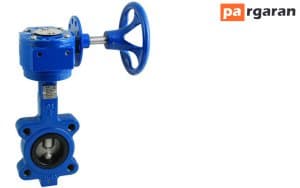
There are three types:
1: Worm gear transmits power to the shaft and disc.
2: Gearbox with a screw and gear transmits power to the shaft and disc.
3: If needed, the rotary handle can be replaced with an automated motor for automatic operation.
Advantages: Easy to use, easy maintenance.
Disadvantages: Slow speed where quick flow cut-off is required, unsuitable for large flows.
Pneumatic (Air)
There are two types:
First type: On/Off; the air compressor with compressed air automatically starts or stops the flow at high speed.
Second type: Gradual; the air compressor with compressed air automatically starts or stops the flow gradually and at a slower speed compared to the first type.
Advantages: High speed, automatic.
Disadvantages: Difficult to repair.
Electric
First type: On/Off; they only have the capability to cut off and turn on the flow.
Second type: The amount of opening and closing of the disc for fluid passage can be controlled to a desired level.
Advantages: Eliminates the need for an operator.
Disadvantages: High energy consumption, lower operating speed compared to pneumatic actuators.
Use of Pneumatic Actuator and Electric Valve
By installing a 5 to 2 electric valve on the pneumatic actuator and executing the PLC signal, commands to open and close the disc are applied.
Advantages: Fastest operation, with the installation of a switch box device, the open or closed status of the disc can be monitored.
Disadvantages: High energy consumption.
Butterfly Valve based on Connection Type
Wafer
It is placed between two flanges in the pipe, is flangeless, and is connected to flange pipes with bolts and nuts.
Disadvantages: Not suitable for sizes larger than 12 inches, not applicable in high-pressure flow lines.
Log
Connected with bolts and nuts between two flange pipes, it has more connection holes compared to the wafer type.
Used at the end of the pipeline.
Advantages: Withstands higher pressure compared to the wafer type, resistant to vibrations, lightweight and compact, and lower repair costs for the disc compared to other models. No additional support required.
Disadvantages: This model can cause flow choking.
Flanged
Connected with two flanges to the piping flanges and used for high-pressure flows.
Advantages: Better sealing compared to log and wafer connections, used in high-pressure flow lines.
Welded
Connections directly to the pipeline with welding for high-pressure flows.
Advantages: Low pressure drop in the flow path.
Disadvantages: Difficult and costly repairs.
Butterfly Valve Based on the Axis Offset of the Disc Relative to the Stem Axis
Without Offset (Concentric) Zero Offset (Single Offset)
The axis of the disc, shaft, and valve body are concentric. When the valve is fully open, the flow is divided into two equal halves. The operation of opening and closing the valve creates friction between the disc and seat, which is a disadvantage of this axis type.
Used in systems with low temperature and pressure.
Double Offset
The disc has an offset relative to the central axis of the shaft and body, enhancing sealing. The friction between the disc and seat occurs only in certain positions in the open and closed cycles, reducing sealing wear.