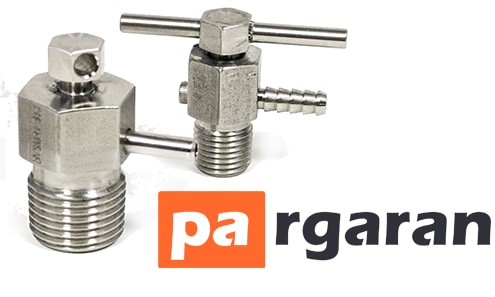
Bleed Valve | Air Vent Valve | A bleed valve is a type of pneumatic valve used for releasing trapped air in pipelines.
The bleed valve has two main functions in pipeline systems.
- It releases the accumulated air in the pipelines that is under pressure, which occurs when the bubble and gas cavities exceed the energy required to transfer the bubble with the fluid flow. The bleed valve is used to vent air from within the pipelines.
- It returns air to the system when the pressure inside the pipe is low.
Types of Bleed Valves include:
- Single Orifice Bleed Valve (large or small orifice)
- Double Orifice Bleed Valve (manufactured by Mirab)
- Disc Bleed Valve (manufactured by Mirab)
1- Small Single Orifice Bleed Valves
These valves are used to expel air present in the pipeline and are usually installed at points in the system where air accumulation is possible. The air outlet cross-section in these valves does not exceed a few square millimeters.
Their operational mechanism consists of a small float that floats at a certain volume in water and keeps the water passage cross-section closed. When air penetrates into the floating buoy chamber, it moves downwards and opens the orifice.
The diameter of the orifice in these valves is usually less than 10 millimeters. After the air is expelled, the buoy rises again to close the orifice. The float material can be made of stainless steel with a rubber coating, plastic materials like polyethylene, etc.
- Large Single Orifice Bleed Valve
These valves are used to release large volumes of air during the filling of an empty pipeline and/or for intake of large air volumes for draining the pipeline.
In these valves, the air passage cross-section is slightly smaller than the nominal diameter of the valve. Like the previous case, the float moves upward to close the air passage orifice and downwards to open it. Unlike small single orifice valves, the float's movement is direct and without a lever mechanism.
These valves are also used to counter the phenomenon of water hammer. For example, when, due to water hammer, the pipeline pressure drops below atmospheric pressure, these valves automatically open to allow air into the pipeline, preventing damage to the pipeline caused by pressure drops. The most important factor in determining the quality of these valves is the float material, sealing system, and the buoy's submergence ratio.
.
The sealing system is often not located on the float itself but is integrated into the body of the valves. The method of attaching the sealing system to its seat, which is often made of rubber, is particularly important because, in these valves, the entry of air causes a force that applies tension to the sealing system downwards.
If this sealing system does not have a firm attachment method, it can dislodge and cause the valve to malfunction.
The float in the valves may be made of stainless steel or plastic materials. For optimal functioning of these valves, the float should move within the valve chamber in a restrained manner. To achieve this, the float is placed inside a restraining chamber, which is usually made of stainless steel. The float material in the valves should preferably be stainless steel or plastic materials such as polyethylene.
2- Double Orifice Bleed Valves (Mirab)
These valves are a combination of the small single orifice and large single orifice air valves, performing the functions of both types. The maximum diameter of these valves is usually up to 200 millimeters. These valves are divided into two types: single-chamber double orifice and dual-chamber.
All air valves must have a shut-off valve at their inlet to enable servicing or replacement of the valve while the pipeline is under pressure.
Some air valves contain an internal shut-off valve that can only be used for servicing. However, if the valve needs to be replaced, this internal shut-off will obstruct the process. Therefore, it is recommended to use air valves with separate shut-off valves.
.
3- Disc Bleed Valves (Mirab)
These valves are a larger type of single-chamber large orifice air valves. Typically, standard air valves, whether single or double orifice, are not produced in sizes larger than 200 millimeters, and usually, disc air valves are used for larger sizes. These valves are used for the intake and release of air in very large volumes, and their diameter is typically greater than 250 millimeters.
These valves do not have a float mechanism and utilize a disc to seal the air passage. They fully open with a pressure drop in the pipeline to 1 meter of negative pressure. This adjustment is controlled by a spring, which allows the disc to begin opening at 1 meter of water column and is performed outside the valve body. To prevent rapid clogging of the valve and impact, a pneumatic brake mechanism is installed on these valves.
I hope you find the article (What are Valves or Industrial Fittings?) satisfactory.
For any questions or suggestions, please contact the Pargaran team here.