Vacuum conveying is the process of moving bulk dry materials, such as powders, from one location to another within a factory using suction. Materials are transferred through a network of pipes from the pick-up point or source to the customer process. Most vacuum transfer products are delivered to the vacuum receiver based on a specific timing interval. At the end of the scheduled sequence, the discharge valve can be opened, and the transferred materials can be discharged into the process.
- Dilute phase conveying moves materials in a stream of air, consisting of approximately equal parts air and product. This method is excellent for transferring nearly any type of powder, such as sugar or flour.
- Dense phase vacuum conveying moves materials as a plug within the transfer pipe. This material moves slower than dilute phase transfer and is an excellent choice for fragile products or a combination of powders.
There are various methods for transferring products under vacuum. Some are very precise, and indeed, some are very expensive. The transfer of materials in a production environment is widespread in industries such as food, pharmaceuticals, and plastics. This article focuses on point-of-use conveyors, which are commonly used in the initial transport of granular products such as grains, plastic pellets, paper streams, etc.
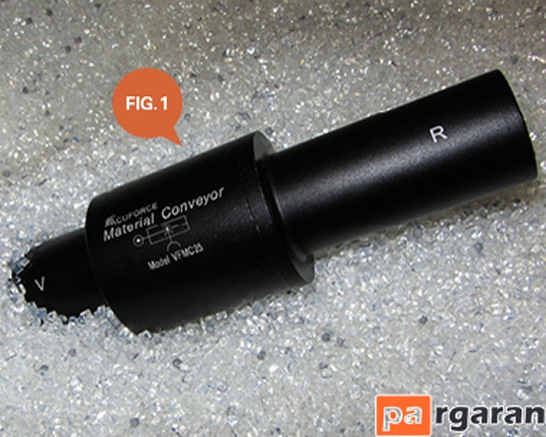
Figure 1 shows a typical materials conveyor. These simple devices, fed with compressed air, provide a rapid and powerful method for vacuum conveying to the user.
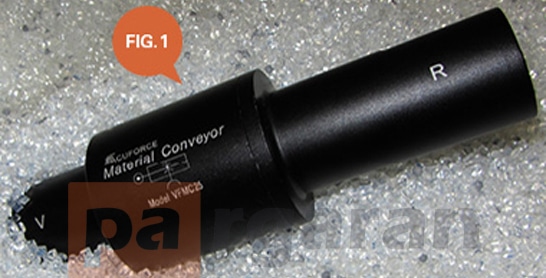
Figure 1 shows a typical materials conveyor
As seen in Figure 2, compressed air connects to the center of the unit at the "P" port. The compressed air flows into a circular loop and passes through small angled orifices. This is marked as "Ød" in Figure 2 and is shown with an arrow in Figure 3, where an internal image of the same model can be seen as in Figure 1.
This air flows toward the "R" port, which is the exhaust. A vacuum force is created at the inlet (port "V"), where the product, such as plastic pellets, is drawn into the device. As the media passes through the unit, it is driven from the exhaust (R) into the receiving hose and transferred to the desired destination.
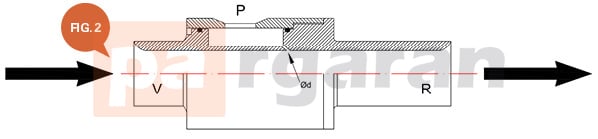
Figure 2: Compressed air connects to the center of the unit at the 'P' port
This type of single-stage venturi (material conveyor) provides a ratio of compressed air to exhaust of about 1:4. This means that if the device uses 25 cfm of compressed air, it will discharge 100 cfm of exhaust air at a lower pressure.
The vacuum hose pressurizes the diameter at port "V" while the exhaust hose is pressurized at port "R". This type of conveyor is available from various manufacturers with typical internal hole sizes ranging from ID Ø1/2 to Ø2 inches. One of the greatest advantages of this type of conveyor is that it requires no maintenance and is a perfect solution for transferring lump product, cleaning the machine's hopper, filling small parts hoppers, separating paper streams from cutting machines, and more.
These types of vacuum venturis can be used for extracting smoke, enhancing airflow in cooling applications, and also separating sheets in the printing industry, which often uses regular compressed air. It can be very expensive.
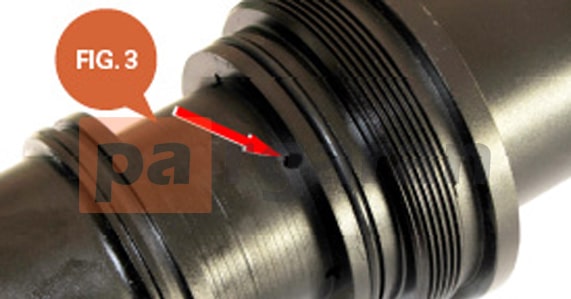
Figure 3: Small angled orifices
However, if the transfer application is a continuous operation, the consumption of compressed air for these models can be very high. Therefore, more complex systems such as the one seen in Figure 4 can be used, which offers a two-stage operation. The upper half of the cylinder creates a vacuum that "draws" the media and allows it to fall down due to gravity.
When the internal level switch indicates that the lower tank is full, the vacuum generator is turned off, the chamber returns to atmospheric conditions (the vacuum is released), and a flapper valve at the base of the chamber opens, allowing the media to drop into a receiving container.
With this type of conveyor, a higher vacuum level can be created, meaning potentially longer transfer distances. A multi-stage compressed air vacuum generator can also be used (Figure 5), which uses less compressed air or even a regenerative blower like the model in Figure 6. This is required for larger machinery and is often present in food processing and pharmaceutical operations.

Figure 4: Two-stage vacuum conveying operation
Vacuum conveying offers significant advantages over mechanical product transportation methods such as conveyors. The two types of vacuum transfer methods seen here provide fundamental insights into the technology utilized in various industries. There are companies that specialize solely in pneumatic or vacuum transfer, with facilities that include massive silos located outside the building. They specialize due to the enormous volume of media that needs to be transported.
The media itself greatly influences the type of vacuum transfer products used, based on its specific weight and surface area. Blowing a plastic bead with a diameter of 1/8 inch through a hole is much easier than doing the same with a similarly sized steel ball.
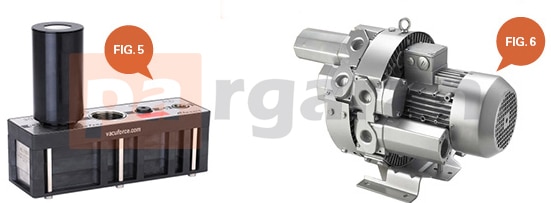
Figures 5 and 6: Multi-stage compressed air vacuum generator, a regenerative blower
Benefits of Vacuum Transfer Systems
- Dust-free powder transfer
Unlike positive pressure, leaks in a vacuum system are inward. This means a dust-free environment. - Easy cleanability.
The vacuum transfer system offers quick, tool-free separation. - Small footprint.
Using a vacuum conveyor, a pipe or hose occupies little space on your facility floor. - Efficient
Powder transfer methods. - Low power consumption.
Consider this article as a general guide, much like any other industrial applications involving equipment selection. To ensure correct selection and installation, professional independent consultation should be sought.
I hope you enjoyed reading the article (How Is Vacuum Conveying Carried Out?).
For any questions and suggestions, please contact Pargaran.
For more information, click here.