This article examines the essential components used in typical vacuum applications, providing users with a fundamental understanding for a quick review of their choices in a vacuum system and elaborating on the main components of a vacuum.
Vacuum Components: Venturi Vacuum
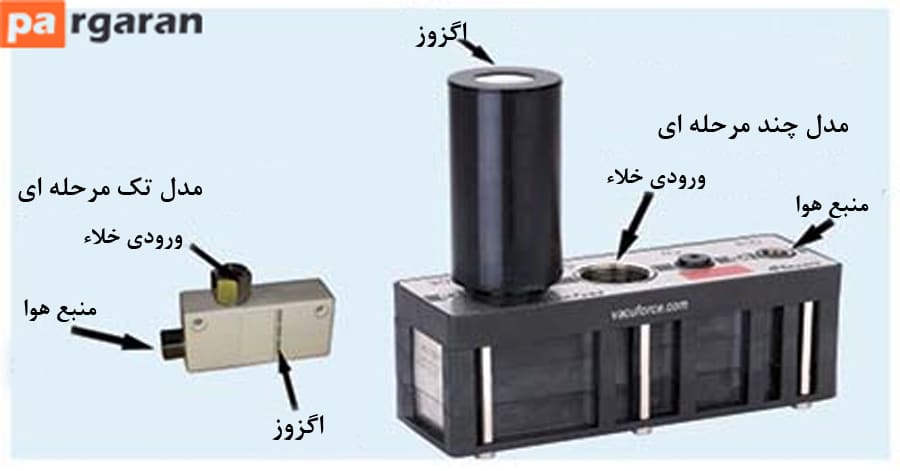
The Venturi vacuum, commonly referred to as "ejectors" or "generators," is an excellent alternative to vacuum pumps (although always depending on the application) and utilizes compressed air at high speeds between 50 psi to 90 psi that passes through a small hole ranging from approximately Ø0.5 mm to Ø3 mm (Ø0.019 inches to Ø0.118 inches).
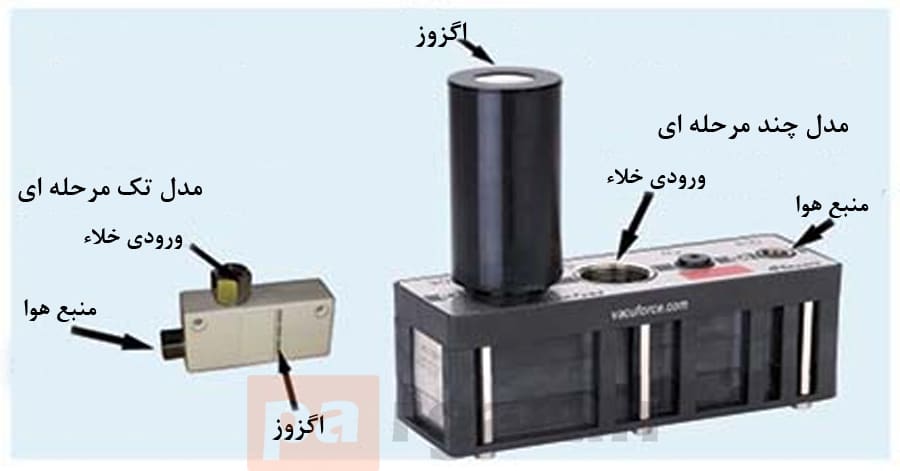
This action creates a dip in atmospheric pressure at the Venturi vacuum port. A typical single-stage Venturi point of use is illustrated on the right, compared to a larger multi-stage unit.
The practical difference between single-stage and multi-stage Venturis is that multiple units use less compressed air to produce a vacuum flow. Therefore, they are commonly used in larger vacuum flow applications. The advantages and comparisons between multi-stage and single-stage Venturis are discussed in the September/October 2008 issue (“Explaining the Venturi Vacuum”).
The size of Venturi vacuums is usually based on the number of vacuum cups used, the length of the vacuum line between the cups and the Venturi, and of course, the cycle time required, determining the vacuum flow rates needed to operate. Keep in mind that Venturis are rarely chosen for the ultimate vacuum they achieve, but rather for the flow they generate.
Specifically, for lifting vacuum cups, anything over 15 inches of mercury is suitable, and anything over 24 inches of mercury is wasteful in energy. For every square inch of the sealing area of the vacuum cup, you can lift about 7 pounds with 15 inches of mercury. This is more than sufficient.
Vacuum Components, Switches, and Sensors
If you haven’t installed a vacuum gauge in your vacuum system and are having issues with your vacuum system, you are now flying blind. It’s like driving a car without a dashboard: rarely used until you need it. If you are having trouble lifting products, the first question I ask is, “What is the vacuum level in the system?”
If you don’t know, then, as I would guess from the very beginning, I limit your options on how to proceed. Therefore, install a vacuum gauge. They are about $3 each and are very easy to find in an industrial supply store.
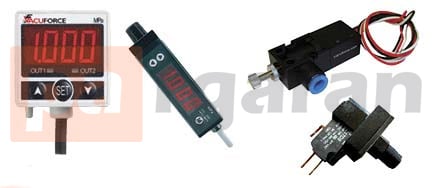
Vacuum sensors and switches, unlike gauges, are used by the machinery itself to tell the PLC of the machinery to continue the cycle or stop the cycle once a pre-set condition is reached at the vacuum level. The right image shows different models of vacuum switches.
All of them achieve one goal of reaching vacuum level conditions. But depending on the IO device used, they send different types of signals. There are two fundamental types: mechanical/diaphragm and solid-state/digital. You see both types in the image. The left pair is digital and provides the same function but simply looks different.
Two very simple diaphragm switches are easily adjustable and do not require anything precise to receive a signal. All these switches offer the same fundamental value to the user. It’s just a matter of their intended application and user preference as to which one is chosen.
The above components are all found in a good vacuum system. The choice of individual components depends on the specific application. However, to understand what needs to be selected, venturis and filters must match the required flow. The flow rate is based on the number of vacuum cups used and the cycle time required.
Valves should be positioned as close to the cups as possible. A gauge should be installed near the vacuum cup. And switches should be placed close to the gauge. If you begin with these fundamentals, you should not go too far wrong.
Vacuum Components: Filters
Vacuum filters are used to trap and prevent dust and particles from applications entering other equipment such as Venturi vacuums, pumps, and control valves. Various types exist with porosity between 7µ and 25µ (“µ” is the symbol for microns or 0.001 millimeters), where a 7µ filter captures particles larger than 0.007 millimeters.
Different filters are available, and you can see a scaled size comparison in the right image.
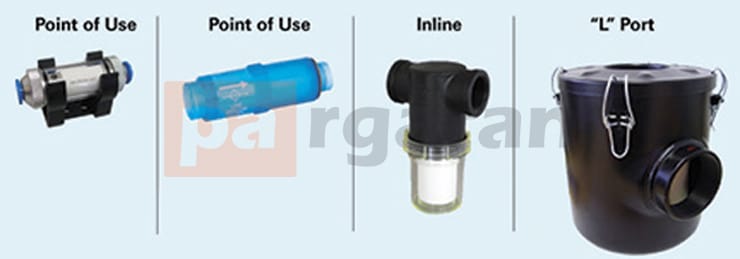
Two point-of-use filters are used where smaller single-stage Venturis are located. The filters are placed directly between the Venturi inlet and the vacuum cups. The inner filter is entirely made of plastic with a clear filter bowl.
These are used in larger vacuum flow applications up to about 180 scfm. The large filter on the right side of the image is an example of larger vacuum pump installations and is available in port sizes for a 3/8 inch threaded pipe to pipes over 8 inches (200 millimeters) in diameter. Most filters are selected based on the flow capacity that matches the individual pump or vacuum line.
However, if a single Venturi or pump with a flow capacity of 20 scfm is used on five vacuum cups, and each vacuum cup line has an internal filter, each filter should have a flow rate of 4 scfm. Filter sizes should be based on flow rate (not port size) to ensure that flow within the system is not restricted.
Vacuum Components: Vacuum Valves
Vacuum valves are not as commonly found in general vacuum applications as they should be. They provide excellent energy protection by allowing the vacuum system to fully charge before the vacuum collection stage of the cycle.
During this “maintenance” stage, the Venturi vacuum can be turned off, allowing for energy conservation. Vacuum valves can be positioned very close to the vacuum cups, practically providing an instant “print” of products. This is a distinct advantage in very high-speed applications.
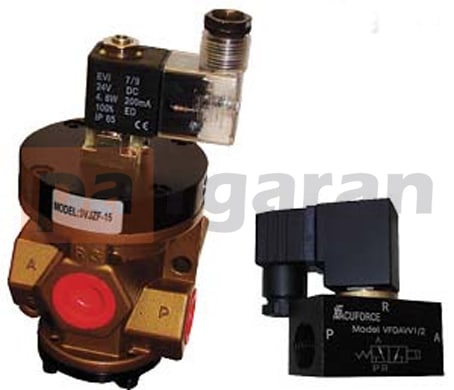
Most vacuum valves are controlled electromagnetically (as seen in the upper left image). Although some are available with a pneumatic pilot. This type is useful for 100% pneumatic circuits where electrical power is not available or even permitted, such as in oil or gas facilities.
Vacuum Components: Cups
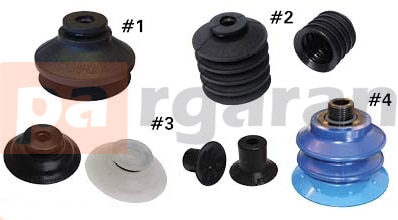
There are various types of vacuum cups, some of the most common can be seen in the right image. The most popular type is the single bell cup (#1), which allows for height variation in the carrying load or variance in the approaching distance of the machine.
This allows the user to set the machinery at an approximate picking point, which requires significantly more precise placement compared to using flat cups against the product being handled. Multi-bell vacuum cups (#2) share the same advantages as single cups. However, the cup is capable of lifting the moving product independently of the device’s motion.
This is particularly useful for separating thin sheets and due to the narrower width of the cup (the difference between external and internal diameter), this cup type is well suited for plastic products, such as food packaging. The cup can deform vertically without breaking the seal.