Steel production is an industrial process where hazardous conditions occur daily. With operations involving heavy equipment and molten or hot steel, the risk of fire is ever-present. Fire hazards are often exacerbated by the use of hydraulic fluids based on mineral oil.
Fire Hazards of Hydraulic Fluids
Fires can lead to personal injury risks as well as potential loss of capital and production. These losses include not only damage to buildings and equipment but also production interruptions that can leave production lines idle for days or even months.
One of the causes of fire in steel production facilities is the combustion of mineral oil-based hydraulic fluids. The highest fire risk in steel manufacturing occurs in operations where processed materials reach temperatures of +/- 1652 degrees Fahrenheit to more than 2732 degrees Fahrenheit (+/- 900 degrees Celsius to over 1500 degrees Celsius).
In most of these processes, hydraulic units are used to operate equipment, and in many cases, mineral oil-based hydraulic fluid is used to power the hydraulic unit. While mineral oil has a clear advantage in terms of cost to performance ratio, it is refined from crude oil and, due to its tendency to ignite easily, it is not always the safest choice.
Fortunately, there are alternatives to manage this risk and reduce the potential for ignition without jeopardizing performance or productivity.
Types of Fire-Resistant Hydraulic Fluids
Standard hydraulic fluids used in steel production are mineral oil-based. However, an alternative to mineral oil-based hydraulic fluids exists in the form of fire-resistant hydraulic fluids, as described in Table 1, which uses the ISO 6743/4 classification.
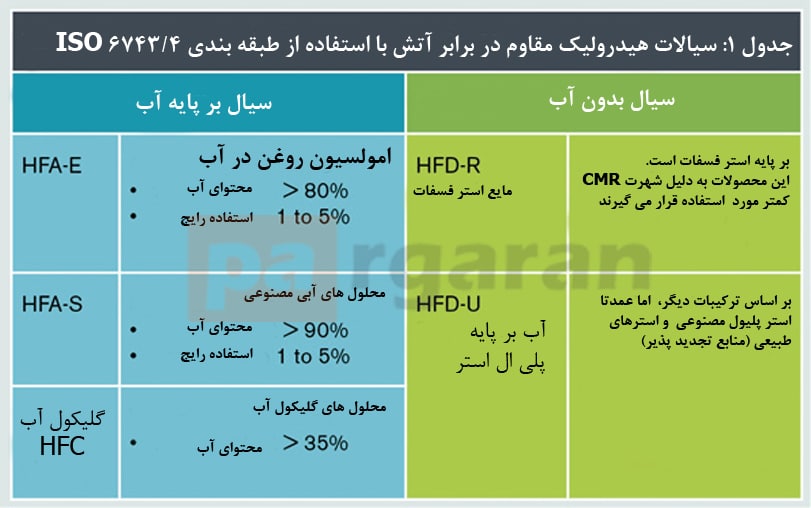
For each type of liquid, there are advantages and disadvantages. Table 2 presents a comparison of the performance properties of several types of hydraulic fluids. Specific properties are considered by maintenance managers as well as key purchasers.
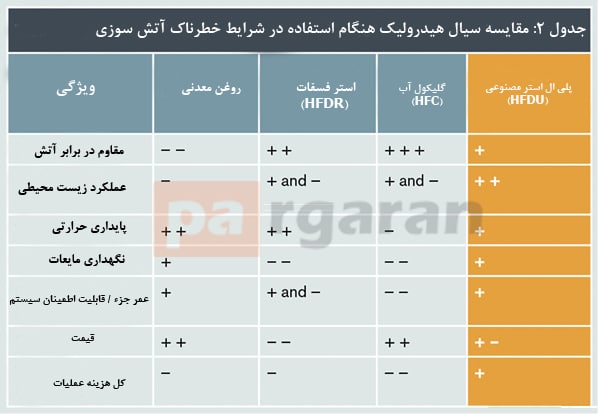
Properties of Various Hydraulic Fluids
Mineral Oil
It offers good hydraulic fluid performance characteristics at a reasonable price, as seen in Table 2. However, since mineral oil is not biodegradable, it is not environmentally friendly. And when the risk of fire and worker safety is factored into the cost of use, mineral oil provides a higher total operational cost.
Phosphate Esters (HFD-R)
An older fluid technology, chemically resistant to fire. However, they are considered to contain materials categorized as CMR (Carcinogenic, Mutagenic, Reprotoxic). The fumes from their combustion are neurotoxic. While these phosphate ester-based products provide good pump lubrication, they can limit the service life of servo valves.
HFD-R fluids can be 10 to 15 times more expensive than mineral oil and must be carefully maintained, as these products form aggressive acids as they age. They are primarily used today in power generation, although they are sometimes found in steel plants as well.
Water Glycols (HFC)
Widely used in steel mills and other industries, they account for approximately 50% of the total market for fire-resistant hydraulic fluids. HFC fluids have excellent fire resistance due to their high water content. In terms of price, they are comparable to mineral oil and cheaper than non-water-based hydraulic fluids. However, HFCs do not measure well in performance characteristics.
The service life of components is generally shorter, more fluid management is required, and energy consumption is 10 to 20 percent higher compared to mineral oils or polyol ester-based fire-resistant hydraulic fluids. All issues contribute to an increased total cost of operations (TCO).
Polyol Ester-Based Fluids (HFD-U)
Are the best alternative to mineral oil. While they are more expensive than mineral oil (approximately 2 to 3 times more), when considering the reduced risk of fire and improved worker safety, they offer a lower total cost. Furthermore, with polyol ester-based fluids, manufacturers do not sacrifice fluid performance and are environmentally friendly.
Understanding the Term "Fire-Resistant"
"Fire-resistant" is often mistakenly referred to as "flameproof" or the ability to suppress flames. Only hydraulic fluids that can truly be considered fireproof are fluids with high water content (HFA). Almost all fire-resistant hydraulic fluids will ignite under specific conditions.
When a certain amount of water evaporates, HFC fluids become ignitable. And while most HFD-U fluids do burn, they do not create the explosive ignition that mineral oil produces, which can lead to an uncontrollable situation.
Fluids can be tested to determine fire resistance. The most common and accepted tests are those conducted by Factory Mutual (FM Global), a testing and certification arm of a major industrial insurance policy (www.fmglobal.com).
By using an FM Global approved hydraulic fluid, manufacturers can often reduce their insurance premiums. Many other organizations and companies have also developed fire resistance tests, which are typically intended to simulate a specific type of real-world accident.
Choose Change Instead of Experience
Polyol ester technology has been in use for nearly half a century in many fire-hazardous applications in steel mills.
From blast furnaces to hot bar mills. If a manufacturer decides to convert to polyol ester fluid in their hydraulic system, the conversion process is not complex. Typically, no change in the hydraulic unit is needed when transitioning from mineral oil or water-glycol hydraulic fluid to polyol ester fluid.
However, the conversion must be done cautiously, as several grades and qualities of polyol ester fluids (HFD-U) are available in the market.
Important checks that should be performed include assessing compatibility with existing mineral oil, as well as the color inside the tank, seals, hoses, valves, and pumps. In the end, tests show that the type of color (single-component colors can be incompatible), as well as pump certifications are crucial.
It's also essential to remember that there are several different suppliers for polyol esters, but most pump manufacturers only approve certain suppliers with no restrictions on RPM and maximum pressure.
Experience shows that when color compatibility is good, no changes or limitations for the hydraulic system are necessary. To ensure the fire resistance of the new fluid, less than 5% of residual mineral oil should remain.
Case Studies of Steel Customers Who Turned to a Fire-Resistant Hydraulic Fluid After Experiencing the Hazards of Mineral Oil-Based Hydraulic Fluids.
1. A customer was operating with a standard mineral oil-based hydraulic fluid. In this specific application, there were frequent hose ruptures, causing oil to splash on recently hot billets. Each time a rupture occurred, the fluid ignited into a massive fire with vapor clouds turning into fireballs.
Containment of these fires was challenging, and each resulted in hours of lost production due to stoppages. After the customer switched to a fire-resistant hydraulic fluid, while hose ruptures still occurred (as the surrounding environment induced them), no vapor explosions happened, and the situation was quickly brought under control.
2. In a customer's operation, a leak caused the mineral oil-based hydraulic fluid to form a pool on the factory floor. During operations, molten metal sparks landed in the oil pool and ignited. The fire spread rapidly, and although it did not cause serious collateral damage, the potential threat was clearly visible. The customer, considering what could happen, consulted...