


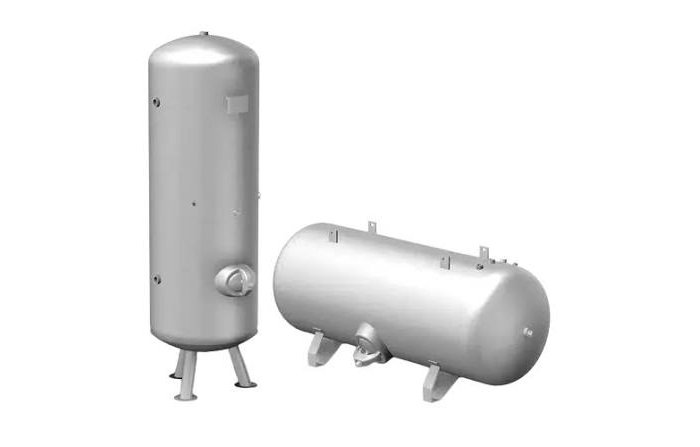
An air receiver or "compressed air tank" is a crucial part of any compressed air system as its primary purpose is to receive and store compressed air after it exits the air compressor. This provides you with a reserve of compressed air that can be utilized without restarting the air compressor. It also helps reduce unstable peaks in compressed air pressure, which is vital for the efficient function of an air compressor system.
The air receiver tank is an integral and important component of any compressed air system. The size of the receiver tank is usually 2 gal/scfm, and in the case of fluctuations or severe demand variations, it increases to 4-10 gal/scfm of flow. Therefore, if a compressor has a rating of 25 scfm at 100 psig, the receiver tank must be at least 50 gallons to 250 gallons in the case of high fluctuations.
In a compressed air system, the receiver tank provides several advantages.
- The receiver tank acts as a reservoir of compressed air to meet peak demands.
- It aids in the removal of water from the system by providing an opportunity for air cooling.
- This minimizes the pulsation in the system caused by a reciprocating compressor or a downstream cyclical process.
Like a water tank supplies water during droughts and stores water during wet times, the air receiver tank compensates for peak demand and helps balance the compressor's supply with system demand.
Receivers are legally required to have a pressure relief valve and pressure gauge. The relief valve should be set 10% above the system working pressure.
Also, it is important to install a manual or automatic drain on the receiver tank to remove water from the system. The integrated filter and air dryer are better positioned downstream of the receiver tank.
What is the Use of Compressed Air Tanks?
Why Use an Air Receiver?
While your compressed air system can operate without an air receiver, the general rule is that air receivers should be used in any compressed air system.
Since the need for compressed air in a factory or plant can vary dramatically throughout the day based on processing requirements or unusual demands, an air receiver is crucial in addressing these changes and demands. An air receiver stores to account for short-term peaks in air demand that the compressor cannot manage.
Not having an air receiver as part of your compressed air system can lead to more loading and unloading cycles, forcing your compressor to work harder than necessary. An air receiver can ensure a steady supply of compressed air even when the demand fluctuates during the day.
In some industries, compressed air storage tanks are used to provide a lower capital investment for the plant and equipment. Some plants often require large amounts of compressed air during the production process.
However, this is only for a short period of the year. Purchasing several large compressed air tanks to collect and store compressed air is much more cost-effective than investing in a compressor large enough for their needs. It also means that the business does not incur costs for operating large compressors for daily operations throughout the rest of the year.
Large pressure vessels can also be used in this manner to store nitrogen or oxygen.
Output Pressure
As previously discussed, an air receiver can be utilized to reduce unstable peaks in your compressed air pressure. It allows you to lower the overall pressure at which the air compressor operates. Without ample storage space, the system must operate at higher pressures, always ready to respond to peak demands.
The compressed air ultimately stored in the air receiver will only be useful if the output pressure is sufficient for the process in which it is used. You need to consider how long the air receiver can supply air at the required pressure for your equipment.
Increased Dryer Efficiency
If the air receiver is placed before the dryer ("wet tank"), it can help improve the efficiency of the air dryer. The compressor's air is very warm and thus contains moisture. As air passes through the air receiver, it cools down. Cooler air holds less moisture than warm air, so excess moisture condenses out and leaves the air in liquid form.
This liquid exits through a drain at the bottom of the air receiver. By removing some moisture, it reduces the amount of work the dryer has to do. This enhanced efficiency saves additional energy for your system.
Measuring Air
Air receivers can come in various sizes and be oriented both vertically and horizontally. Therefore, when choosing an air receiver for your compressed air system, one size does not fit all.
Many recommend considering a tank volume of 10 to 15 liters for each CFM of compressed air needs when choosing a properly sized air receiver. This may vary based on your compressed air system and the use of your compressed air; however, this calculation can serve as a good starting point.
Draining the Air Receiver
Many overlook the fact that if your compressed air system does not include an air dryer, moisture can accumulate inside the air receiver. Excess moisture inside the air receiver can lead to corrosion of the receiver, blockage of pipes, and damage to your pneumatic equipment. All these factors can have a ripple effect and may result in damage to your product or processing.
An air storage tank should be drained daily to prevent potential damage. Automatic condensate drains can be utilized to prevent this and eliminate any moisture.
Steel, Galvanized, or Stainless Steel Tanks?
Most air receivers are constructed internally from bare steel coated with a special formulation on the outside to reduce corrosion. The external paint often corresponds to the type of gas; blue for compressed air, green for nitrogen, and white for oxygen. A basic steel tank works well for most applications and is the least expensive option. However, if excess liquids collect within the tank, it may be prone to corrosion and unsuitable for food-grade facilities.
Galvanized air receivers are coated inside and outside with zinc to prevent rust from forming. Zinc reacts with corrosive agents before reaching the base metal, protecting it. Galvanized tanks perform better in maintaining air purity as they reduce the risk of particulates from corrosion contaminating the air source.
Stainless steel air receivers are primarily used in applications requiring very high purity air. They are the most expensive option but are highly durable and resistant to corrosion. Hospitals, laboratories, electronic equipment manufacturers, food manufacturers, and other applications requiring high-purity air should consider stainless steel tanks.
I hope you enjoyed reading the article (What is the Role of the Air Receiver Tank in a Compressed Air System?).
For any questions or suggestions, please contact Pergaran.
For more information about
Tags:


