Actuator, is the most important part of a system to perform the desired activity, and for this purpose, this element is placed at the end of each control system. In other words, it is a category of precision instrumentation equipment whose function is to convert a control signal into the required physical signal for the process.
For example, it can convert a control signal into a mechanical action or can be a hydraulic system actuator; jacks can create linear movements for that system.
The most important part of a system is the actuator, which performs the desired activity, and for this reason, this element is located at the end of every control system. In other words, it is a set of precision instrumentation equipment designed to convert a control signal into the necessary physical signal for the process.
For instance, it can convert control into a mechanical action or can be a hydraulic system actuator; jacks can generate linear movements for that system.

Control valves are one of the most widely used precision instrumentation equipment in the chemical, oil, gas, and food industries. Opening a valve creates a movement, which is why actuators are referred to as actuators or drivers. Actuators execute control commands by regulating measurement parameters.
In the figure below, the position of actuators in a control system is depicted. This is why actuators can be considered as intermediaries between the control system and the surrounding environment.


Applications of Actuators
An actuator is simply a device that causes something to move or operate. Each of us uses at least one actuator daily. For example:
-
Grocery Store Door
When we enter a grocery store, the door automatically opens for us. The act of the door opening is actually performed by actuators.

-
Car Seat
Without a push, the car seat cannot move forwards or backwards. The actuator makes this movement possible for us.

Use Cases for Actuators
- When a quick shut-off of flow is needed for safety,
- A high torque is required,
- Remote access to a valve is necessary,
- Quick access is needed.
Introduction to Types of Actuators
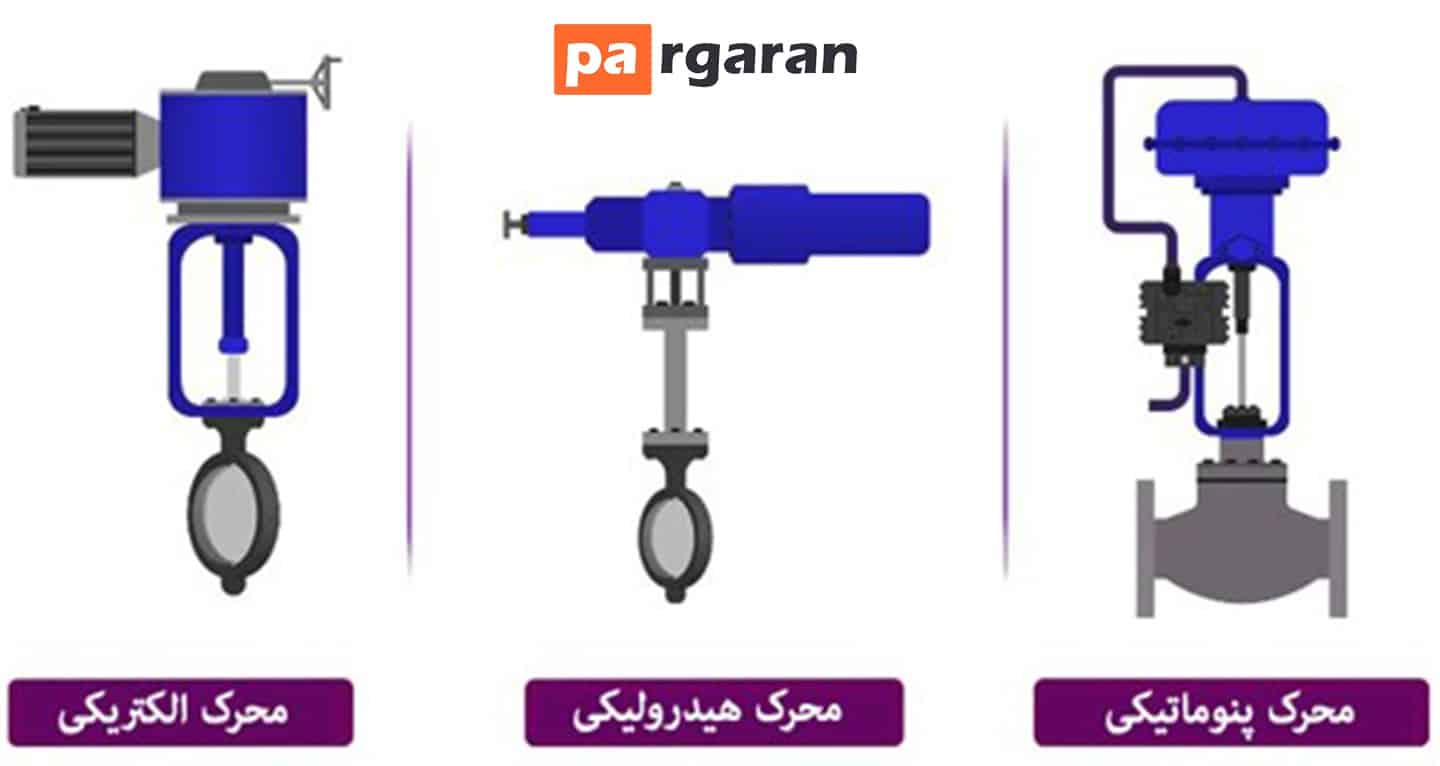
Actuators can be categorized based on rotation angle, type of energy source or movement factor, type of movement, internal structure, industrial valves, and step valves into different classifications.
Types of Actuators Based on Movement
Linear actuators: This force is generated by linear actuators such as hydraulic jacks or linear electric actuators and can be applied in one direction and in opposite directions.
This actuator acts like a jack, producing a large amount of force with linear movement, while also providing high precision. Given the aforementioned cases, it is typically used in laboratories. However, it generally occupies more space than rotary actuators and is commonly used in specific applications.

This actuator operates like a jack and produces a lot of force through linear movement while maintaining high precision. It is predominantly used in laboratories and specific applications. Note that it occupies more space compared to rotary actuators. Here, we refer to the classification of different types of linear actuators:
Types of Linear Actuators
- Pneumatic jacks
- Hydraulic jacks
- Linear servo motors
- Solenoid jacks
Continuous Rotary Actuator
This type of force is rotational, but the angle is limited to the number of turns or even less than one turn. This actuator moves something through rotational or circular motion.
Its simple construction comprises a toothed shaft for connecting to a valve at the center, with two pistons on either side that are connected to the shaft via teeth. In a double-chamber actuator, there are two compartments that are completely isolated from each other; the inner part between the two pistons and the outer part between each piston and the wall.
Filling and draining the actuator fluid in these two areas causes the pistons to move. Additionally, the piston, utilizing gears connected to the shaft, provides the necessary torque to turn the valve. Here, we refer to the classification of different types of rotary actuators:
Types of Rotary Actuators
- Electric motors
- Pneumatic motors
- Hydraulic motors
Rotary actuators can also be divided into two categories:
Limited Angle Rotation (Part-turn)
This type of force can generate unlimited rotational force like electric motors.
Continuous Rotation (Multi-turn)

Actuator from the Perspective of Rotation Angle
Actuators can be divided into two categories based on rotation angle:
- Clockwise
- Counterclockwise
Clockwise means they turn in the direction of clock hands to open the valve. Counterclockwise means they turn against the direction of clock hands to open a closed valve. This classification helps to choose the appropriate actuator according to whether the valve is mostly open or closed.
Introduction to Types of Actuators from the Perspective of Movement Factor

Electric Actuator
This is the most common type of actuator and can have numerous subcategories. Modern actuators that use an electric motor to supply the required energy. This type of actuator operates both like electric motors and semi-electric units, such as electric jacks, utilizing various previous types. In this case, this type of actuator is referred to as electro-hydraulic.
The applications of electric actuators range from computer components to industrial components.