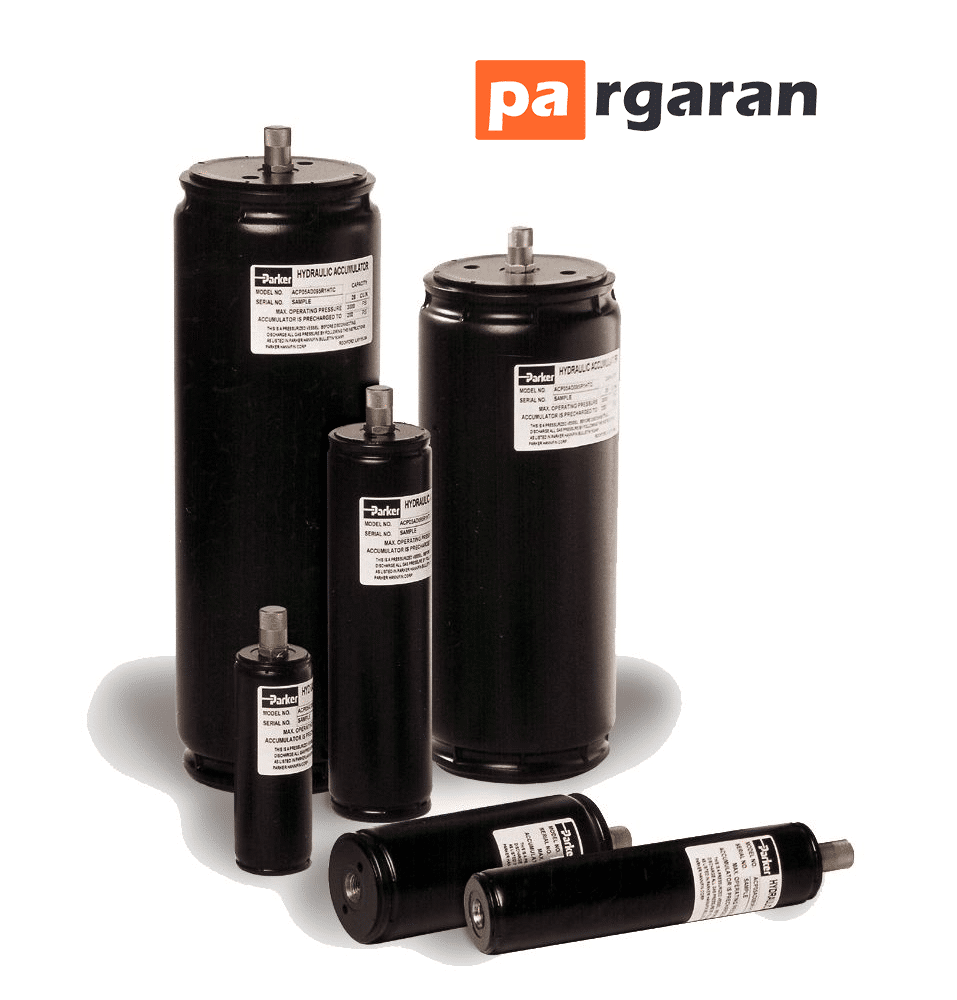
Piston Accumulator:
Accumulators are commonly used to enhance efficiency in pumps. They provide more stable performance and retain significant power in case of an electrical failure. Accumulators are installed in hydraulic systems to save energy and control pulses.
Hydraulic accumulators utilize smaller pumps, while piston accumulators draw energy from the pump during pressure spikes. This energy is available for immediate use and exceeds what the pump can provide alone.
Piston accumulators employ pistons as separating elements. They can withstand a significantly higher gas compression ratio (up to 10:1) and flow rates of up to 215 liters (57 gallons) per second.
Thus, the maximum pressure of the hydraulic fluid stored in a piston accumulator and the release rate of hydraulic fluid to the hydraulic system can be much higher. However, the piston inside the accumulator introduces internal friction that negatively affects response speed.
Piston accumulators store large quantities of fluid and benefit from high compression ratios and flow rates.
In comparison to hydraulic batteries, which use a different separating element (bag or diaphragm), piston batteries require a higher level of fluid cleanliness.
Operation of the Piston Accumulator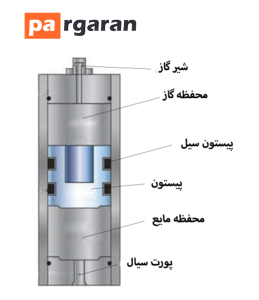
In a hydraulic piston accumulator, the fluid area is separated from the gas area by a gas-tight piston connection. The gas area is filled with nitrogen gas.
The fluid area is connected to the hydraulic system, so any increase in circulating pressure causes fluid to enter the hydraulic accumulator due to gas compression. Conversely, any drop in circuit pressure causes the compressed gas in the hydraulic accumulator to expand and push fluid back into the circuit.
Piston hydraulic batteries can operate in any position. However, it is recommended that these types of accumulators be installed with their gas area facing up to prevent contamination of the fluid accumulation by gravity at the piston seal. In these types of accumulators, the piston acts as an intermediary between the gas and oil.
The advantage of this type of accumulator is its performance at very high and very low temperatures.
The piston accumulator is constructed as a cylinder and uses the piston as a separator between two compressible fluids, which is usually nitrogen gas, and incompressible fluid, which is typically oil in hydraulic systems.
Piston accumulators are widely used in heavy industries that require very high pressure and flow rates.
Applications, Advantages, and Disadvantages of the Piston Accumulator

Applications
Piston accumulators are used in applications that require the storage of large amounts of fluid up to 2500 liters in a hydraulic battery at very high pressures (up to 1000 bar).
The flow speed of piston batteries is no different from others; thus, even under conditions of smaller fluid storage and lower pressures, the piston accumulator may be the best type of hydraulic storage available.
- In applications where a sudden rupture of a diaphragm bag and consequent complete discharge of gas into the circuit could pose a danger or be operationally unacceptable (due to gas dissolving into the reservoir oil and hence the risk of cavitation).
- When liquid needs to be stored across a narrow pressure differential, and additional gas bottles are used (transfer application).
- When the pre-charging pressure is very similar to the minimum working pressure.
- When there is a high flow rate and a minimum pressure differential is required.
- When a sudden complete discharge of the stored liquid occurs.
- When the maximum working pressure exceeds four times the pre-charging pressure.
Disadvantages of the Piston Accumulator:
- High manufacturing cost and dimensional limitations.
- At low working pressures, the friction of the seal against the cylinder wall prevents proper operation.
- Due to the potential for leakage from the seal, it requires periodic recharging.
- Considering the friction between the accumulator cylinder and its piston, piston accumulators usually have slower response rates compared to diaphragm batteries and tube accumulators, and they are not effective in damping shock caused by sudden pressure surges in the fluid flow. Additionally, due to the reciprocating motion of the piston in the piston accumulator, the incoming fluid must be filtered and free from solid particles.
Advantages of the Piston Accumulator:
- Higher volumetric efficiency, as they can completely empty their gas without damaging the piston. The relationship between maximum and minimum pressure can reach up to 25, which is significantly higher than that of bladder type. Direct contact with the internal surface of the accumulator gas reduces the gas compression factor. It can also be used as a transfer application with auxiliary gas bottles.
- Rapid piston displacement, lightweight, and its unlimited connection port reduces output flow. The piston response time is around 3 million seconds.
- The modular structure allows for the construction of vastly different amounts of main components, resulting in competitive prices, especially for transfer applications (where a nitrogen bottle is connected to the gas side of a piston battery).