In this article, we will learn how to identify hydraulic connections (hydraulic threads) in just 4 steps. Machinery and equipment are designed and manufactured in every corner of the world.
Hydraulic systems alone utilize countless types of connections and adapters with different sealing methods and shapes. While sealing methods can often be distinguished by appearance, the shapes of connections tend to look similar, making it difficult and time-consuming to identify them when changes or repairs to equipment are needed.
Knowing the correct hydraulic connections is crucial for selecting the appropriate replacement parts necessary for maintenance and repairs. Choosing the wrong part can lead to damage to the connections during installation, jeopardizing the pressure-holding capacity and reliability of the connections or adapters. Quick and accurate identification of threads can help maintain safe, productive, and profitable operations.
There are six types of connections commonly used in hydraulic pipe connections: UN/UNF, NPT/NPTF, BSPP (BSP, parallel), BSPT (BSP, tapered), metric parallel, and metric tapered. Four simple steps will help you identify them.
Step 1: Identify Whether Hydraulic Connections are Parallel or Tapered
Connections are produced in two forms:
- Tapered connections, also known as dynamic thread connections.
- Parallel connections, referred to as straight thread connections.
Determine whether the thread is tapered or parallel. NPT/NPTF and BSPT are tapered threads, while UN/UNF and BSPP are parallel. Metric tapered and metric parallel are self-explanatory. In some cases, Step 1 can be performed solely through visual inspection.
Tapered connections have a smaller diameter at the end of the connections, while parallel connections maintain the same diameter from start to finish. If this is not clear upon looking at the connections, use the parallel jaws of a caliper for comparison.
Additionally, the presence of an O-ring or the removal of a pipe nut usually indicates that the male thread is parallel. Completing Step 1 eliminates three out of the six possible thread shapes.

Step 2: Calculate the TPI (Threads Per Inch) of Hydraulic Connections
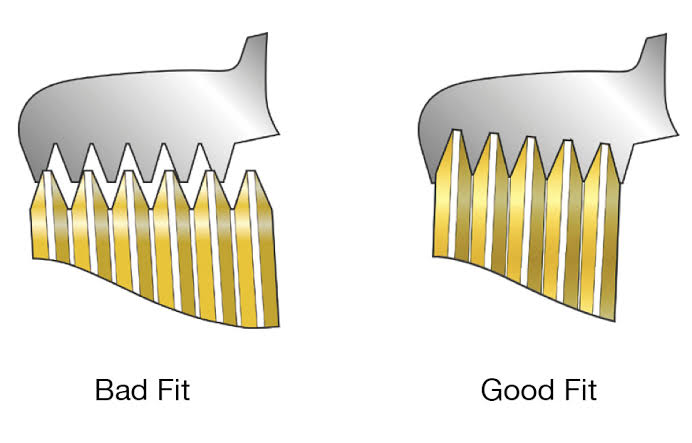
This can be deciphered using a gauge for comparison or by measuring and accurately calculating the number of threads over a specified range. Comparing threads against a bright background with a thread gauge is much easier.
Since some thread pitches are very similar, it's a good idea to test a few gauges before deciding which one is best for you.
The result of Step 2 further narrows down the possible thread shapes, as most have a specific pitch. For potential pitches, refer to the Step 2 column in Table 1.

Step 3: Determine the Size of Hydraulic Connections
Determine the size. The combination of results from Steps 1 and 2 determines the correct method for Step 3 – or in some cases helps with estimation. There are two methods for this.
Determining thread size; this depends on whether the connection is a pipe connection (NPT/NPTF, BSPT, BSPP) or not (UN/UNF, metric parallel, metric tapered).
Remember that tapered (as determined in Step 1) doesn't necessarily mean that it is a pipe thread (for example, metric tapered). Similarly, pipe connections can be parallel (for instance, BSPP).
For pipe connections, determine size by comparing it to the nominal size specification, as shown in Figure 1 (a helpful tip – sizes up to a nominal size of 2 inches can be determined by measuring the actual outside diameter and subtracting one-quarter inch.
Then (rounding) for non-pipe connections, the actual size can be determined by measuring the outside diameter (major diameter) with calipers, as illustrated in Figure 2.

Figure 1: Determine Pipe Connections Size by Nominal Size Profiles

Figure 2: Determine Non-Pipe Connections Size with Calipers
Step 4: Identify Connections
Technically, this final step does not pertain to thread identification. Rather, it is a method for determining the type of thread in an industrial standard format for understanding others. You can see examples of different formats in the Step 4 column of Table 1.
These formats usually indicate the size of the thread (whether nominal or actual), type, and in some cases, pitch. Your maintenance and repair specialists can use this simple four-step process to reduce equipment failure. Prevent expenses related to purchasing (and returning) incorrect parts, and help ensure a safe and accident-free work environment.

Table 1. *For JIS (Japanese Industrial Standards), connections can be identified similarly to BSPP and BSPT but defined respectively with PF and PT, for example, PF 1/8 and PT 1/2.
Frequently Asked Questions About Hydraulic Connections:
How Should the Size of Tapered Connections be Measured?
In tapered connections, the size of the connections is actually the diameter of the fourth or...